9 Best Ways to Use RCS for Customer Service (Reduce Call Center Load)
Key Takeaways
|
Customer expectations have shifted and evolved dramatically over the past few years. They expect instant, seamless, and highly efficient experiences and communication on their mobile phones.
While SMS ensures instant communication and fast delivery, it’s text-only, which somewhat limits the interactive and visual experience customers can expect. Enters RCS, Rich Communication Services.
RCS is the next evolution of SMS, transforming basic text messaging into engaging, personalized, and interactive experiences that improve satisfaction and allow brands to stand out from the crowd.
In this article, we’ll discuss several ways businesses can leverage RCS messaging to enhance customer experience and service, and to resolve customer queries quickly and efficiently.
Jump to: |
What is RCS Business Messaging?
Rich Communication Services, RCS, also often referred to as SMS 2.0, is a business communication platform that allows businesses to send rich media messages with interactive and engaging elements.
RCS supports rich media such as images, videos, GIFs, and stickers, as well as interactive features such as suggested replies, suggested actions, buttons, links, maps, and CTAs. Besides, it also allows brands to send messages with a verified sender profile, enabling them to add their business name and logo, boosting customer trust.
These features enhance and streamline the customer experience and buying journey, driving increased sales and conversions.
💡 Also Read: RCS messaging Best Practices and General FAQs |
Why RCS Matters and is Replacing SMS For Customer Support?
RCS opens a wide range of opportunities to help brands enrich their messaging campaigns, boost engagement, and drive sales. While SMS is limited to plain text, basic links, no interactivity, and no branding, RCS provides and enhances all these features and more.
Here are the top reasons why RCS significantly matters for customer service more than SMS:
- RCS helps build trust through verified branded messaging, improving customer engagement when they see a business name and logo associated with a message.
- It enables self-service through interactive menus and chatbot integrations, allowing them to check order status, book appointments, update details, and resolve issues independently.
- It reduces resolution time through guided conversation flows and quick reply buttons, helping customers find answers instantly without waiting for email responses or navigating IVR systems.
- It improves engagement with rich media, CTAs, clickable buttons, and conversational messaging, driving higher engagement and response rates than SMS.
- RCS creates a seamless mobile experience by delivering messages directly to users’ native mobile applications, reducing drop-off rates and improving user satisfaction.
Thus, RCS for customer support helps teams deliver faster, smarter, and more interactive support within users’ native mobile apps.
RCS vs SMS vs WhatsApp For Customer Support
Customer support today is mobile-first, and businesses heavily rely on the three major messaging platforms, including SMS, RCS, and WhatsApp.
All these platforms differ significantly in capability, control, branding, and user experience. While SMS offers universal reach and no internet dependency, it comes with security risks and fewer features than RCS.
💡 Also Read: RCS Vs SMS: Detailed Comparison Guide. |
At the same time, WhatsApp offers global popularity and end-to-end encryption over RCS, but it also requires app installation and other stringent security measures.
Here’s how these three platforms differ in customer support.
Factor | RCS | SMS | WhatsApp |
App installation | No | No | Yes |
Rich media support | Yes | No | Yes |
Verified business profile | Yes | No | Yes |
Native messaging app | Yes | Yes | No |
Interactive buttons | Yes | No | Yes |
SMS fallback | Yes | No | No |
Read receipts | Yes | No | Yes |
Chatbot support | Yes | Limited | Yes |
Platform dependency | Carrier + Google ecosystem | Carrier-based | Meta-controlled |
Best for | Modern customer support | Basic alerts | Conversational marketing |
Here’s why RCS is better and dominates SMS and WhatsApp when it comes to customer support:
- RCS provides a native messaging experience to users without requiring them to install any apps. This means lower friction and higher engagement.
- RCS displays a verified branded identity, which is lacking in SMS and WhatsApp, and requires it within the Meta ecosystem.
- RCS enables better interactivity than SMS, enabling structured support flows, top-based navigation, embedded maps and videos, and carousel product displays.
- RCS has fewer platform restrictions than WhatsApp, which enforces strict template approvals, 24-hour session rules, and pricing tied to conversation categories.
- RCS provides stronger analytics and reporting than SMS, including read receipts, typing indicators, click tracking, and engagement metrics.
- RCS ensures strong security and compliance with secure session-based interaction and verified sender identity.
Thus, RCS provides the best of SMS and WhatsApp, with universal reach, rich media capabilities, security, interactivity, and verified branding, making it ideal for customer support and experience.
But some businesses are still relying on traditional service models or are just beginning to explore messaging channels. If you're evaluating SMS as part of your support strategy, it’s important to understand the common operational challenges that come with ticketing and workflow management.
Read our detailed guide on Common SMS Ticketing Software Challenges to learn how to overcome them effectively. |
9 Ways to Leverage RCS For Enhanced Customer Service
1. Enhanced business messaging
RCS significantly enhances the messaging experience for customers compared to traditional SMS, offering a suite of features and benefits that enhance customer interaction.
Unlike SMS, RCS supports rich media, enabling businesses to leverage images, videos, and audio to convey messages more effectively. Besides, features like typing indicators and read receipts enhance message transparency by indicating whether a message has been delivered.
Additionally, businesses and marketers can include links, CTAs, buttons, and other interactive elements to make it easier for customers to engage with your brand, leading to faster decision-making and higher conversions.
Examples of enhanced messaging:
- Visual product carousel with purchasing link and buttons
- Product guides or helpful PDF resources to help customers solve their queries
- Demo videos to better explain their purchasing journey or product details
2. Offer interactive customer support
RCS allows brands to send interactive troubleshooting and support texts to facilitate addressing customer queries and issues.
Traditional SMS often requires customers to type long texts or reply with keywords to ask questions or reach support teams. RCS streamlines this process with
- Suggested reply buttons
- Tap-to-call or tap-to-chat options
- Clickable action menus
- Visual navigation flows
Additionally, RCS also enables two-way messaging, allowing customers to send images, videos, and other files to illustrate their issues, after which the support team can understand and address the issue on-call or by sending visual guides and images.
Examples of interactive customer support:
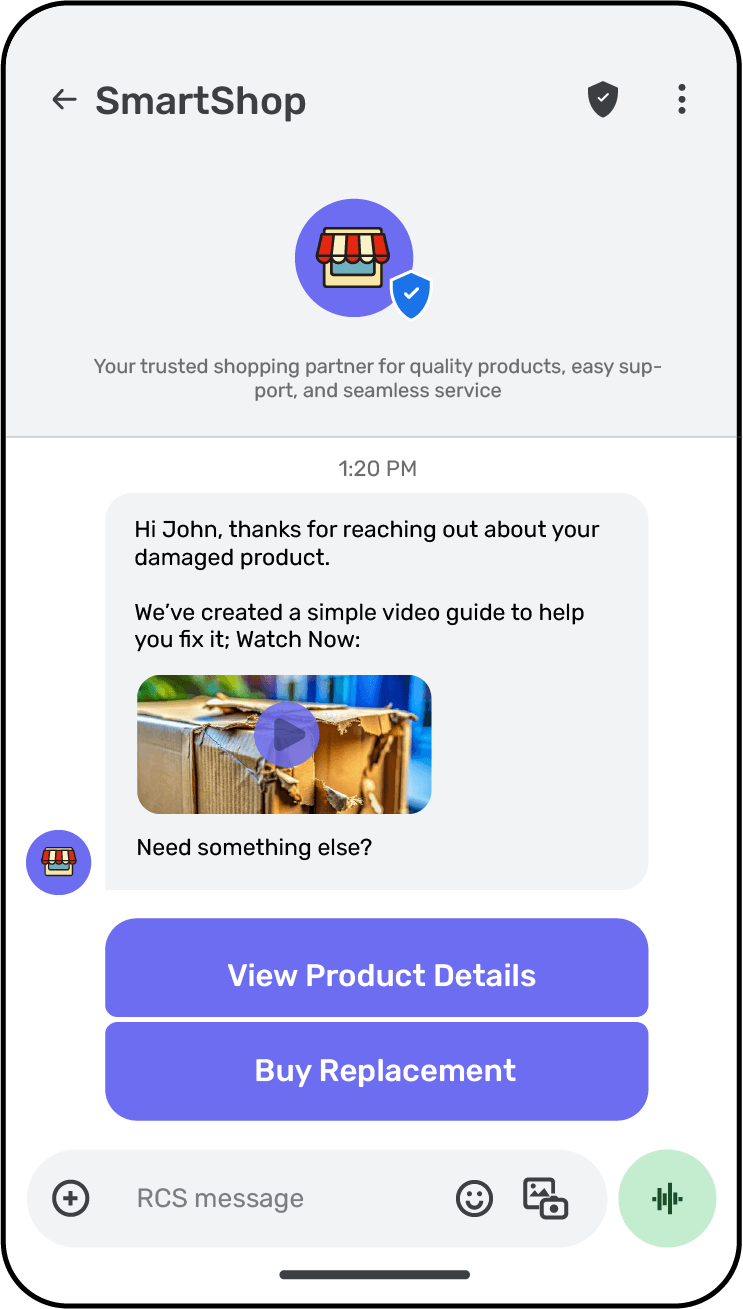
- Replying to a customer query about a damaged product with a detailed video response, enabling them to fix the product with ease.
- Customers can simply click the ‘Track order,’ ‘View product details,’ or ‘Buy Now’ buttons to take further action, without following a specific navigational flow.
3. Automated chatbots and conversations
RCS seamlessly integrates with AI-driven chatbots, allowing businesses to provide 24/7 customer support without needing human intervention.
Chatbots can automate several mundane and repetitive tasks, such as appointment booking, answering common questions, order tracking, billing inquiries, and showing ticket status updates.
With RCS messaging, chatbots can use interactive buttons, links, carousels, and suggested replies to improve communication and make it more efficient and intuitive. Structured conversation flow guides users in every step, eliminating confusion and improving clarity.
At the same time, when needed, conversations can be escalated to human agents without losing context, ensuring continuity, reducing customer frustration, and delivering a high-quality customer experience.
Examples of automated chatbot experiences:
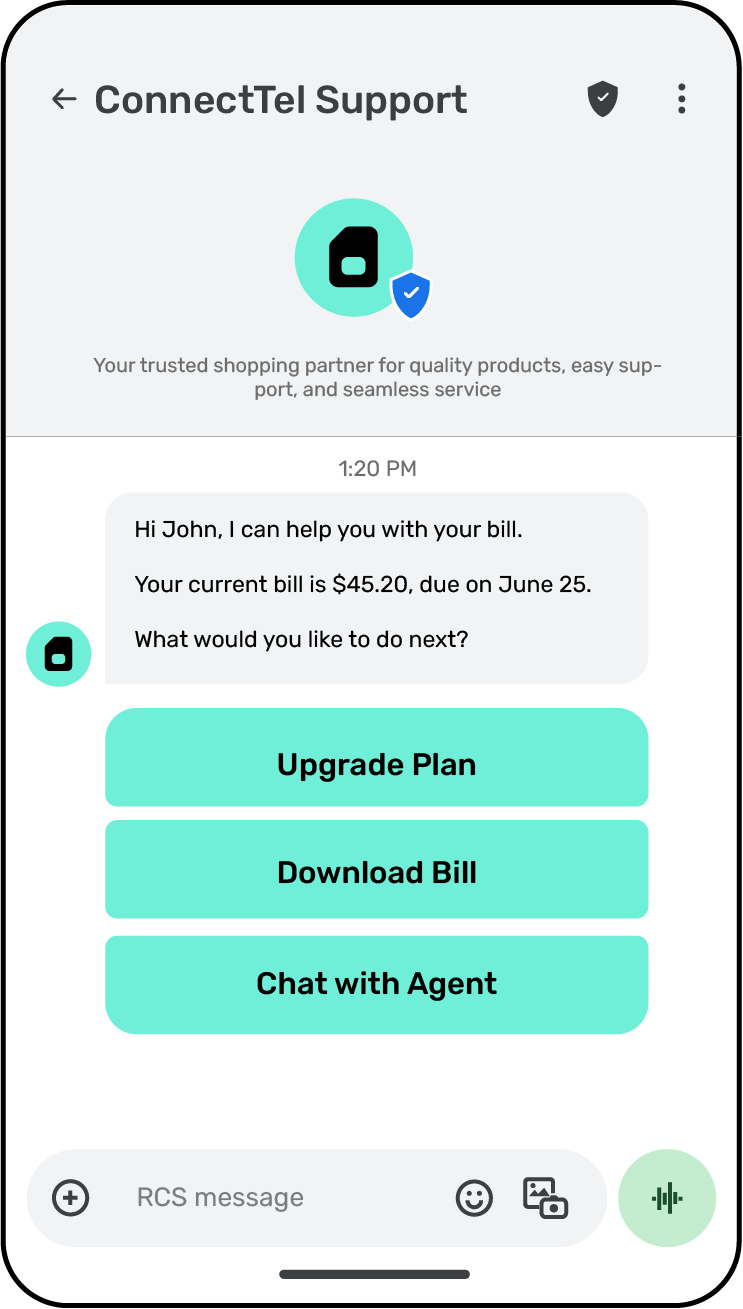
- A customer inquires about a telecom bill, and the chatbot responds with suggested actions, like ‘Upgrade Plan’ and ‘View Data Breakdown.’ If the issue persists, the chatbot escalates the query to a live agent.
- A customer inquires about order status, and the chatbot provides a link to help the customer track their order.
4. Offer personalized offers and experiences
Personalizing and tailoring your messages is crucial for building strong customer relationships, and RCS allows dynamic personalization based on customer data, such as browsing behavior, past purchases, service history, and location.
The customer service team can use personalization to:
- Recommend relevant products
- Share upgraded suggestions
- Offer royalty rewards
- Share tailored renewal reminders
Personalizing customer experience makes support feel more proactive than reactive, allowing brands to connect with customers on a personal level. With RCS, brands can create messages that dynamically adapt to the recipient’s preferences.
Examples of personalized offers and experiences:
- Instead of sending a generic renewal message, like ‘Your plan expires soon,’ brands can send a personalized message like ‘Hi Sarah, your Pro Plan expires in 3 days.’
- Instead of sending irrelevant, random product suggestions, brands can send highly relevant, personalized recommendations based on users’ preferences.
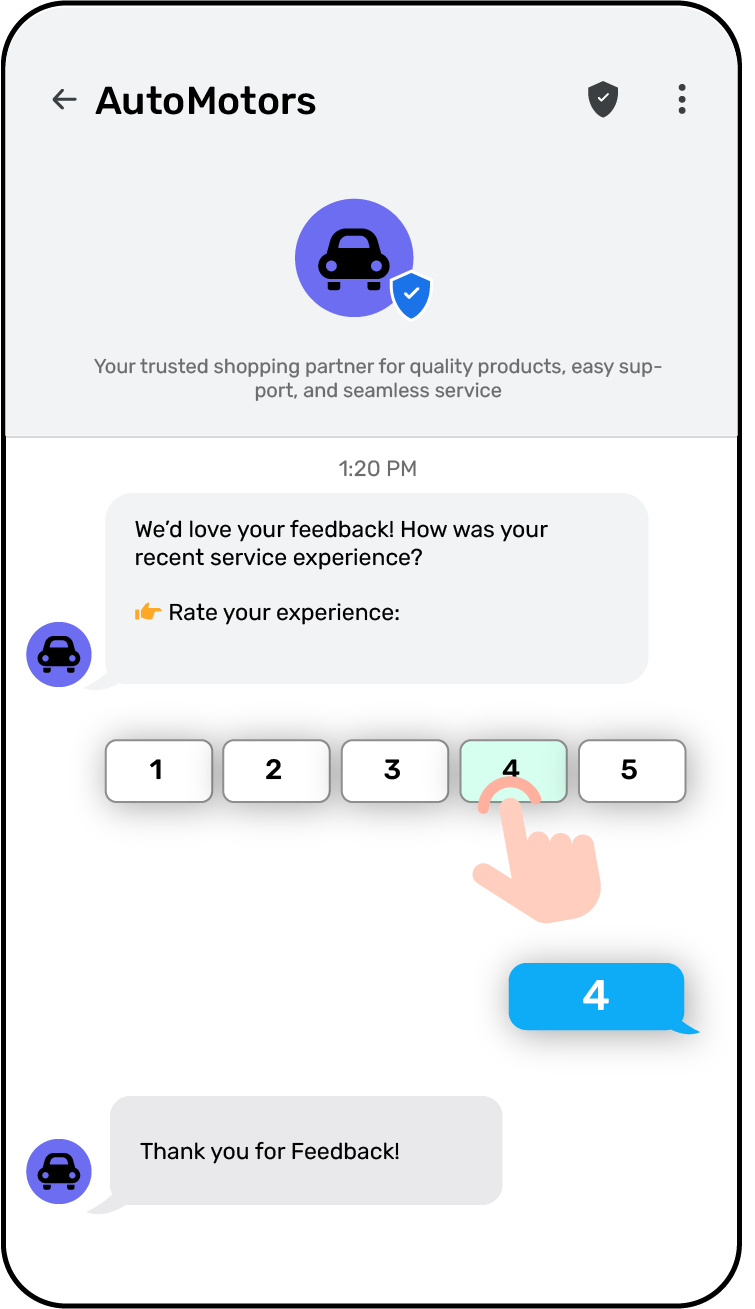
5. Collect real-time feedback
Besides using RCS to deliver customer support, you can also use it to collect real-time user feedback to enable continuous improvement and growth. It makes it easier to monitor your team’s performance in customer support and interactions, and what needs to be improved to enhance customer experience.
Using RCS, you can gather customer feedback through rich and interactive surveys. With RCS’s interactive features and elements, businesses can add buttons, sliders, questions, and multiple suggested options to make the experience more engaging.
Examples of collecting real-time feedback through RCS:
- Brands sending a one-tap rating button slider (1-5 scale) or questions with suggested response options to collect feedback.
- Sending an NPS (Net Promoter Score) survey to measure customer satisfaction, loyalty, and enthusiasm.
6. Combine surveys with rewards
To increase customer participation, companies can combine feedback requests with incentives and rewards, including loyalty points, discount codes, cashback, and early access to promotions.
This not only helps teams improve survey completion rates but also increases and encourages repeat engagement.
Example of combining surveys with rewards:
- Encourage customers to rate user experience in exchange for 10% discount on their next purchase.
7. Ensuring secure communication
Security and privacy are critical in customer service, especially in industries such as healthcare, banking, finance, and insurance.
RCS enables security with encrypted message channels, verified sender identity, secure authentication flows, controlled access via verified business accounts, and protected data exchange with structured chat sessions.
Examples of sending secure messages with RCS:
- Instead of sending plain SMS OTP, brands can use RCS to add a verified business identity, an authentication badge, and encrypted links to their portals to gain customer trust and promote a secure environment.
- In the healthcare sector, instead of adding sensitive patient information to a message, healthcare providers can include a secure login button, an encrypted link to the patient portal, and a verified sender proof to ensure security and compliance.
8. Real-time ticket status cards
Traditional support updates rely on portal logins and emails. RCS changes that and provides interactive, action-enabled, and dynamic support inside the messaging thread.
Instead of email updates, businesses can send live ticket IDs and status cards, an issue summary, the assigned agent name, current status, estimated resolution time, and action buttons, removing manual email replies, portal logins, and inbound calls.
This significantly reduces customer support volume, lowers agent workload, enables faster ticket closure, and improves customer satisfaction.
9. In-chat payments and refund approvals
Payment-related issues are among the most common queries that cause friction with support. RCS enables secure, action-based payment resolution directly within the messaging chat thread.
When an issue arises, the backend system triggers an RCS message that includes information such as the refund amount, transaction summary, subscription details, payment due date, refund timeline, and secure action buttons.
This streamlines financial workflows, failed payment recovery, and sends subscription cancellation confirmation, improving customer trust and reducing chargebacks.
TXTImpact RCS for Customer Service
At TXTImpact, we recently officially launched our new platform, TXTImpact Omnihub, which includes one of our most popular solutions, RCS Business messaging.
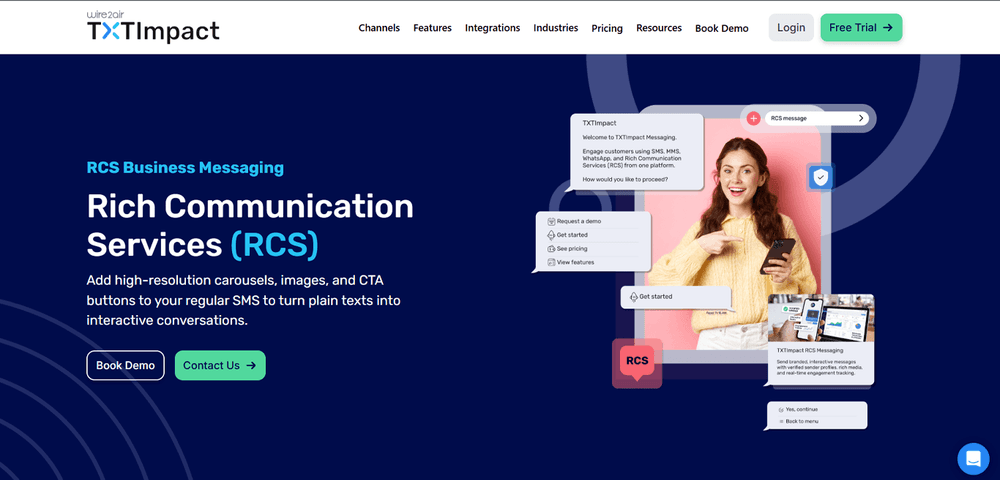
TXTImpact provides a highly reliable and scalable RCS solution that comes with features such as rich media sharing, interactive messaging, branded messaging, and enhanced security.
Here are the reasons why TXTImpact is an ideal solution when looking for RCS service for your business:
1. TXTImpact provides multichannel delivery
TXTImpact positions itself as a seamless multichannel messaging platform with a unified messaging hub that includes RCS, SMS, MMS, WhatsApp, and Unified API, and other business messaging channels.
It provides a winning multichannel strategy which includes:
- Messages automatically fall back to SMS when RCS is unavailable
- Delivers rich, branded messages to users in their native messaging apps
- Maintains conversation continuity across channels
- Ensures 100% reach without compromising engagement
2. CRM and helpdesk integration
TXTImpact’s RCS platform is built for deep integration with leading CRM and support systems, such as Zapier, HubSpot, and Zendesk. The benefits of integration include:
- Automatic ticket creation and resolution with RCS. RCS automatically generates incoming messages in real time, updates them based on customer replies, allowing agents to respond directly from their helpdesk interface. This turns RCS into a true support channel, and not just a notification tool.
- CRM integration enables personalization at scale, allowing businesses to segment audiences dynamically, personalize responses based on customer attributes, trigger event-based messaging, and route conversations by customer tier and history.
- Unified API allows businesses to directly integrate RCS into their existing systems for better automation, real-time messaging workflows, and seamless coordination between CRM, support platforms, and internal applications.
- RCS to Email and Email to RCS integration allows customer messages sent via RCS to automatically appear in support email or helpdesk inboxes. Agents can reply directly from email, and responses are delivered instantly to customers as RCS messages. This enables seamless two-way communication while using existing customer service workflows.
Additionally, the integration also reduces agent handling time, allowing agents to see customer profiles, purchase histories, previous interactions, and ticket status, thereby improving first-contact resolution.
3. Automation and bot-to-agent AI flow
RCS offers structural conversational flows that enable tap-based menu navigation, decision trees, rich media-based troubleshooting, and dynamic branching logic. Other key automation features include:
- With workflow rules and automation, users can automate the entire conversational flow, resulting in faster query resolution and lower agent workload.
- RCS enables seamless bot-to-agent escalation while preserving the full context of the message, without customers having to repeat information, improving customer satisfaction and resolution speed.
- TXTImpact enables smart routing of conversations based on customer intent, sentiment, issue type, business hours, and customer tier with priority handling.
Other reliable features included within TXTImpact’s RCS messaging include:
Rich interactive experiences
Built-in compliance and registration support
Interactive chat bubbles, carousels, location, and quick replies
Enhanced security with end-to-end encryption
Seamless system integration with existing systems
Ready-to-use, fabricated templates for OTPs, promos, and messages
Comprehensive technical documentation and SDKs
All these features combined turn messaging into a continuously improving support engine.

How Does RCS Reduce Call Centre Costs?
While call centres were the driving force behind customer service a few years ago, today they are costly to run and require significant resources and equipment. Between training infrastructure, staffing, and handling high-volume calls, customer support instantly becomes one of the highest operational costs for businesses.
In such a situation, RCS becomes a game-changer by enabling an automated, media-rich, and interactive messaging experience directly within the native messaging application of users’ devices.
Here’s how RCS reduces call centre costs:
- RCS deflects incoming calls with self-service options, enabling customers to take further action through interactive buttons and menus, reducing call volume and agent workload.
- Reduces Average Handling Time (AHT) and resolution cycles dramatically by allowing customers to upload screenshots, share documents, select predefined options, and complete identity verification securely.
- Automates repetitive queries, such as refund requests, order status requests, appointment confirmations, service troubleshooting, and other common queries through chatbots, eliminating the need for human agents in such situations.
- Minimizes agent escalations as most queries are either handled by chatbots or through self-service options, as RCS provides explainer videos and video troubleshooting steps, real-time status updates, and interactive product guides, lowering operational complexity.
Reduces callbacks and missed calls, enabling customers to respond to queries directly in chat, allowing agents to continue conversations asynchronously, and helping customers receive proactive updates, eliminating frustration and repeated dialling.
RCS directly impacts businesses’ bottom lines by automating support, deflecting calls, reducing handling time, lowering telecom costs, and increasing first-contact resolution.
Real World Case Studies of Using RCS For Customer Support
Acme Ride - Sharing Service - Improve Security via RBM
In August 2024, Acme Ride, a sharing service company were facing security issues and was looking for a solution to strengthen security with Two-Factor Authentication (2FA) supported by a branding messaging agent.
To achieve this goal, the company integrated RBM into the user authentication process for secure, branded messaging using SMS as a backup or a fallback mechanism.
This resulted in enhanced customer trust and reduced fraud risk. Additionally, the improved, robust authentication process enhances customer loyalty and user satisfaction by delivering clear, timely authentication messages.
Global e-commerce platform - Improve customer satisfaction
A major e-commerce platform wanted to reduce support ticket volume and enhance customer satisfaction across multiple markets.
To achieve this, the platform implemented RCS business messaging for order tracking, customer support automation, and return processing.
This resulted in:
- 85% faster customer support resolution
- 70% reduction in support ticket volume
- 45% increase in customer satisfaction scores
- 60% reduction in call centre costs
Conclusion
Businesses today need communication mediums that are interactive, personalized, intelligent, and seamless across touchpoints. With the evolving customer expectations, traditional messaging channels no longer keep up.
RCS business messaging transforms basic communication into a full conversational workflow. However, to unlock the full potential of RCS, businesses need a platform that connects the messaging experience with help desks, CRM systems, and automation workflows.
TTXImpact’s RCS business messaging fulfils this need and combines multichannel delivery with intelligent fallback, automation, deep CRM integrations, and seamless bot-to-agent handoff, enabling businesses to improve response times, reduce support costs, and enhance customer satisfaction, while staying scalable and compliant.
If you’re looking to enhance your customer service experience, start your free trial with TXTImpact today or contact us to learn more.
Frequently Asked Questions
♦ Which industries benefit the most from RCS customer support?
Industries such as banking, e-commerce, telecom, travel, SaaS, and healthcare benefit most from RCS business messaging due to high customer interaction volumes and the need for prompt, secure, engaging, and real-time communication and support.
♦ Can RCS integrate with existing customer support tools?
Yes, RCS providers and platforms like TXTImpact integrate with helpdesk and CRM systems such as Zendesk and HubSpot, enabling personalization, ticket creation, and seamless agent workflows.
♦ Is RCS suitable for small to mid-sized businesses?
Yes, absolutely. RCS, especially from providers like TXTImpact, offers scalable, reliable solutions for businesses of all sizes. Businesses can use RCS for marketing, support, and automation without requiring enterprise-grade infrastructure.
♦ What are the compliance and opt-in rules in the U.S.?
In the United States, businesses must comply with the Telephone Consumer Protection Act (TCPA), which requires obtaining prior written consent from users before sending SMS and RCS messages. Additionally, businesses must also follow CTIA guidelines and carrier policies for registration and brand verification.
♦ How secure is RCS compared to SMS?
RCS provides encrypted messaging, verified sender identity, and authentication flows, which significantly reduce fraud and spam risks, making RCS much more secure and robust than SMS.
About the Author:
 | Rahul Kumar (Marketing Specialist) Rahul Kumar is a Digital marketer with 7+ years of experience in SEO, AEO,SMS marketing, WhatsApp marketing, SaaS, and WordPress. He has led successful growth campaigns for startups and tech brands, combining data-driven strategies with compelling content. His work has been featured on top SaaS blogs, and he’s known for turning complex ideas into high-converting digital strategies. |