RCS vs SMS: Why You Should Make the Switch Today?
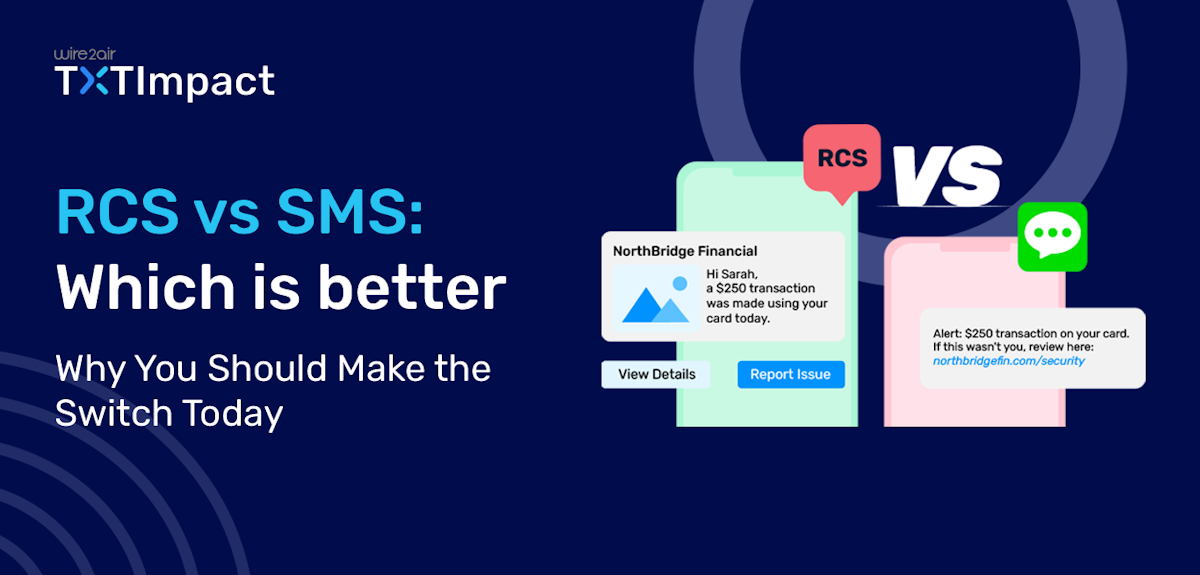
SMS (Short Message Service) has been a primary communication channel for over three decades. Friends and families, as well as businesses, often relied on SMS texting to connect directly with each other and customers. It completely transformed how we communicated in its early days.
However, the rise of RCS (Rich Communication Services), often referred to as SMS 2.0, is gradually changing the scenario, making businesses explore the benefits of RCS for their communication and marketing campaigns.
RCS is a new-age messaging platform that meets today’s customers’ needs and provides enhanced capabilities, including rich media experiences and branded messaging.
We’ll discuss even more differences between the two platforms and how transitioning to RCS can help you grow your business and engage with your customers better.
Jump to: |
SMS: The Standard Messaging Tool For Years
SMS is the most commonly and widely used messaging technology globally. From basic phones to smartphones, SMS works on any mobile device and requires no Wi-Fi or internet, except a cellular network.
In fact, TXTImpact’s 15-Year Industry Study Report suggests that SMS adoption has increased by 300% between 2013 and 2024, thanks to factors like low-code integrations, advances in automation, and federal laws compliance
This ever-growing communication tool enables businesses and users to send simple texts with up to 160 characters; however, it cannot send multimedia content, such as images and videos, which gave rise to the Multimedia Messaging Service (MMS).
MMS, an enhanced version of SMS, allows users to send images, videos, and audio over cellular networks.
Even today, SMS remains a popular communication channel with 23 billion text messages sent in a day. However, it lacks some of the advanced messaging features and capabilities that RCS offers for an engaging and interactive customer experience.
Pros of SMS:
Provides a wide and universal reach, as every mobile device is SMS compatible, regardless of location or device type.
Allows businesses to send concise and urgent alerts and notifications without internet access.
Provides a familiar and simple user interface.
Affordable messaging solution for its simplicity and low development costs.
Cons of SMS:
Restricts message character limit to only 160 characters per message.
Limited functionality with no options for dynamic and rich media elements available.
No business identity or branding elements, as it relies on shortcodes and longcodes to send messages.
Lack of security with no end-to-end encryption.
Minimal analytics with no read receipts or typing indicators.
RCS: The Upgraded Messaging Solution For Tomorrow
RCS, or Rich Communication Service, is a next-generation messaging solution that provides rich features and elements combined with SMS reach. Meaning, like SMS, you can send RCS messages to any mobile device, although with internet connectivity, including rich media features, such as images, carousels, videos, and other interactive elements.
It supports longer messages with a higher character limit, as well as multimedia and interactive features, such as quick reply buttons, CTAs, and read and delivery receipts.
Although it was first introduced and created in 2007, it has recently gained popularity and an increased adoption rate since Apple rolled out iOS 18 support for RCS.
Pros of RCS:
Supports rich media like images, carousels, videos, and GIFs.
Increases the character limit to up to 3,072 characters.
Supports branded business identity.
Boosts security with encryption and verified sender identity.
Provides advanced analytics and read receipts insights.
Cons of RCS:
The internet dependency makes it reliant on Wi-Fi and mobile data.
Limited adoption exists because not all carriers, devices, and regions support RCS.
Slightly higher costs than SMS due to rich media and interactive features.
RCS vs SMS vs MMS: Comparison at a Glance
RCS vs SMS vs MMS: Comparison at a Glance
Features | SMS | MMS | RCS |
|---|---|---|---|
Character limit | 160 characters | 160 characters | 3,072 characters |
Adoption and reach | Universal, supported on all mobile devices | Universal, supported on all mobile devices | Growing, supported on iOS and Android, and selected carriers |
Media capabilities | Text only | Supports images, audio, and video with a limited file size | Supports rich media, quick replies, carousels, and CTAs |
Network dependency | No internet required | Wi-Fi and internet dependency | Wi-Fi and internet dependency |
Security | No security features | No security features | End-to-end encryption in transit |
Branding and verification | Businesses can elevate branding with vanity or custom shortcodes, such as 211311; however, it restricts adding the brand name or logo | No branding | Verified and branded business identity with brand name and logo |
Typing indicators | ✗ No | ✗ No | ✓ Yes |
Read and delivery receipts | Delivery receipts | Delivery receipts | Read and delivery receipts with advanced analytics |
User experience | Only offers chat features | Enhances UX with images and videos | Enhances UX with rich media, quick reply buttons, and suggested replies |
Cost | Cost-effective | Cost-effective | Slightly higher and varies depending on the carrier and provider |
Group messaging | Supported with limited features | Supported with limited features | Advanced group messaging with rich media, reactions, etc. |
SMS fallback | ✗ No | ✗ No | Yes, for devices not compatible with RCS |
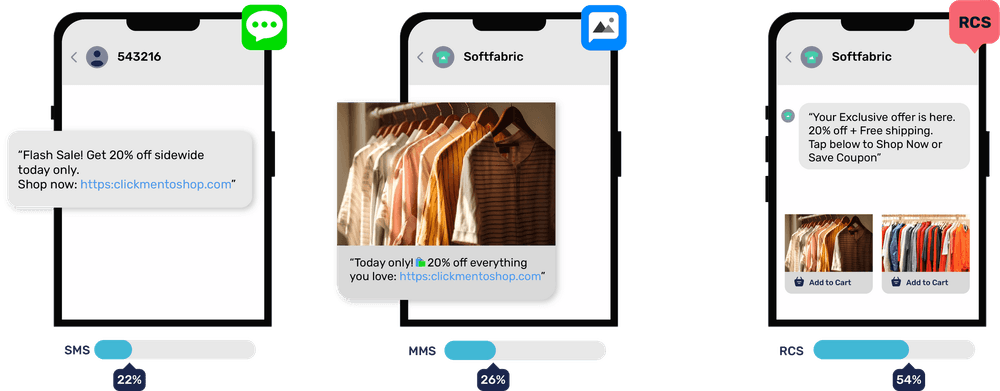
Which messaging experience drives more engagement?
RCS vs SMS: Key Comparison Features
While SMS focuses on simplicity, RCS tends to meet the growing customer needs and expectations. Here are the key differentiating factors between the two:
Category | SMS | RCS |
|---|---|---|
Branding | SMS lacks branding elements. Messages are sent through shortcodes or phone numbers, which gets expensive and makes users question the authenticity of the brand message. | RCS allows businesses to include their brand name, logo, and colors, displaying an authentic and verified brand identity. This builds brand recognition and trust amongst customers, enabling a 35x higher open rate. |
Engagement and Interactivity | With SMS, customers and businesses can only communicate one-way or two-way via texts, limiting customer engagement. | RCS enables richer interactions — customers can click buttons and CTAs, choose suggested replies, browse product carousels, and more, leading to higher engagement and quicker customer actions. |
Insights and Analytics | Offers limited reporting capabilities with only message delivery confirmations. | Provides advanced analytics — read receipts, delivery metrics, engagement tracking, and typing indicators — helping brands optimize campaigns based on performance. |
Security and Trust | Increased risks of spam and spoofing due to lack of branding; 98% of cyberattacks rely on social engineering like spoofing and SMS phishing. | RCS builds trust with a branded identity, verified sender status, and reduced chances of spoofing — increasing customer confidence. |
User Experience | SMS has a simple, outdated interface, making the experience less intuitive for customers. | RCS provides a modern, visually appealing interface with smooth navigation — enabling customers to browse or purchase products directly within the message. |
How Effective is RCS Marketing Compared to SMS?
Both SMS and RCS are powerful tools when it comes to mobile marketing. The type of communication solution you choose completely depends on your business needs.
SMS’s wider audience and a familiar communication channel, and RCS’s enriched customer and user experience cater to businesses with distinct requirements. At the same time, RCS automation allows businesses to send personalized messages to their customers.
This personalized, branded, and visual experience makes a huge difference. Irrespective of the industry, whether you’re in banking and finance, e-commerce, or healthcare, RCS proves to be a highly impactful, effective, and secure communication and marketing solution for businesses.
💡 Also Read: RCS vs iMessage: What is the difference and which is better for marketing? |
SMS and RCS Use Cases
While RCS wins and is a preferred communication solution, SMS still has specific use cases you can use it for to benefit your business and marketing campaigns.
Here are the scenarios when you should use RCS vs SMS for your business.
SMS use cases: Use SMS when
You want to reach a wide audience, regardless of device, region, or carrier.
You want to send urgent messages and alerts right away, such as flight updates, emergency alerts, transactional alerts, or broadcast announcements.
You have budget constraints and prefer a simple marketing channel.
You need text-only message requirements without any advanced features.
RCS use cases: Use RCS when
You want to run rich media campaigns with visually appealing images, videos, carousels, and interactive buttons.
Branding matters to your business, and you want to send consistent branded messages through a verified business profile.
You want to enhance customer interactivity with interactive buttons, quick replies, and forms that drive higher conversions and engagement.
You need deeper and advanced analytics with read and delivery receipts and typing indicators.
Your target audience has RCS-enabled devices and primarily resides in regions that support RCS.
You want to prioritize interactive customer support with real-time conversations.
You want to facilitate appointment booking and management with interactive buttons and quick replies.
You want to provide an intuitive feedback collection experience by using forms and surveys embedded in RCS messages.
💡 Also Read: 12+ RCS Messaging Use Cases, Examples and Real-World Case Studies |
Case Study: How the Los Angeles Rams Used RCS To Drive an Exceptional Customer Engagement
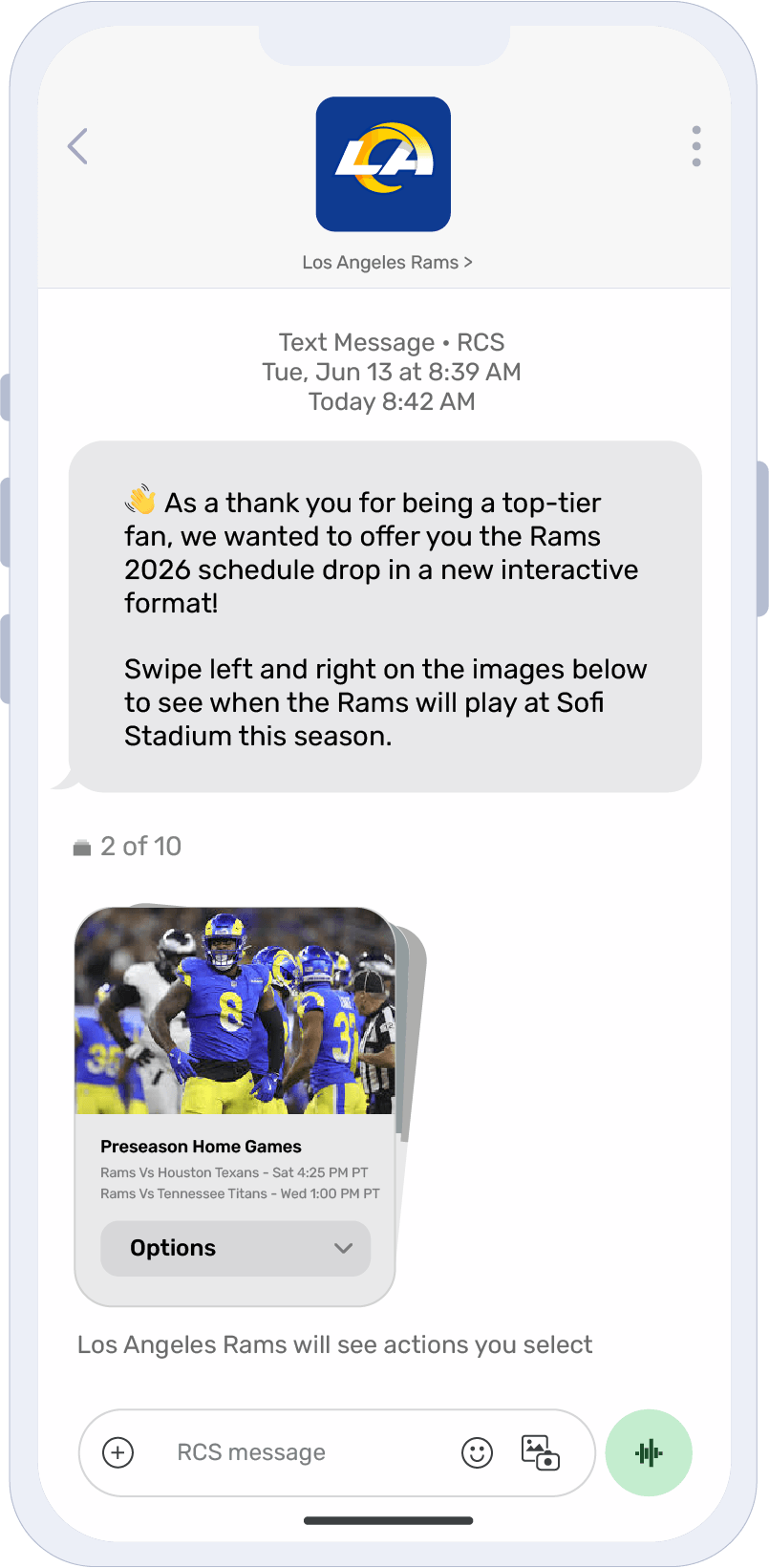
The LA Rams became the first professional sports team to use RCS business messaging to drive sales and customer engagement.
Problem/challenge:
Despite a large fanbase of millions, only a small percentage of fans were attending the LA Rams’ 10 home games. To overcome this, the company was looking for a tool that’d help them better connect and engage with their customers.
Solution/approach:
The LA Rams adopted RCS for business, using rich cards and carousels to market their ticket offerings and testing other creative assets of RCS. They A/B tested the RCS performance against SMS to measure the impact.
The result:
The pilot campaign of the LA Rams saw a significant 70% boost in engagement and a 60% increase in ticket sales, showing the major impact of moving beyond traditional SMS and adopting rich RCS messaging.
Why is RCS the Future of Business Messaging?
RCS is at the forefront of business messaging evolution. Here are a few facts that suggest RCS is the future of business messaging:
Growing carrier support: Major carriers in North America support RCS, including Verizon, AT&T, T-Mobile, and Sprint, as well as Vodafone, Telekom, and other carriers in Europe and Asia.
Google’s support: Google’s Jibe backend provides RCS support for users whose mobile carriers don’t support RCS, ensuring the platform’s broad availability and significance.
Increased user base: With Apple iOS integration and broad carrier support, RCS has seen an increasing growth and adoption, with over 1 billion active RCS-enabled users worldwide.
Conclusion
SMS and RCS are both popular tools that help businesses meet their communications needs. While SMS provides extensive reach and helps send urgent alerts, RCS boosts user experience with rich media and branded messaging content.
However, as technology evolves and consumers demand quick and intuitive messaging experiences, RCS proves to be a better solution, providing more benefits than traditional SMS.
If you are ready to explore RCS, check out TXTImpact’s RCS business messaging service, which includes all the key features you need to elevate customer experience and build an impactful marketing campaign.
Whether you’re an established business or a startup, TXTImpact facilitates the RCS journey with an intuitive RCS Gateway API support, 24/7 developer assistance, ready-to-use message templates and seamless integration with existing workflows.
Ready to switch from traditional SMS to impactful RCS messaging? Contact us today to learn more.
💡 Also Read: RCS Vs Whatsapp: What is the difference and which one is better for marketers? |
Frequently Asked Questions
♦ Which media and devices support RCS and SMS?
SMS works on all types of mobile devices, regardless of carrier or region. RCS is supported on Android and Apple devices with some carrier support.
♦ What is the difference between RCS and iMessage?
RCS is used for both Android and Apple devices; whereas, iMessage is Apple’s exclusive messaging platform, which comes pre-installed on all iPhones and Apple devices. Some features that iMessage offers, similar to RCS, include read receipts, typing indicators, reactions, and media sharing. Read: RCS Vs Imessage
♦ Do I need to download an app to use RCS?
No, you can send RCS messages directly to your customers’ native messaging apps, without installing any external application. However, you need an internet connection and RCS-enabled devices on both ends.
♦ Does RCS cost more than SMS?
RCS pricing for businesses depends on the carrier and service provider. At the same time, for the features it offers, like rich media, interactive elements, and a longer character limit, RCS is a cost-efficient option for businesses compared to SMS.
TXTImpact offers affordable and reliable RCS business messaging with no hidden charges.
♦ Can you send group messages with RCS?
Yes, RCS supports group messaging with features like read receipts, message reactions, and multimedia sharing.
About the Author:
 | Shubham Anand (Marketing Executive) Shubham Anand is a result-oriented Digital Marketing Manager with 7.5 years of experience in developing and executing impactful B2B and B2C digital marketing campaigns. He has a proven track record in generating leads, increasing brand visibility, and optimizing marketing efforts for measurable ROI for SaaS, the IT Industry, the Food & Beverages Industry, Edtech, and the e-commerce industry. |