Consumer Texting Behavior Report 2026: How U.S. Companies/Businesses Use SMS Today

Executive Summary
The role of SMS in business communication has evolved in recent years. SMS, from humble beginnings, has now become a multi-functional business asset. It is now being used for sending reminders, alerts, marketing campaigns, secure logins, authentication, rich media, and even live voting across dozens of industries.
Organisations across different verticals like healthcare, finance, logistics, nonprofits, unions, education, retail, legal firms, and so many more are leveraging its speed, reliability, and whopping high open rates of 98% to democratize and streamline information sharing, both at the stakeholder level and with clients.
The trajectory of SMS business adoption has been driven by a lot of factors, like advances in automation, low-code integrations, compliance with federal laws, and AI-powered personalization. Key metrics, such as a 300% growth rate since 2013, a 400% increase in healthcare usage alone, and the fact that 60% of businesses now use two or more SMS features, label the growing importance of SMS in the business world.
What remains to be seen is how AI-based innovations like auto-generated SMS content, interactive SMS workflows, RCS, and smart voice-SMS hybrids will shape business communication even further in the United States and the whole world. The 2026 State of Business SMS Adoption report reveals more information.
Introduction
Communications in the business context and even in life have gone through different stages and changes, but there is one thing that never changes: 'the urgency and time sensitivity of information', both internally with stakeholders and externally with customers and clients.
At the heart of this need, SMS has always been a reliable option because it does not rely on internet connectivity, carrier compatibility, borders, or geographies.
In America, businesses have long relied on SMS as a primary channel of communication for critical, time-sensitive messaging, unlike social media, where information often gets lost in digital noise.
This report examines the ways that SMS marketing has changed, what U.S. businesses uncovered about how they utilize SMS by 2026, and how emerging advancements in technology, such as RCS, AI-driven messaging, and intelligent SMS workflow, will define its future.
Methodology
Data Source: Aggregated, anonymized usage data from 15 years of TXTImpact U.S. business accounts.
Time Reviewed: 2011–2026
Scope: 100s of organizations across industry categories
Privacy: No reference to individual companies, specific features, revenue, or market performance
Key Insights 2026
360° Communication: SMS serves as an omnichannel communication tool, including alerts, reminders, logins, marketing, and more.
Cross-Industry Adoption: SMS has been adopted across different sectors, including legal, healthcare, nonprofit, education, tech, logistics, retail, finance, real estate, unions, etc.
Compliance: Businesses prefer an SMS marketing tool that works in compliance with federal laws. For example, TXTImpact SMS marketing poses 10DLC, TCPA, GDPR & HIPAA compliance.
Two-way Communication: SMS enables two-way communication with polls, surveys, rich media, and auto-replies rather than a one-way conversation.
Actionable Messaging: SMS marketing fetches measurable outcomes, giving businesses an upper hand to optimize campaigns for better ROI.
Speed & Reliability: SMS remains the fastest, most direct channel for time-sensitive information.
SMS Adoption Trends (2011–2026)
A year-by-year look at how SMS evolved from simple outreach to AI-driven, secure, two-way communication.
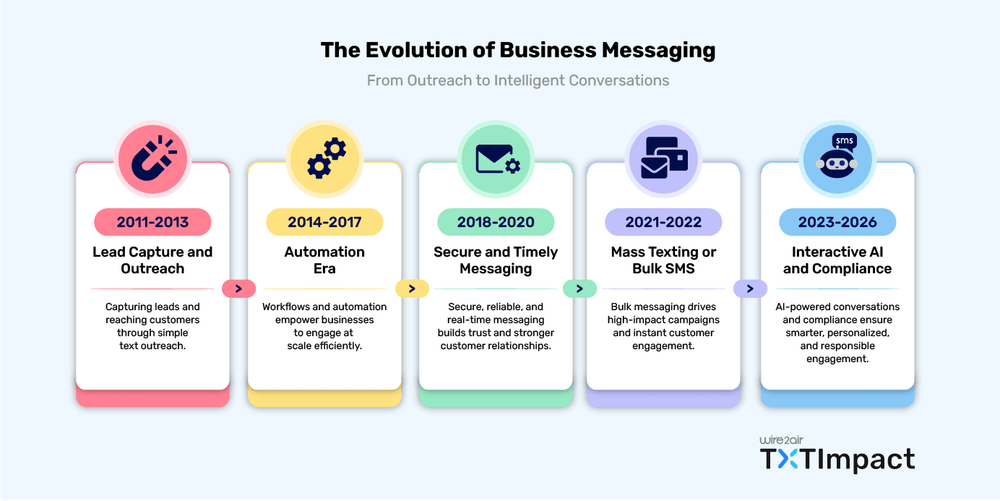
Period | Key Developments |
|---|---|
2011–2013 | Businesses began using SMS for lead capture and customer outreach. |
2014–2017 | Automation improved efficiency and found its use in order tracking, notifications, and internal coordination. |
2018–2020 | Messaging became critical for secure client communications, appointment reminders, and time-sensitive alerts. |
2021–2022 | Surge in real-time, remote communication needs led to mass adoption across industries for support and updates. |
2023–2026 | Two-way, interactive messaging, AI, secure user validation, and mandatory 10DLC registration. |
SMS Adoption Across Business Sectors - 2026
From healthcare to finance, see where SMS is driving the biggest impact till 2026.
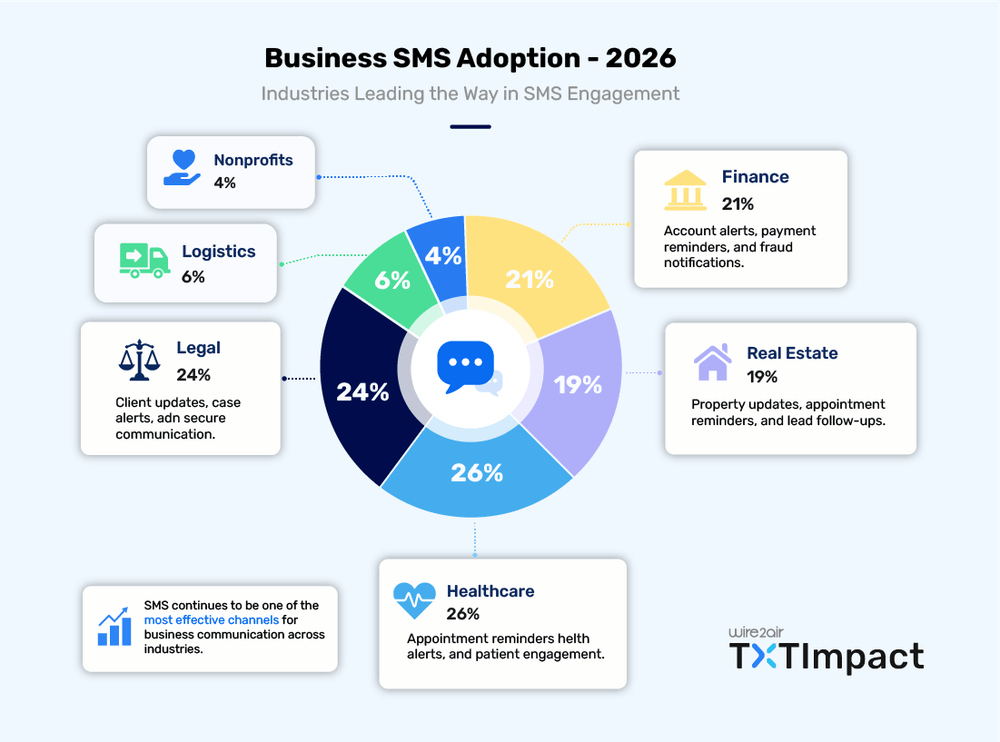
Rank | Sector | Growth Trends | Key Use Cases | Business Impact |
|---|---|---|---|---|
1 | Legal | 15%+ of total usage | Client communication, sending updates | Faster replies, smoother communication |
2 | Healthcare | 400% growth since 2020 | Sending reminders, collecting feedback | Fewer missed appointments, better connection |
3 | Real Estate | 12% current market share | Lead generation, sending alerts | More interest from people, quicker reach |
4 | Finance | 100% increase in usage | Verifying accounts, sending login alerts | Safer access, following rules and guidelines |
5 | Nonprofits | Accelerated growth since 2022 | Running campaigns, collecting opinions | More responses, stronger community support |
6 | Logistics | 3x more use | Sending updates, automating messages | Faster operations, better tracking |
SMS Usage & Adoption Rate (2011-2026)
A 15-year journey showing how SMS tools evolved from simple outreach to AI-powered communication.
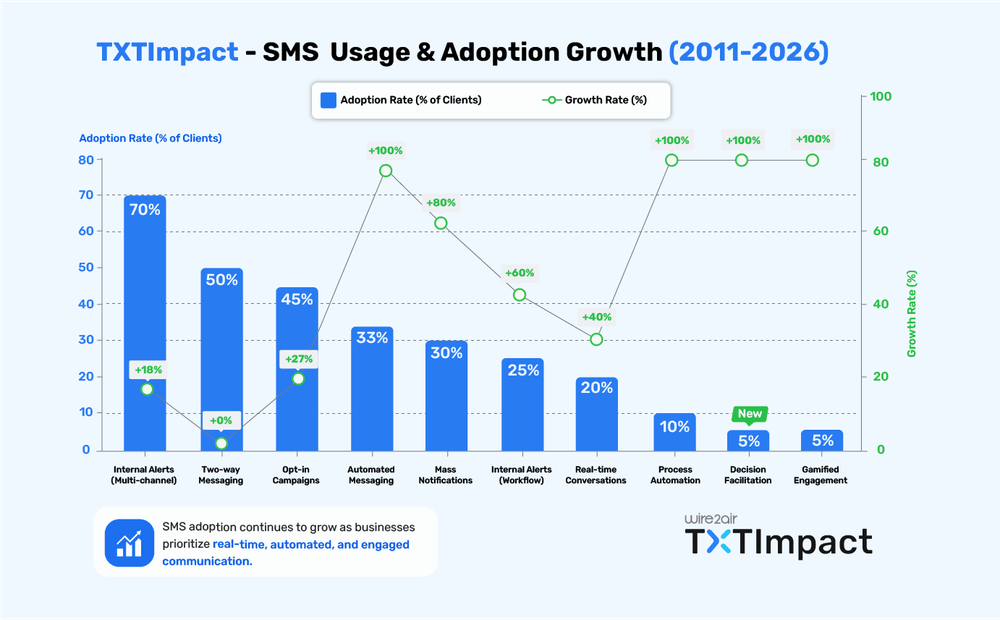
Purpose | % of Clients | Use Cases | Trends |
|---|---|---|---|
Internal alerts & multi-channel client communication | 70% | Reminders, updates, documentation | 18% YoY increase from 2023 |
Conversational texting | 50%+ | 2-way communication | Consistent usage with no significant rise or fall since 2023 |
Opt-in & subscriber growth campaigns | 45% | List building, user opt-ins | 22% increase over the previous year |
Text automations & system integration | 33% | Automation, onboarding, alerts | 100% growth compared to 2023 |
Mass notifications & group messaging | 30% | Promotions, group notifications | 80% YoY growth from 2023 |
Internal alerts & multi-channel client communication | 25%+ | Workflow automation, auto responses | Sharp increase in adoption between 2021 and 2023 |
Real-time conversations | 20%+ | Feedback collection, NPS, polling | 40% usage increase from 2023 |
Process automation | 10%+ | Login authentication, secure actions | 100% growth since the previous year |
Decision facilitation tools | Breakout tool | Internal polling, quick consensus | 10+ in 2026 |
Interactive learning & gamified engagement | Niche (rising) | Learning, engagement, micro-gamification | 100% growth from 2023 |
Business Sectors Usage
How different sectors leverage SMS tools to solve challenges and drive measurable results.

Legal Services
Usage: Reduced case delays and missed hearings through real-time text communication.
Result: Law firms saw 27% faster client turnaround.
Healthcare
Usage: Improved appointment adherence, patient feedback collection, and care coordination via text.
Result: One large clinic reduced no-shows by nearly one-third.
Finance
Usage: Improved security and customer experience via automated authentication and alerts.
Result: Customer login time reduced by 35%; fraud incident resolution sped up by 50%.
Nonprofits
Usage: Built donor/member lists, gathered campaign feedback, and drove civic engagement through mobile outreach.
Result: One health-focused nonprofit collected 2,000+ survey responses in 7 days.
Logistics
Usage: Delivered timely updates, promos, and alerts to customers through high-volume messaging.
Result: 10x increase in outbound message volume since 2020.
Key Trends Driving SMS Adoption
How versatility, dependability, and evolving workflows continue to fuel SMS growth in 2026.
Versatility
The fundamental reason for SMS adoption in 2026 has shifted from raw metrics to platform versatility. Business decision-makers no longer inquire "Which sector sends the most SMS messages?" but instead "How can SMS be incorporated within our current workflows to generate quantifiable business value?"
Businesses increasingly recognize SMS as a versatile tool across departments. Marketing teams use it for personalized outreach, operations for supply chain coordination, HR for employee engagement, and IT for alerts. This highlights SMS's strength as a universal communication layer. The trend is throttled by advanced features like AI and RCS, and seamless integration with CRMs.
Sector-Wide Behaviors
Rather than competing for dominance within individual industries, SMS providers are now aligning with broader business needs that apply across sectors.
Service industries have employed SMS as an organizational tool to control field staff, coordinate visits, and inform customers in real time of service completion. Meanwhile, consumer-facing brands in retail, hospitality, and finance use SMS to build lasting customer relationships through quick, personal touchpoints.
The insight here is that these uses succeed because they tap into basic human communication needs, not because they are customized to sector-specific contexts.
Evolving Needs
Even industries that transformed digitally in the past years still look for new and creative uses of SMS technology, and that’s why providers like TXTImpact have always focused on improving technology and systems, only for the better. Moreover, this development contradicts the assumption that communication technology adoption follows a linear lifecycle with definitive termini, but the truth is that it evolves as businesses and demand grow.
For example, in finance, SMS has moved beyond simple transaction alerts. Banks now use it for multi-factor authentication, compliance alerts, audit trails, and emergency messages. Such applications were not feasible with previous SMS platforms but have become common practice with new-generation, enterprise-grade SMS solutions.
Dependability
SMS remains the most dependable and immediate form of communication, with open rates consistently over 98% and responses in just minutes. As more companies follow an omnichannel customer experience approach, SMS serves as both a primary communication channel and a failsafe mechanism.
Unlike emails, app alerts, or social media posts that may get lost or blocked, SMS ensures important messages are delivered, no matter what.
Low-Code Integration
Low-code and no-code tools have made SMS integration easy for any business. TXTImpact offers SMS APIs, ready-made software integrations, and drag-and-drop builders so even non-technical teams can set up automated messages.
This democratization of SMS technology has driven wider adoption among business functions that had no technical means of deploying tailored communications solutions in the past. Now, marketing agencies, support, and operation teams can build custom SMS workflows like alerts, follow-ups, and escalations, all without or fewer technical knowledge or coding skills.
Comprehensive Use Case Analysis
From customer engagement to compliance, SMS drives efficiency at every level.
Business Objective | SMS Use Cases |
|---|---|
Customer Engagement | Offers, feedback, loyalty campaigns |
Operations & Logistics | Dispatch coordination, delivery updates |
Compliance & Security | OTPs, audit trails, critical alerts |
Customer Support | Ticketing systems, agent escalation alerts |
Employee Communication | Shift schedules, HR notices, training prompts |
Strategic Benefits of SMS Platforms in 2026
Scalability
Modern SMS platforms in 2026 help businesses grow communication efforts without added complexity. With built-in automation, analytics, and easy integrations, they remain simple to use. TXTImpact provides all these features at regular pricing without any hidden charges for value-added features.
Platform scalability also includes supporting growing volumes of messages, more use cases, and larger bases of users without compromising on performance.
Reliability
In high-stakes environments, communication reliability becomes a critical competitive differentiator. SMS platforms that consistently deliver messages, maintain uptime, and provide accurate delivery reporting enable businesses to build trust with customers and employees who depend on time-sensitive information.
TXTImpact not only delivers on performance but also offers strong compliance, security, and support. If you are looking to experience this, we suggest signing up for a free trial and gaining first-hand experience.
Enterprise-Wide Integration
One of the biggest SMS trends in 2026 is its use across the entire organization and not just in marketing or customer service. Businesses now want SMS to fit into their existing workflows and meet the needs of different teams.
This means choosing platforms that support multiple users, roles, permissions, reports, and integrations, all managed from a single account and dashboard. TXTImpact is the perfect fit for all enterprise needs, with the flexibility to scale for businesses of all sizes.
Recommendations for CXOs
Sign up for a multi-functional SMS software that provides features like reminders, surveys, and automation features to achieve better RoI.
Always sync the tool with your niche use cases, for example, surveys in nonprofits, MFA in financial services, APIs in logistics, and RCS in retail.
Monitor tool performance on a campaign-by-campaign basis and then rewire your strategy for more interactive and feedback-driven communication.
Always prioritize compliance and cybersecurity, especially in sectors such as healthcare, finance, and legal, under federal laws like TCPA, GDPR, HIPAA, 10 DLC, and more.
Future Outlook
AI-Powered SMS Automation
Analysts predict that in the future, SMS tools will be coupled with more powerful AI to generate and send behaviour-based, personalized texts using user behaviour insights for better customer satisfaction without much manual input.
Conversational SMS Flows
SMS is set to evolve from a medium that sends one-time alerts to action-based communications. In times, users would complete actions like booking appointments, processing payments, or getting support, all via automated text threads.
Deep CRM Integration
SMS tools will be linked with CRM software on a deeper and advanced level. This will allow for swift and hyper-personalized outreach based on historical data and user interactions.
RCS (Rich Communication Services)
Text or visual-based SMS will mostly shift toward RCS, for more media-rich, and app-like interactions, comprising images, videos, carousels, and buttons for better engagement and intuitive UX.
Gamified SMS (Feedbacks, Voting, Polls, Surveys)
Organisations will utilise SMS more for interactive experiences like voting and live polls, while gamified engagement is expected to grow across events, internal communications, and customer feedback.
MFA and SMS-Based Security
With rising concerns and awareness regarding cybersecurity, SMS-based multi-factor authentication (MFA) will see long-term use, especially in regulated industries like finance and healthcare.
Text-Driven Surveys
Quick, accessible, mobile-friendly SMS surveys will become the norm in nonprofits, universities, public services, and customer research.
API and Webhook-Driven SMS
As more companies switch to automating backend processes, SMS will become more deeply embedded via APIs/webhooks, which is very common in logistics, SaaS, real estate, and utilities.
Voice + SMS Hybrid Interfaces
In the long run, expect SMS to pair with voice AI (like chatbots and IVRs) for a smooth switch between text and speech support throughout the customer journeys.
Regulation and Compliance
SMS tools (TXTImpact) will continue evolving to meet global data privacy and compliance standards (like TCPA, GDPR, and future AI-use regulations).
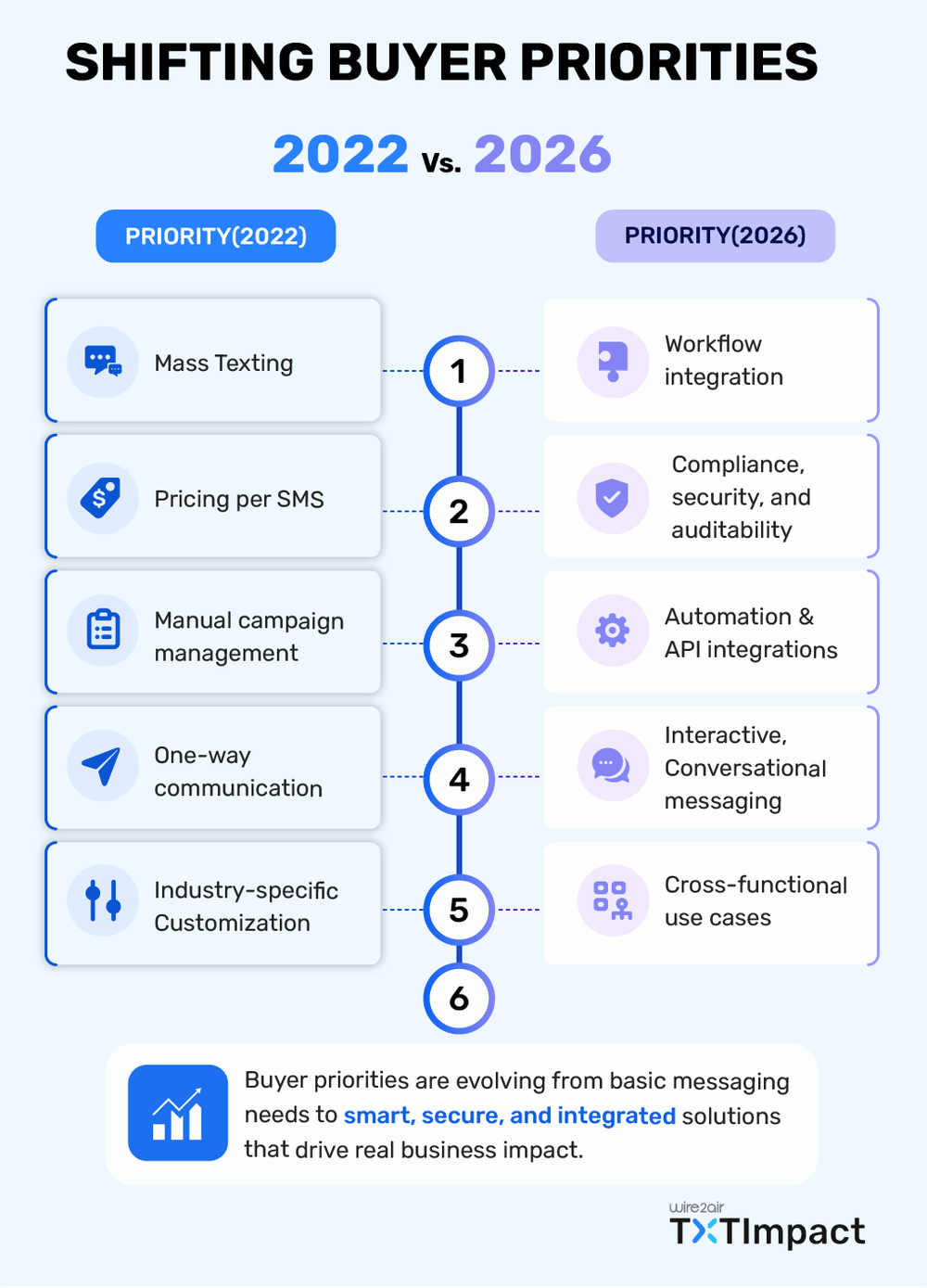
Shifting Buyer Priorities
(2022 Vs 2026)
|  |
💡 Also Read: Apple ios 26 sms Filtering |
Conclusion
Humble SMSs are today no longer just a tool for sending short text messages but have evolved to be a strategic business asset. In 2026 and beyond, it will continue to evolve into a dynamic platform that supports personalized, compliant, and enterprise-wide communication.
From automating workflows to deep CRM integrations, and from real-time customer support to critical security alerts, SMS is becoming deeply embedded in core business operations.
As industries continue to adopt smarter, faster, and more scalable communication tools, businesses that digitally transform with advanced SMS capabilities today will be better equipped to meet the expectations of the information era. The future of SMS is intelligent, interactive, and powered by AI!
Source: TXTImpact (2011-2026) Industry Study
About the Author:
 | Mamta Arun (Director Operations) Mamta Arun is a seasoned operations leader with 25+ years in B2B SaaS, SMS marketing, and telecommunications. As Director of Operations at Wire2Air TXTImpact, she ensures seamless service delivery, process automation, and compliance with TCPA and GDPR. With deep expertise in enterprise messaging and workflow automation, Mamta helps businesses enhance engagement, streamline communication, and drive scalable growth. |