What are RCS verification and RCS Verified Senders: Easy Explanation
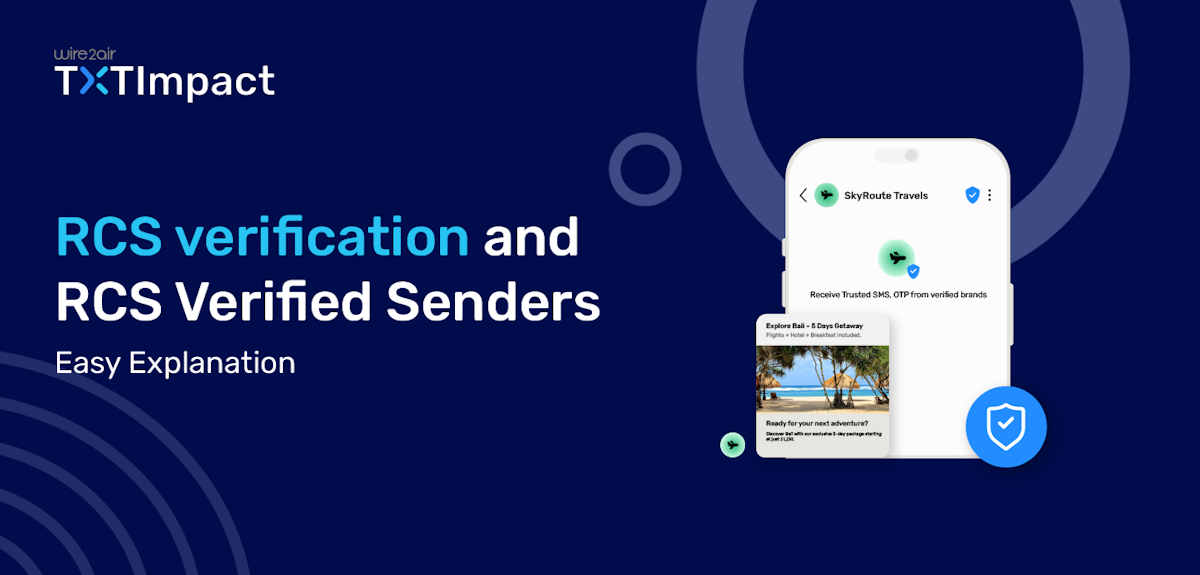
With the increasing prevalence of spam and cybercriminal activity, trust has become an essential factor in the brand-customer relationship. To trick users into sharing their sensitive data, scammers send unsolicited texts that impersonate known brands.
In fact, around 51% of browser-based phishing attacks involve some form of brand impersonation. This makes trust an integral part of buying and decision-making for 81% of consumers.
As phishing and scam attempts increase, brands must verify their business identity and build customer trust by ensuring brand credibility. Messaging technologies like Rich Communication Services (RCS) are helping businesses achieve this by enabling verified sender profiles, branded messaging, and enhanced security within conversations.
This article dives deep into understanding the significance of RCS verification, the benefits of verified senders, how to get your business RCS verified, and more.
Jump to: |
What is RCS Verification?
Rich Communication Services, RCS, also referred to as SMS 2.0, is an advanced communication channel that allows brands and businesses to send rich media and visually appealing images, videos, and carousels. It also includes interactive elements and features, such as suggested actions, suggested replies, buttons, CTAs, location, links, and more.
Unlike OTT platforms such as WhatsApp, users don’t need to download an app to use RCS features. Instead, RCS messages are delivered directly to users’ mobile devices’ native messaging applications.
Another crucial reason for RCS’s growing popularity is a verified, branded sender identity.
With RCS verification, businesses can include their business name, logo, brand colors, and other elements that enhance the brand's credibility and legitimacy. This also significantly boosts customer trust, as they know that the message is coming from a trusted source.
This makes it easy to differentiate spam messages from legitimate ones, reducing the risk of spam and phishing attempts. Let’s learn more about the benefits of RCS verification.
What Are RCS Verified Senders and RCS Agents?
RCS verified senders are simply businesses and organizations that have been officially approved to message customers using RCS, enabling customers to see clearly who the message is coming from.
When a business is termed as an RCS verified sender, the RCS message sent shows the brand’s real name, logo, and brand colors, confirming the message sender is trusted and legitimate.
However, many businesses confuse RCS senders and RCS Agents, which are clearly different. While the RCS verified sender signifies the business identity, the RCS Agents show how the business sends and manages messages.
In simple words, RCS Agent is the technical messaging application/account that helps businesses send, receive, and manage conversations and handle rich and interactive features.
Thus, while the RCS verified sender is the verified business profile, the RCS Agent is the engine that drives the conversation.
💡 Also Read: How to send Bulk RCS messages? (Step-by-Step Easy Guide) |
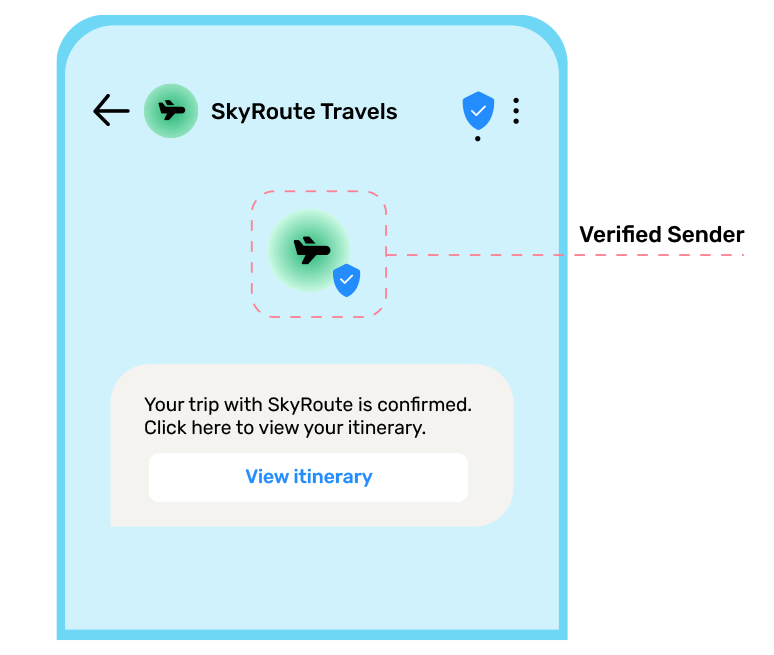
How Does an RCS Verified Sender Look Like?
An RCS verified sender looks like a fully trusted and branded business profile within the user’s native messaging application, and not like a random shortcode or phone number.
Here are the typical elements that verified sender users see:
- A verified badge or a verified business label
- Official business name
- Brand logo and profile image
- Brand colors and styling
- Rich messages instead of plain texts
Benefits of RCS Verification For Businesses
Authenticating your brand identity and building customer trust instantly enhances your brand credibility, creating a trusted and safer environment. Here’s how a verified sender ID can benefit your business:
1. Enhanced credibility and brand recognition
SMS and text messages are popular means for fraudsters to send spam messages and conduct phishing attacks. In fact, according to FTC data, customers lost about $470 million to text message scams, which is five times the amount reported in 2020.
This makes it imperative for customers to identify the brand message and its source. With RCS verification, businesses can build a consistent, recognizable brand image across business communication, allowing customers to recognize who the message is from and its intent instantly.
This also builds a memorable brand experience for customers, boosting the brand’s credibility, identity, and recognition.
2. Reduced fraud and improved legitimacy
When customers easily identify your brand message, it becomes difficult for fraudsters to impersonate your brand and send spoofed or scam messages.
Since RCS Agents are required to pass stringent identity and use case checks with strict authentication, customers are protected from fraudulent links, fake promotions, and malicious phishing campaigns, making RCS ideal for sensitive use cases, such as transactional messaging, OTPs, 2FA codes, and payment confirmations.
Furthermore, a verified sender identity immediately enhances your brand's legitimacy, deterring fraudsters and protecting customer trust and data.
3. Increased customer experience and satisfaction
73% of customers trust a brand more when it has a consistent visual identity. This is because a consistent visual identity directly translates to reliability. For customers, a verified sender feels more secure, enabling them to share sensitive data and information with the brands they trust and recognize, without second-guessing.
It removes doubt and friction from their customer journey, improving customer engagement and experience, leading to increased sales and repeat purchases.
4. Improved message delivery and visibility
Verified RCS messages are less likely to be blocked, ignored, or filtered by messaging applications. This is a highly critical feature, especially after the iOS 26 SMS Screening and Filtering update, which filters incoming messages into folders such as ‘Unknown Senders’ and spam.
With a recognizable and trustworthy brand identity, your messages are most likely to end up in the primary inbox rather than being flagged as spam, improving message visibility and deliverability and ultimately boosting read and open rates, as well as click-through rates (CTRs).
5. Supports regulatory and compliance policy
Ensuring compliance reduces the risk of account suspension, legal penalties, campaign shutdowns, and reputational damages.
Steps To Implementing RCS Business Verification
Becoming a verified sender is important to building a credible brand image, building customer trust, and ensuring security and compliance. Here’s a step-by-step process to become a verified sender and send RCS messages to your customers.
Step 1: Gather key requirements
Before jumping straight into the verification process, gather all the necessary details to ensure a streamlined verification process. It’s important to keep the necessary documents and data ready beforehand to avoid last-minute hassle. Here’s what you typically need for the process:
- Legal proof of your business registration, including the business name and certification documents.
- Proof of domain ownership, including supporting documents and the official website URL.
- Business contact information with documentation, including the business address, a supporting email, and a phone number.
- Links to privacy policy and terms of service.
This step ensures that your business is operating under a legitimate business identity. Any inconsistencies, broken links, mismatched brand names, or missing legal pages will result in immediate rejection of the application.
Step 2: Choose a reliable RCS provider
To send RCS messages, you need a reliable and suitable RCS provider to help you with the verification process.
An RCS provider can help you with business registration and RCS Agent creation processes. For instance, TXTImpact provides an intuitive RCS Business Messaging setup that comes with full Gateway API support, facilitating integration and other crucial steps.
It also helps you register your business by requiring you to enter relevant business information and upload documents, including business registration and domain ownership.
Once you submit your brand details, TXTImpact helps you create an RCS Agent, also known as an RCS Sender, that serves as your business's official brand identity. Here you can:
- Define your RCS Agent name
- Upload the business logo and visual assets
- Select the business category
- Configure regional availability with carrier reach
Reliable RCS providers, like TXTImpact, speed up and facilitate these processes, helping businesses whenever they get stuck.
Step 3: Use case declaration
In this crucial verification step, businesses must clearly explain and demonstrate the purpose of using RCS messages, and share messaging templates and examples.
A few most common and typical use cases include:
- Promotional campaigns, which include product launches, offers, and seasonal discounts.
- Transactional messages, including OTPs, account alerts, payment confirmations, and order updates.
- Conversational support, which includes chat-based assistance and customer support services.
Additionally, businesses must also specify and share message frequency, sample message templates, and opt-in and consent collection methods to ensure compliance.
Step 4: Verification and approval
Once the registration and use case submission process is completed, the verification process begins, along with a detailed policy compliance review by Google and additional checks by mobile carriers.
The review areas typically include:
Spam risk assessment
Adherence to Google RBM content policies
Transparency and clarity of message purposes
Compliance with local regulations
The verification process length varies depending on your business type and RCS provider.
After successful verification, businesses often receive approval from their RCS providers, along with brand and RCS Agent approval.
Once approved, businesses can start using RCS with a verified status and set up a business to run messaging campaigns and business communications.
RCS Verification vs SMS Verification: What’s The Difference?
Unlike RCS verification, which focuses on sender trust and a verified branded identity, SMS verification doesn’t have true sender verification. Instead, it requires businesses to use phone numbers, alphanumeric sender IDs, and short codes to send texts and run SMS campaigns.
Moreover, SMS verification doesn’t undergo a stringent verification process and requires minimal to no approval, making SMS campaigns highly vulnerable to phishing and brand impersonation.
Here’s an overview of RCS business vs SMS verification differences:
Aspect | RCS Verification | SMS Verification |
Sender identity | Verified brand identity tied to an RCS Agent | Short codes, phone numbers, or alphanumeric sender IDs |
Brand authentication | Mandatory with complete brand and use case verification | Not mandatory and often minimal |
Trust indicators | Robust visual trust signals within the native messaging apps | No built-in trust indicators |
User visibility | Displays brand name and logo | Appears as a generic ID or an unknown number |
Approval process | A multi-step approval process by Google and the carrier | Little to no pre-approval required |
Spoofing risk | Extremely low, as each sender is uniquely verified | High, as sender IDs can be easily impersonated |
Message deliverability | Higher and primary inbox placement for verified senders | Highly impacted by spam filters, with messages moved to the ‘Spam’ or ‘Unknown Sender’ folders |
Policy enforcement | Strict, proactive, and continuously monitored | Limited and reactive |
User confidence | High, as users trust and engage more readily | Low, with users hesitating to engage with the messages |
Opt-in and consent handling | Enforced as part of compliance and verification | Managed externally |
Ongoing monitoring | Continuous compliance and quality monitoring | Minimal monitoring |
Differences between RCS verified senders and SMS Short codes
Sending messages through RCS verified senders and from SMS short codes differ distinctly, along with the varying user experience. While RCS verified senders feel like chatting with a real, verified brand, SMS shortcodes feel like receiving a text from a random, unknown number.
Here’s how the two methods differ:
Aspect | RCS verified sender | SMS short codes |
Sender identity | Verified business name and logo | Only 27126 or (555)-555-5555 numbers |
Branding | Complete branding | No branding |
Trust indicator | Verified badge | No built-in verification |
Message format | Rich messages | Text and MMS (maximum 1 MB) |
User experience | App-like chat experience | Basic texting |
Interactivity | Buttons, quick replies, carousels | Keyword-based replies |
Spam protection | Strong | Moderate |
Best for | Branded, interactive customer communication | High-volume alerts and OTPs |
Best Practices For a Smooth RCS Verification Process
Businesses can face several delays and rejections during the RCS verification process due to factors such as mismatched brand details, non-compliance, and more.
Here are some best practices businesses must follow to minimize back-and-forth review and reduce approval time for a quick, successful RCS verification process.
1. Provide complete and consistent brand details
Before submitting your application and brand details, ensure that all the information you provide is accurate and consistent across all touchpoints. Best practices for this include:
- Ensure your website is live and publicly accessible
- Use the exact legal business name and matching brand name
- Avoid discrepancies between the brand name, logo, and domain name
- Ensure consistent contact details, business address, and support details.
Inconsistencies in these details raise red flags and hinder the RCS verification and approval process.
2. Define clear and realistic messaging use cases
Clearly describing and demonstrating how you intend to use RCS messaging for your business is critical for approval. It’s important to:
- Share accurate and exact message samples and templates
- Be specific about message types, such as transactional, promotional, and conversational
- Provide a realistic and exact message frequency
- Align messaging purpose with user value
3. Ensure compliance and website credibility
Your website and online presence play a huge role in the RCS verification process. A broken, inaccessible, and unprofessional website hampers your brand’s visibility, delaying verification and approval.
To avoid this, ensure your company information, such as the Contact Us Page and About Us page are clearly visible. At the same time, also ensure
- Your website has published a privacy policy and terms of service
- It doesn’t have any broken links or placeholder content
- It has a secure HTTPS domain
- It consists of transparent information about your products and services
An incomplete, broken, and weak website is one of the most common causes of RCS rejection.
4. Demonstrate consent collection and explicit opt-in
Customer consent is highly non-negotiable in RCS. To ensure compliance, quick verification, and approval, businesses need to provide clear documentation of how users opt in, such as via website forms, SMS opt-ins, checkout flows, or app consent.
It’s also important to explain how opt-outs will be handled, maintain records of user consent, and avoid pre-checked boxes or implied consent. Strong opt-in practices and explanations significantly reduce spam complaints and build customer trust post-launch.
5. Align message content with approved use cases
Once your RCS messaging is approved, ensure it remains within the scope of verification. Businesses must avoid introducing new message types and content templates without approval.
Additionally, businesses must:
- Avoid aggressive promotional campaigns and misleading languages
- Reapply if your messaging strategy changes significantly
- Match actual content with submitted messaging samples and templates
Using unapproved message templates or deviating from the approved use cases can result in suspension of your account and business.
6. Partner with an experienced RCS provider
A knowledgeable and experienced RCS provider can significantly streamline and facilitate your RCS verification process.
When looking for an RCS provider, look for features like:
- Google and carrier support and relationships
- Ongoing compliance monitoring support
- Pre-verification checks and guidance
- Technical support
TXTImpact provides all these features and more to help you with the verification process and kickstart your RCS campaigns as early as possible, while avoiding delays and rejections.
Wrapping Up
Verified senders are the cornerstone of the RCS ecosystem. Verifying your RCS business account enhances brand credibility, builds customer confidence, and significantly reduces risks of spam and fraud.
Besides, RCS can also help brands boost open rates and engagement with increased brand trust and rich media and interactive features. However, to ensure a streamlined verification process, choosing a suitable RCS provider is crucial.
TXTImpact offers a smooth, hassle-free RCS verification and approval process, helping brands and businesses at every stage of the process. Moreover, it ensures a seamless setup and onboarding post-approval, enabling businesses to kickstart their RCS campaigns instantly.
If you’re looking for a secure and reliable RCS provider for quick, easy verification, contact us at TXTImpact today.
FAQs
♦ Why do verified senders improve engagement rates?
Verified senders display a recognizable brand name and logo, which instantly builds customer trust, removes uncertainty and doubt for users, and reduces the risk of phishing. This increased user trust and confidence ultimately leads to higher open and engagement rates since users know who the message is coming from and its intent.
♦ Are there industry-specific restrictions for RCS verification?
Yes, industries like healthcare, finance, crypto, and gambling often require and face stricter verification reviews and may require additional documentation or approvals.
♦ How does RCS verification impact customer opt-out behavior?
A verified, branded business identity and transparency significantly reduce customer opt-outs by setting clear expectations and helping users recognize the message source and its credibility.
♦ Can businesses send OTPs and authentication messages using RCS?
Yes, because of its verified sender ID, businesses can send transactional and authentication messages, including OTPs, 2FA codes, and payment confirmations, via RCS, improving user trust and confidence.
♦ How to troubleshoot RCS verification issues?
You can troubleshoot and avoid RCS verification issues by reviewing your brand details, privacy policy, opt-in and opt-out documentation, and ensuring that all information you provide is accurate and free of inconsistencies.
About the Author:
 | Rahul Kumar (Marketing Specialist) Rahul Kumar is a Digital marketer with 7+ years of experience in SEO, AEO,SMS marketing, WhatsApp marketing, SaaS, and WordPress. He has led successful growth campaigns for startups and tech brands, combining data-driven strategies with compelling content. His work has been featured on top SaaS blogs, and he’s known for turning complex ideas into high-converting digital strategies. |