How to send bulk RCS messages in 2026? (Step-by-Step Guide for Businesses)
Business messaging has evolved significantly in recent years, driven by rising customer expectations. Customers expect convenience and personalization from a brand when they interact with it. This evolution and expectations gave rise to Rich Communication Services (RCS).
RCS is SMS 2.0, enhancing its capabilities to provide an engaging, interactive, secure, and branded messaging experience for customers. With over a billion RCS messages sent every day in the U.S., its growing popularity is making it one of the topmost communication solutions for businesses.
And to enhance RCS capabilities and meet mobile-first customer expectations, businesses are moving towards bulk RCS messaging, enabling them to send media-rich, high-volume messages at scale and run successful marketing campaigns.
This article specifically dives into the RCS bulk messaging sending process, its benefits, use cases, and best practices to streamline communication for your business.
Jump to: |
What is Bulk RCS Messaging?
RCS bulk messages are RCS messages sent in large volumes(i.e. Thousands of contacts, even millions) to customers, offering a rich and engaging customer experience.
Whether it’s to send promotional campaigns, critical flight alerts and updates, or new product announcements, bulk messaging helps businesses reach a wider audience, and RCS makes the experience even more convenient, trustworthy, and interactive with its enhanced features.
Here are the RCS features that facilitate the bulk messaging experience for both brands and customers:
Rich media delivery: RCS allows you to send high-resolution images, videos, GIFs, carousels, files, and product cards to enhance customer experience.
Interactivity: RCS supports interactive buttons, suggested and quick replies, links, calendars, and location sharing to boost engagement and streamline the customer journey.
Verified sender branding: RCS messaging allows you to include your brand name, logo, color, and tagline to boost brand visibility, recognition, and profile.
IP-based message delivery: Unlike SMS, RCS messages are sent over mobile data or Wi-Fi, resulting in faster delivery, higher open rates, and larger file-sharing capabilities.
These features of RCS make it one of the most sought-after marketing and communication mediums for businesses, enabling them to achieve higher ROI and better results.
How do Bulk RCS Messages Help Businesses? Key Benefits
Here are some reasons why businesses use RCS messages, and they can benefit from them.
1. Higher engagement and visibility
74% of customers are more likely to engage and interact with a brand through RCS. This is because of interactive features, such as images, videos, buttons, and quick links, that facilitate the customer journey and enable customers to take quick actions with minimal effort or hassle.
2. App-like user experience
RCS bulk messages are sent directly to your customers’ native mobile messaging applications, with no additional app or software download required. This makes it super-convenient for brands and users alike, giving customers an app-like experience with product carousels, rich cards, suggested actions, interactive menus, and guided flows in their native applications.
3. Real-time two-way interaction
RCS supports real-time back-and-forth two-way interactions and live updates, making it ideal for personalized communication and customer service. With a conversational interface, RCS streamlines customer interactions and satisfaction.
4. Advanced analytics and metrics
RCS provides real-time analytics and metrics, including read and delivery receipts, link clicks, button interactions, open rates, and engagement and conversion rates to boost your campaign performance. These metrics significantly help marketers to gain deep insight into their customer behavior and fine-tune and optimize campaigns for better results.
5. Secured and spam-free messaging
With sender verification and built-in authentication, RCS significantly reduces security, spam, and fraud risks, unlike SMS, where messages can be easily intercepted. Besides, it supports end-to-end encryption, making it ideal for sending OTPs and transactional messages.
6. Personalization at scale
Advanced analytics and data on customer behavior and preferences allow brands to personalize customer experiences with behavioral nudges, personalized recommendations, promotions, and alerts, making the conversation feel more natural, valued, and intuitive.
How to Send Bulk RCS Messages Easily (Step-by-Step Method)
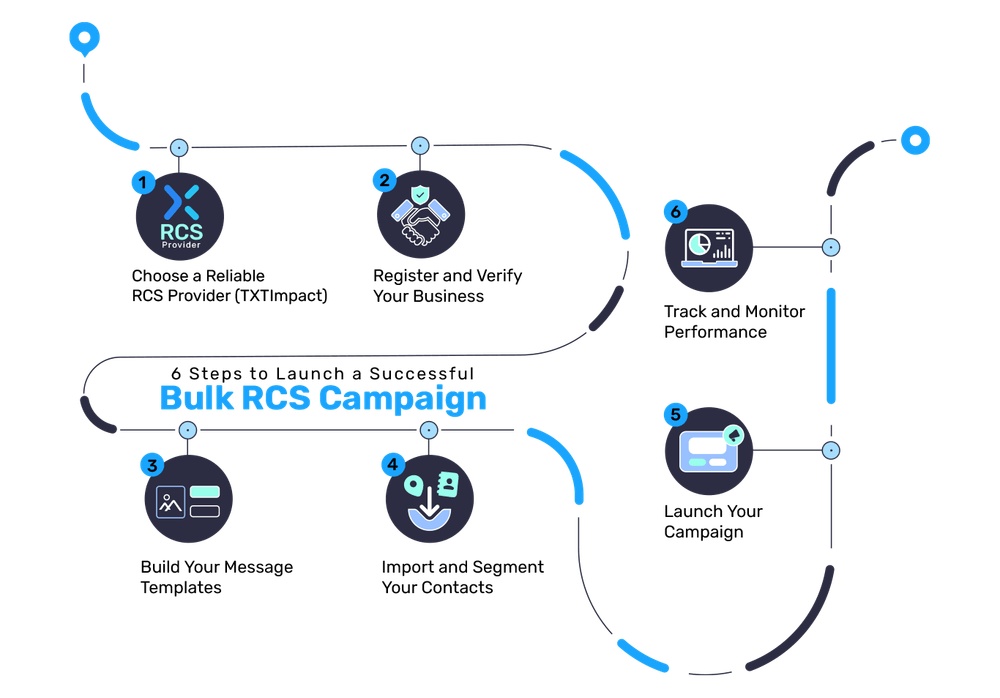
Before you get started with bulk RCS campaigns and outreach, you need to choose a reliable RCS provider, get your business verified, and complete other crucial steps as mentioned below:
1. Choose a reliable RCS messaging provider
You need an RCS service provider to securely and reliably send bulk RCS messages at scale. An RCS provider serves as a mediator between your business and the network service provider to help you reach and deliver the right messages to your customers.
When choosing an RCS provider, here are the top features you must consider:
- Simplicity and the intuitive interface
- Template builder with rich media and support
- Advanced integration capabilities
- Advanced read receipts and analytics
- Security and compliance workflows
- 24/7 customer support
TXTImpact offers a highly interactive and secure RCS messaging service with rich media, interactive chat bubbles, and CTA buttons, along with ready-to-use templates and seamless system integration, making it easy for your business to send bulk RCS messages.
2. Register and verify your business profile
Once you choose an RCS provider, the next step is to register your business with a network service provider. Your RCS provider (TXTImpact) must help you onboard RCS and collect the required business details for verification.
The business information required might vary depending on the service provider and country, but, ideally, in most cases, the details you need to provide are:
- Business name
- Business logo
- Brand colors
- Website domain
- Industry category
- Cover image and description
- Messaging use cases
- Sample message flows
- Opt-in sources
Banner information Once this data is uploaded and ultimately approved, you will receive a verified business badge and a sender ID, which will display your verified business profile, including your company name and logo, when you send RCS messages to your customers.
Read: How to Get RCS Approved: Easy Step by Step Process |
| 📝Note: Since sending bulk RCS messaging doesn’t require a phone number like bulk SMS, 10DLC registration is not required. However, to use the SMS/MMS fallback option (highly recommended), 10DLC registration is mandatory along with the RCS agent registration process. |
3. Create your bulk RCS message templates
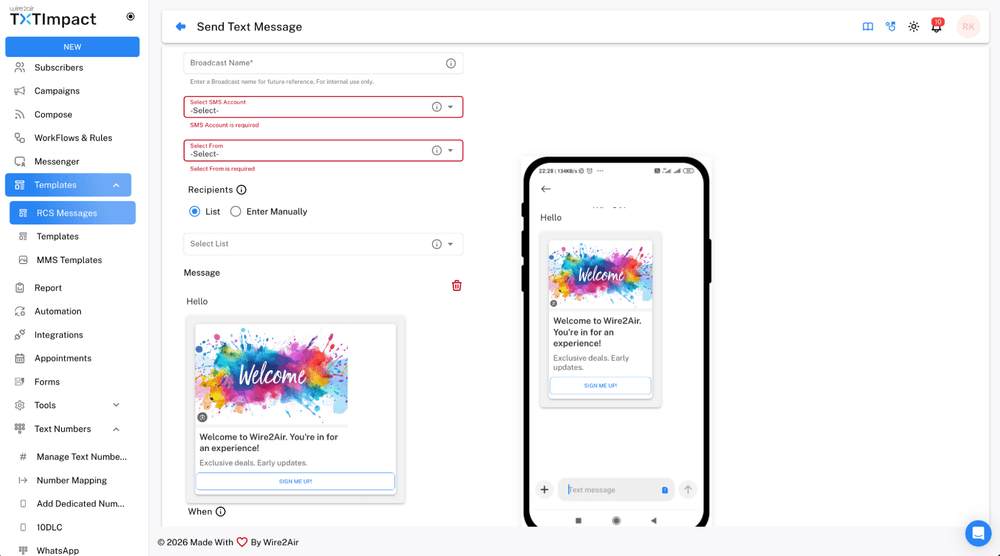
Once your business profile is ready, the next step is to create message templates. While WhatsApp Business messaging requires pre-approved templates, you don’t need pre-approved templates for RCS. You can simply create bulk templates for use cases that best meet your business needs and RCS campaigns, including carousels, product cards, coupons and discounts, and promotional content.
To make this easier and streamline customer bulk outreach, we offer ready-to-use RCS templates at TXTImpact for promos, OTPs, messages, and more.
4. Import and segment your contact details
Once the templates are ready, another crucial step is to import and segment your contact details to send the right type of messages to the right customers.
You can segment your customers by browsing behavior, purchase history, region and geographical location, age, loyalty tier, cart status, and customers who opted in and opted out of your campaigns.
With TXTImpact’s intuitive dashboard, you can easily create multiple subscriber lists and import contacts either directly or by uploading a file containing phone numbers. Once the list is ready, you can reach out and send messages to all the contacts at once.
5. Launch your bulk RCS campaigns
Once your messages are approved and ready to be sent to subscribers, schedule and send them to your customers.
We guarantee 100% message delivery with SMS/MMS fallback. Meaning, if users don’t have RCS enabled on their device or the carrier doesn’t support RCS, the messages will fall back to SMS or MMS.
6. Track and monitor performance
RCS offers rich and advanced data and analytics, including read and delivery receipts, click-through rates (CTRs), open rates, button and CTA clicks, and media interactions.
It’s important to monitor and track these metrics to analyze your bulk RCS campaign performance, helping you identify which strategies work and which need refinement or optimization to achieve the desired results.
Top Use Cases of Bulk RCS Messages
RCS bulk messaging opens the door for several top use cases for businesses, as follows:
Product launches: With RCS’s rich cards and carousels, businesses can easily add product images for new and bulk product launches and announcements and entice customers to browse the products.
Promotional campaigns: With visually compelling images, videos, and carousels, brands can leverage RCS to run bulk promotional campaigns, flash sales, and offers and discounts.
Customer engagement: With interactive loyalty rewards, personalized birthday and anniversary gifts, and membership tier upgrades, businesses can significantly boost customer loyalty and engagement.
Feedback and surveys: post-purchase or post-events, brands can send interactive and convenient feedback forms and surveys with suggested and quick replies to boost customer satisfaction and engagement.
Ticketing and events: Brands can send event confirmations and announcements, ticket confirmations and updates, reminder messages, and ticket cards at scale to their customers using RCS bulk messaging.
Travel updates: Airlines, travel agencies, and itinerary management can send flight confirmations and updates, hotel booking confirmations, or itinerary changes to their customers using RCS rich buttons, links, and cards.
- Retail notifications: Omnichannel retailers can send store-opening alerts, in-store events and offers, and workshop invitations via carousels, maps, and location triggers in RCS rich messaging.

What are the Limitations/Challenges of RCS Bulk Messaging?
RCS faces certain challenges and limitations when it comes to reach and carrier support.
Challenge: Compared to SMS, RCS has a limited global reach, as not all carriers, countries, or devices support RCS.
Solution: However, to overcome this challenge and ensure guaranteed message delivery, providers, like TXTImpact, offer SMS and MMS fallback service; meaning, if users’ devices or carriers don’t support RCS, the message falls back to SMS.
Challenge: RCS doesn’t work online; it requires mobile data or Wi-Fi connectivity to deliver the messages. A limited or no internet connection can delay message delivery.
Solution: To overcome this limitation, it’s recommended to schedule and send critical messages and broadcast announcements at times when users are most likely to have good internet connectivity. At the same time, SMS fallback is beneficial when the users’ device Wi-Fi or data is not connected.
Challenge: RCS capabilities differ across various devices and versions. For instance, an iOS or Android phone with an outdated OS won’t be RCS compatible and lack interactive RCS features.
Solution: To combat this limitation, it’s important to design message templates that gracefully degrade and fall back to SMS, without losing crucial information.
RCS Bulk Messaging Best Practices
Here are some of the best practices you must follow to ensure the effectiveness of your RCS bulk messaging campaigns.
- While RCS supports a bunch of interactive and engaging features, adding too many elements can reduce compatibility with carriers and devices. Hence, it’s important to design simple, responsive, and device-friendly message templates to avoid broken layouts and missing content.
- Focus on adding value in the messages you send to your customers, whether it’s promotional content, discounts, product recommendations, or reminders. Staying relevant and to the point is key to ensuring high engagement and interaction.
- Ensure compliance with international laws and regulations, such as CCPA, GDPR, and other local data protection regulations, and obtain user consent and opt-ins before sending messages to your customers to avoid legal penalties.
- Optimize the timing and frequency of your messages to avoid spamming your customers and harming your brand credibility and reputation. At the same time, it’s crucial to segment users and send personalized messages based on their purchase history and preferences.
- Using clear, actionable CTAs is recommended to drive quick action and boost conversions. Adding too many buttons, links, and options can lead to decision fatigue, making customers feel overwhelmed and confused.
- Leverage omnichannel strategy: RCS works best when combined with SMS, MMS, email, and WhatsApp, reaching a wide range of audiences on these platforms and creating a cohesive customer journey and engagement.
Which is better: Bulk SMS or Bulk RCS (from an ROI point of view)?
While bulk SMS has value and is efficient for time-sensitive, high-volume messaging, bulk RCS delivers better results and RoI due to its rich, interactive features. Here’s why bulk RCS is better than bulk SMS:
Increased read rate and engagement: Compared to SMS, 80% of customers read an RCS message, and 25% respond, thanks to its rich, interactive elements that pique customer engagement.
Higher conversions: Customers convert more often with RCS due to its visual appeal and convenient experience. For instance, Subway experienced a 140% higher conversion and response rate compared to SMS in one of their campaigns.
Verified and branded sender identity via RCS increases customer trust and brand reliability and credibility, significantly reducing fraud and spam risks.
Excellent RoI: The interactive elements of RCS boost companies' returns on investment compared to SMS. For example, when Casas Bahia chose RCS to enrich the customer experience and promote its offerings, it achieved a whopping 6.2x higher ROI than traditional channels.
Thus, when it comes to RCS, rich visuals and intuitive buttons and suggested replies reduce friction, streamline customer journey, and boost customer interaction and experience, enhancing RCS RoI compared to SMS.
Can I Easily Switch From Bulk SMS to Bulk RCS?
The short answer is, yes. You can easily switch from bulk SMS to bulk RCS, given that your setup and messaging service provider support RCS.
For instance, at TXTImpact, we offer a seamless and hassle-free SMS to RCS upgrade, while keeping your workflow intact and adding interactive RCS features to it. Here’s why upgrading from SMS to RCS is easy with TXTImpact:
TXTImpact supports both SMS and RCS on a single platform, making the upgrade easy.
You can use the same dashboards, APIs, and workflows for bulk RCS that you use for bulk SMS.
Your automations, contact list, subscriber list, and segments remain fully compatible whether you use bulk SMS or bulk RCS.
TXTImpact facilitates and helps you with brand verification, RCS Agent setup, and creating and uploading rich media to get you started with RCS.
TXTImpact ensures 100% message delivery with the RCS fallback to SMS feature.
So, if you’re looking to switch from bulk SMS to bulk RCS, don’t give it a second thought. Simply opt for TXTImpact’s RCS business messaging to make the upgrade a breeze.
Is RCS the Future of Bulk Messaging?
Yes, RCS is definitely emerging as the future of bulk messaging. It outperforms traditional SMS, offering a highly interactive and rich messaging experience with buttons, carousels, images, videos, and branded profiles.
This type of enhanced engagement and customer satisfaction makes RCS provide better value over cost than SMS or email.
At the same time, the increasing user adoption and growing carrier support positions RCS as a dominant and growing texting platform, making it the future of business messaging and marketing.
Conclusion
With rich media, advanced analytics, and branded messaging, RCS is becoming the pioneer of business messaging evolution, and a growing number of brands and businesses are increasingly adopting RCS for its high RoI.
With the holiday and sales season approaching, if you’re looking for a reliable RCS provider that facilitates bulk messaging campaigns for your business, go for TXTImpact. We offer a secure, compliant, and intuitive RCS solution with seamless integrations and dedicated support to help you meet your diverse campaign needs.
Talk to our experts by contacting us to get started!
Frequently Asked Questions
♦ What is the difference between RCS and SMS for bulk messaging?
While SMS is limited to plain text and supports only 160 characters with no rich media, RCS lets you add visually appealing images, videos, carousels, GIFs, and buttons to facilitate bulk messaging and enhance the customer experience.
♦ What type of businesses benefit most from bulk RCS campaigns?
Retail, banking, eCommerce, finance, and healthcare industries benefit the most from RCS bulk campaigns, reaching thousands of customers with rich media and driving conversions.
♦ Can I integrate bulk messaging with CRM and other automation tools?
Yes, you can easily integrate our RCS solution with your existing CRM systems, eCommerce platforms, automation tools, business communication platforms, and analytics platforms. With TXTImpact, you can seamlessly integrate RCS with applications such as Shopify, Zendesk, and Salesforce.
♦ Can I send documents or long-form content using RCS bulk messaging?
Yes, you can share brochures, PDFs, tickets, receipts and other files directly through RCS messaging.
♦ What technical requirements are needed to run bulk RCS messaging campaigns?
To effectively implement RCS bulk messaging, you need an RCS service provider, internet connectivity, seamless application integration, and branded sender registration.
♦ How does RCS ensure peak deliverability during the peak holiday season?
RCS’s IP-based delivery reduces network congestion during peak periods and the holiday season. Another RCS feature is SMS fallback, which converts and sends RCS messages into SMS due to bandwidth or network connectivity, and if the user’s device doesn’t support RCS.
About the Author:
 | Mamta Arun (Director Operations) Mamta Arun is a seasoned operations leader with 25+ years in B2B SaaS, SMS marketing, and telecommunications. As Director of Operations at Wire2Air TXTImpact, she ensures seamless service delivery, process automation, and compliance with TCPA and GDPR. With deep expertise in enterprise messaging and workflow automation, Mamta helps businesses enhance engagement, streamline communication, and drive scalable growth. |