40 Legacy Enterprise Systems That Use Email-to-SMS Gateways for Real-Time Alerts
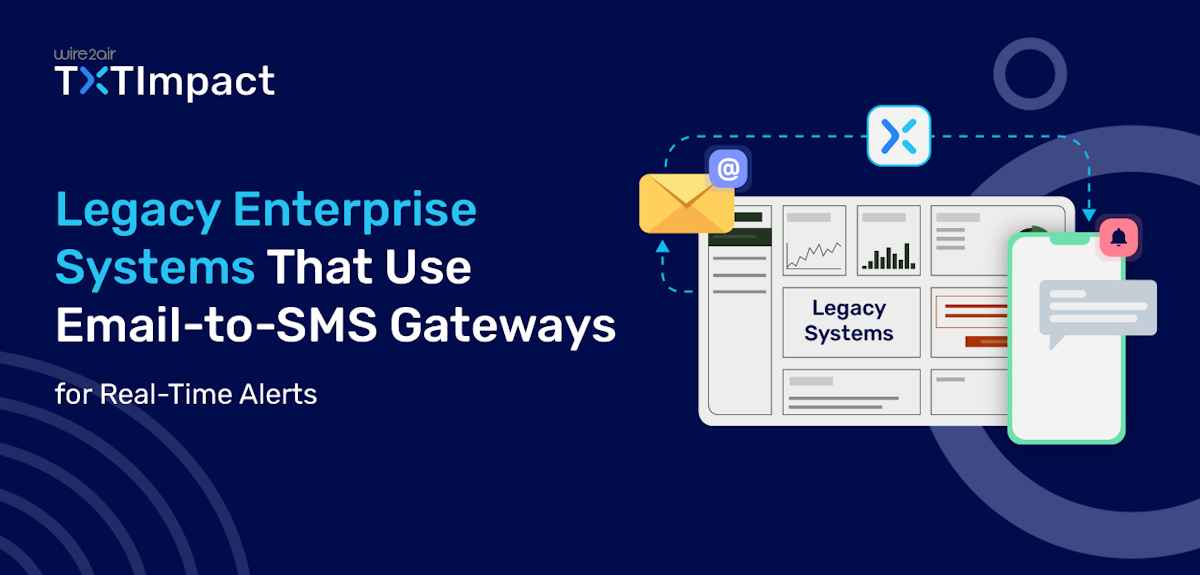
Despite rapid digital advancements and the rise of modern messaging platforms, many enterprises and SMBs continue to rely on legacy software systems for their core operational workflows.
These legacy applications typically use SMTP email alerts to trigger critical notifications, as they were not originally designed to integrate with modern SMS or HTTP APIs. In many environments, this has become a practical and efficient way of sending SMS from legacy systems without requiring physical SMS/GSM modems or complex API integrations.
Email-to-SMS gateways bridge this gap by converting email alerts into real-time text messages, enabling legacy systems to deliver instant mobile notifications without major infrastructure changes.
In this article, we explore 40 legacy enterprise systems that successfully use email-to-text gateways for real-time alerts across IT, healthcare, security, DevOps, and industrial environments.
Key Takeaways:
|
Jump to: |
Why Many Legacy Systems Cannot Integrate Modern SMS or HTTP APIs?
Many legacy enterprise systems were built before API-based communication became standard. As a result, integrating modern SMS or HTTP APIs into these systems is often difficult or impractical.
Common reasons include:
1. Architecture Limitations
Older systems were designed to send alerts via SMTP email rather than external APIs.
2. Outdated Technology
Legacy platforms often use outdated programming languages or frameworks that lack modern API support.
3. Closed or Proprietary Systems
Many enterprise tools are vendor-controlled, making it difficult to modify the software to add SMS API integrations.
4. Risk to Critical Operations
Legacy systems often support mission-critical services, so modifying them can introduce operational risks.
5. High Modernization Costs
Adding API capabilities may require extensive redevelopment, testing, and infrastructure upgrades.
6. Compliance Constraints
In regulated industries, system modifications may trigger audits or certification processes.
Because nearly all enterprise systems can send SMTP emails, many organizations rely on email-to-SMS gateways to convert these alerts into text messages without modifying the legacy software.
What is an Email-to-SMS Gateway and How Does it Work for Legacy Systems?
An email-to-SMS gateway is a service that converts an email into an SMS (short message service) or text message and delivers it to a mobile device via a mobile carrier’s network. It enables systems that can send emails to trigger SMS alerts without needing a dedicated SMS API integration.
Most legacy software systems can send emails and email alerts via SMTP. An email-to-SMS gateway automatically converts those alerts to SMS.
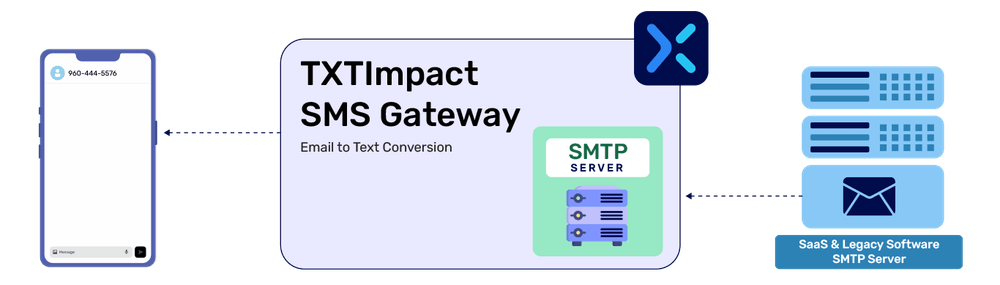
Here’s how the gateway works for legacy systems:
A legacy system generates an alert, such as a transaction alert, server downtime, or a medical device warning
The system sends an email through SMTP
The email is addressed to a special carrier gateway format, such as [email protected]
The telecom carrier receives the email
The carrier converts the email into an SMS
The SMS is delivered to the recipient’s mobile number
Previously, many businesses used carrier email-to-SMS gateways to send text messages. For example, Verizon users could receive messages at [email protected], while AT&T users used [email protected]. These gateways were popular in legacy systems because they required minimal configuration, no additional software development, and worked easily with existing on-premises email infrastructure. However, major carriers such as Verizon, AT&T, and T-Mobile have discontinued their email-to-SMS gateway services. Fortunately, businesses can still send SMS from email using platforms like TXTImpact’s Email-to-Text gateway, which provides a secure and reliable alternative without depending on carrier gateways. |
40 Enterprise Legacy Systems that are already relied on, Email2SMS solutions, and their Use Cases
Here are 40 different enterprise legacy software, organized by industry, and how they use email-to-SMS gateways to send text notifications, alerts, and even two-way communication.
Infrastructure and Network Monitoring Systems
1. Nagios
Nagios is an open-source infrastructure monitoring system for servers and network devices.
Its email-to-text use cases include:
- Server downtime
- Service failures
- CPU spikes
It’s typically set up on an on-premise Linux server with SMTP alerting.
The setup includes Nagios alert -> SMTP email -> [email protected] -> SMS
Email-to-text enables easy SMS alerts without API coding in legacy deployments such as Nagios.
2. PRTG Network Monitor
PRTG is a network monitoring tool with a sensor-based alerting system.
Its use cases include:
- Bandwidth overload
- Device failure
- Uptime monitoring
The typical setup includes a Windows server with email triggers.
Email-to-SMS helps PRTG network monitors to send immediate NOC notifications without SMS integration.
3. Zabbix
Zabbix is an enterprise monitoring platform for IT infrastructure.
Email-to-text use cases for Zabbix include:
- Outage detection
- Infrastructure monitoring
- Performance threshold alerts
- Replication lag
- Database failure alerts
A typical Zabbix setup includes an on-premises server sending SMTP notifications.
Email-to-SMS ensures quick escalation alerts to admins’ mobile devices for enterprises using Zabbix systems.
4. Icinga
Icinga is an open-source monitoring device derived from Nagios that sends alerts when hosts or services are down.
Use cases include:
- host/server failure alerts
Its setup includes a Linux-based monitoring node with SMTP alerts.
Icinga is used when minimal configuration changes are needed for SMS escalation.
5. Checkmk
Checkmk is an enterprise infrastructure performance monitoring system used to send updates and notify teams when anomalies occur.
Use cases include:
- Infrastructure alerts
- Application anomalies
Its typical setup is an on-premise monitoring server using email notifications.
Email-to-text gateways are used for Checkmk for quick mobile reach for IT teams.
6. OpenNMS
OpenNMS is a carrier-grade network monitoring platform used by telecom providers and large enterprises.
Use cases include:
- Infrastructure failures
- Telecom network outages
Its setup includes enterprise NOC deployment with email alerts.
Email-to-SMS for OpenSMS is used during critical outage escalation to field engineers.
7. Naemon
Naemon is a Nagios-core-based network monitoring platform used for network and application monitoring.
Use cases include:
- Network failure alerts
- Application failure notifications
Its setup within Linux-based monitoring with SMTP.
Email-to-SMS provides a cost-effective SMS workaround.
8. Shinken
Shinken is a scalable distributed monitoring framework designed to scale large monitoring environments.
Use cases include:
- Large infrastructure health monitoring
Its setup within multi-node monitoring clusters using SMTP alerts.
Email-to-text provides a simple mobile escalation path for enterprises.
Network Operations and Data Center Monitoring
9. SolarWinds Network Performance Monitor
SolarWinds Network Performance Monitor is an enterprise network performance monitoring platform used to detect outages and performance bottlenecks.
Use cases include:
- Bandwidth bottlenecks
- Router downtime
A typical setup includes a Windows server with SMTP alerts.
Email-to-SMS helps in real-time NOC escalation for this particular legacy software.
10. SolarWinds Network Configuration Manager
SolarWinds Network Configuration Manager tracks and monitors device configuration changes for enterprises.
Use cases include:
- Compliance alerts
- Unauthorized configuration changes
Its typical setup includes enterprise IT deployment with email alerts.
Email-to-SMS provides instant alerts for configuration violations.
11. IBM Tivoli Monitoring
IBM Tivoli monitoring is a monitoring suite for IT systems used in large IT environments.
Use cases include:
- Performance degradation alerts
Its typical setup is mainframe and enterprise environments with email triggers.
Email-to-SMS extends legacy alerts to mobile devices.
12. HP OpenView / HPE Operations Manager
HP OpenView is a legacy enterprise infrastructure monitoring platform used to monitor applications, servers, and other infrastructure components.
Use cases include:
- Server and application health alerts
Its setup includes large enterprise data centres that use SMTP.
Email-to-SMS for OpenView integrates alert escalation without modernization.
13. ManageEngine OpManager
ManageEngine OpManager is a network monitoring tool for IT administrators that tracks switches, routers, and servers.
Use cases include:
Switch/router failure alerts
A typical setup includes an on-premises monitoring server with SMTP.
Email-to-SMS helps the tool with quick SMS notifications to IT staff.
14. Centreon
Centreon is an enterprise monitoring platform that’s widely used in IT and telecom.
Use cases include:
- Service interruption alerts
A typical setup includes a Linux server with SMTP-based alerts.
Email-to-SMS for Centreon provides direct escalation to operations teams.
15. WhatsUp Gold
WhatsUp Gold is a network and infrastructure monitoring system and fault detection system to detect network failures.
Use cases include:
- Infrastructure outages
- Network failures
WhatsUp Gold is typically set up with a Windows server with email notifications.
Email-to-SMS helps WhatsUp Gold provide low-cost SMS alerting.
16. CA Spectrum
CA Spectrum is a network fault management system used by telecom providers and large enterprises.
Use cases include:
- Telecom infrastructure fault detection
Typical setup includes a large NOC deployment with email alerts.
Email-to-SMS for CA Spectrum helps in critical fault escalation.
DevOps and Build Automation Systems
17. Jenkins
Jenkins is one of the most widely used open-source CI/CD systems for automated software building.
Use cases include:
- Deployment errors
- Build failures
Typical setup includes a dev server sending SMTP notifications.
Email-to-text for Jenkins helps handle immediate build failure alerts.
18. Bamboo CI
Bamboo CI is Atlassian’s build automation and deployment platform.
Use cases include:
- Failed deployments
Bamboo CI is typically integrated into a DevOps pipeline with SMTP.
Email-to-SMS helps teams using Bamboo CI escalate critical issues.
19. TeamCity
TeamCity is a continuous integration server used by development teams to automate builds and deployments.
Use cases include:
- Build and deployment notifications
TeamCity offers a typical setup with an enterprise CI server with email alerts.
Email-to-SMS for the TeamCity platform helps in faster developer response.
20. Buildbot
Buildbot is a build automation platform used in large development environments.
Use cases include:
- Software build monitoring
A typical setup of Buildbot includes development servers using email notifications.
Email-to-SMS for Buildbot provides a simple SMS alerting solution for dev teams.
Security Monitoring and SIEM Platforms
21. IBM QRadar
IBM QRadar is an enterprise SIEM, security information and event management platform used for threat detection and intelligence.
Use cases include:
- Security incident detection
A typical setup for IBM QRadar includes an enterprise SOC that uses email notifications.
Email-to-SMS for IBM QRadar includes fast alerting for critical threats.
22. Splunk Enterprise
Splunk Enterprise is a log analytics and SIEM platform used for security analytics.
Use cases include:
- Threat detection alerts
A typical setup of Splunk Enterprise includes a SOC environment with SMTP triggers.
Email-to-SMS for Splunk Enterprise offers immediate incident response alerts.
23. ArcSight
ArcSight is an enterprise SIEM system used to detect and investigate security incidents.
Use cases include:
- Cyberattack detection alerts
A typical setup with ArcSight includes a large enterprise security deployment.
Email-to-SMS helps the ArcSight platform with high-security threat escalation.
24. AlienVault OSSIM
AlienVault OSSIM is an open-source security monitoring platform used to identify potential threats.
Use cases include:
- Vulnerability and intrusion alerts
A typical setup includes an on-premise security server using SMTP.
Email-to-SMS for AlienVault OSSIM offers a cost-effective SMS escalation solution.
25. LogRhythm
LogRhythm is a security analytics platform designed for incident detection and response.
Use cases include:
- Incident response alerts
Typical setup for LogRhythm is SOC with email-based alerting.
Email-to-SMS helps LogRhythm with rapid mobile notifications.
Industrial Automation and SCADA Systems
26. Siemens WinCC
Siemens WinCC is a SCADA platform for industrial monitoring to monitor manufacturing and power plant operations.
Use cases include:
- Equipment failure alarms
- Remote site operational alarms
- Power plant parameter threshold breaches
Its setup is a on-premise plant control system with email alerts.
Email-to-SMS for Siemens WinCC helps notify engineers instantly.
27. GE iFix
GE iFix is an industrial automation control platform used to control and monitor industrial processes.
Use cases include:
- Process deviation alerts
- Chemical plant safety alarms
- Tank level and pressure threshold breaches
It’s set up with manufacturing plants with email alarms.
Email-to-SMS helps GE iFix with immediate operator notification.
28. Wonderware System Platform
The Wonderware system platform is an industrial operations and monitoring system used to track factory equipment.
Use cases include:
- Production equipment alerts
- Quality control deviation warnings
- Conveyor belts or robotic arm fault warnings
A typical setup includes factory-floor monitoring with SMTP alerts.
Email-to-SMS helps the tool with simple mobile escalation.
29. Citect SCADA
Citect SCADA is a control system used in manufacturing plants and environments to monitor plant operations.
Use cases include:
- Industrial fault alerts
- Real-time plant shutdown alerts
A typical setup includes a SCADA server with SMTP output.
Email-to-SMS for Citect SCADA works without API development.
30. Ignition SCADA
Ignition SCADA is an industrial application platform used to monitor plant equipment and processes.
Use cases include:
- Equipment alarms
- System failures
- Remote facility environmental alerts
Its typical setup includes an on-premise SCADA gateway with SMTP alerts.
Email-to-SMS for Ignition SCADA helps with easy mobile alert routing.
31. FactoryTalk View
FactoryTalk View is a Rockwell industrial and automation monitoring platform used in industrial environments.
Use cases include:
- Machine breakdown alerts
- Preventive maintenance triggers
- Assembly line performance degradation alerts
Its typical setup includes an on-site automation server with email.
Email-to-SMS helps FactoryTalk View with quick technician alerts.
Backup and Infrastructure Systems
32. Veeam Backup and Replication
Veeam backup is an enterprise backup monitoring platform used to monitor data protection jobs.
Use cases include:
- Backup job failures
- Suspicious activity alerts
- Ransomware detection
Its typical setup includes a backup server with SMTP alerts.
Email-to-SMS helps the system with immediate DR team notification.
33. Veeam Backup and Replication
Commvault backup is an enterprise data protection platform used for backup and disaster recovery.
Use cases include:
- Replication errors
- Backup job alerts
Its typical setup includes an enterprise backup system with SMTP.
Email-to-SMS helps with fast escalation for data risks.
34. Veritas NetBackup
Veritas NetBackup is an enterprise backup and recovery platform widely used in large enterprises.
Use cases include:
- Failed backup or restore alerts
- Restore operation failures
- Storage capacity threshold warnings
Its typical setup includes a data centre deployment with email triggers.
Email-to-text helps ensure backup failure visibility.
35. Acronis Backup
Acronis Backup is a backup and cybersecurity solution used by managed services and enterprise platforms.
Use cases include:
- Backup failures
- Ransomware detection alerts
- Cloud backup sync issues
Its typical setup is an MSP or enterprise server with email notifications.
Email-to-SMS helps with rapid response alerts.
Healthcare and Paging Systems
36. OnPage
OnPage is an incident alerting platform for IT teams to receive critical alerts from monitoring systems.
Use cases include:
- IT system outage alerts in hospitals
- Critical on-call alerts
- Biomedical equipment failure alerts
Its typical setup is iterating monitoring tools via email.
Email-to-SMS provides a simple SMS bridge for legacy systems.
37. Spok Paging System
Spok paging system is a clinical paging and alerting platform used for clinical paging and alerts.
Use cases include:
- Emergency code alerts
- Lab-critical result escalations
Its typical setup is a hospital paging server integrated with email.
Email-to-text helps extend paging to mobile phones.
38. TigerConnect (formerly Amcom)
TigerConnect is a clinical communication platform used in healthcare systems for critical alerts.
Use cases include:
- Urgent care team alerts
- Urgent patient status updates
Its typical setup includes hospital systems generating SMTP alerts.
Email-to-SMS helps wth reliable mobile escalation.
39. American Messaging Paging System
The American Messaging paging system is a nationwide healthcare paging network used by hospitals and emergency services.
Use cases include:
- Clinical emergency notifications
- Disaster response notifications
Its setup includes hospital email systems routing to paging gateways.
Email-to-text helps the tool extend legacy paging into SMS delivery.
40. Epic Systems (Epic HR)
Epic Systems is one of the most widely used electronic health record (EHR) platforms in healthcare networks and large hospitals.
Use cases include:
- Patient admission/discharge notifications
- System downtime alerts for clinical teams
- Medication administration warnings
Its typical setup includes an on-premise or hybrid hospital EHR system integrated with internal SMTP servers.
Email-to-SMS helps Epic Systems to notify on-call doctors and clinical staff about alerts and critical updates instantly.
Why Email-to-SMS is Essential For Legacy Systems?
Email-to-text is essential for legacy systems as well as SaaS software that are looking for a no-code solution to send SMS notifications from their software, as it streamlines communication without requiring additional software installation or major infrastructure changes.
Here are a few reasons why email-to-SMS is beneficial for legacy systems:
- No API development required, and it effectively works with the existing SMTP configurations without rewriting legacy code.
- It provides a cost-effective setup, avoiding expensive modernization or third-party integrations.
- It requires minimal infrastructure changes as it easily integrates with on-premise environments.
- Email-to-text gateways help extend system lifespan, enabling older platforms to support mobile alerts.
- It supports critical workflows, making it ideal for sending critical warnings, outage alerts, and security incidents.
- It provides real-time escalation, converting email alerts into immediate SMS notifications.
- Email-to-SMS gateways ensure low technical overload, making it easier to manage via existing mail servers.
- It works across industries, making it common in healthcare, IT, industrial, and telecom environments.
💡 Also Read: How to send SMS notifications from SaaS and Legacy Systems Using SMTP? |
Business Risks of Continuing to Rely on Carriers' Email-to-SMS Gateways
While email-to-SMS gateways provided a convenient and cost-effective solution for legacy systems and industries, they now pose several reliability and security risks.
This is mainly because major carriers have shut down their email-to-SMS services. From AT&T and Verizon to T-Mobile, these carriers discontinued their email-to-text service due to security concerns, technical limitations, service changes, and the rise of modern business messaging applications.
Continuing with these email-to-text gateways provided by carriers can make businesses face these business risks and issues:
- Unreliable delivery
- No delivery confirmation due to a lack of read and delivery receipts
- Message truncation due to character limits
- Carrier filtering and blocking
- Security vulnerabilities, such as SMTP spoofing and unsecured email routing
- Compliance gaps with limited support for consent records, audit logs, and opt-in tracking
- No two-way communication
- Scalability limitations
- Lack of analytics and reporting capabilities
- High dependency on carrier support
- SLA and downtime risks
- No sender identity control
These risks make email-to-SMS highly unsuitable for mission-critical enterprise applications and software.
TXTImpact: A Modern, Reliable Solution to Replace Carrier Email-to-SMS Gateways
TXTImpact provides a secure, compliant, reliable, and scalable email-to-text service compared to carrier-based email-to-SMS services.
Unlike carrier services that require different carrier domains, TXTImpact lets you send messages in a single format. Once integrated with your legacy systems, all SMS alerts can be sent using the [email protected] format.
💡 Also Read: How to send Texts from email (Step-by-Step Guide) |
Unlike SMTP-to-carrier routing, TXTImpact provides a direct connection to carrier networks and messaging aggregators, ensuring greater visibility, higher deliverability, and stronger compliance controls.
With an efficient and simple email-to-SMS solution, TXTImpact provides an excellent email-to-text alternative for businesses and legacy systems with the following features and benefits:
Direct SMS API integration
No Carrier domain dependency
Two-way messaging
Guaranteed delivery reports
Advanced compliance controls
Custom sender ID
High throughput and scalability
Keyword-based routing
Email domain whitelisting
Message history and logs
Detailed analytics and reporting
Besides email-to-SMS, TXTImpact supports multi-channel compatibility, also offering email-to-MMS, email-to-RCS, and email-to-WhatsApp, allowing businesses to reach customers across multiple platforms from their email inboxes.
Conclusion
While modern systems support and use APIs for business communication, many legacy enterprise systems still rely on SMTP for alerts and notifications to drive customer interaction.
While email-to-SMS gateways once provided a simple and convenient solution, carrier-based email-to-SMS services now pose several security risks. Carrier shutdowns, security vulnerabilities, compliance limitations, and a lack of delivery visibility make carrier-based email-to-text gateways unreliable for businesses.
TXTImpact provides an excellent carrier-based email-to-text alternative, offering high flexibility, two-way communication, improved deliverability, and streamlined customer communication, ensuring a secure, compliant solution for businesses.
Thus, if you want to improve your campaign’s response rates, reduce operational risks, and future-proof real-time communication workflows, contact us to get started with TXTImpact or start a free trial to explore our platform for yourself.
FAQs
♦ Is email-to-SMS compliant with regulations?
Yes, reliable SMS providers, such as TXTImpact, ensure compliance with regulations, including HIPAA and TCPA, by providing consent tracking, audit logs, and trial periods, and by implementing encryption controls across all their services, including the email-to-text service.
♦ Why are delivery reports important for enterprise alerts?
Delivery reports confirm whether a message reached a recipient’s device. Without them, businesses find it difficult to verify if critical alerts and messages were delivered successfully.
♦ What is the main difference between carrier gateways and SMS APIs?
Carrier email gateways convert emails into SMS without providing much control or tracking of delivery. SMS APIs, on the other hand, provide direct carrier connectivity, two-way messaging, delivery status, and compliance tools, providing a reliable and secure messaging environment.
♦ How can businesses transition from email-to-SMS gateways to modern messaging?
The gateway to modern messaging transition typically involves auditing current SMTP alert flows, choosing a reliable SMS provider, integrating APIs, and testing failover and compliance workflows before full deployment.
♦ Do major carriers still support email-to-SMS gateways?
No, most major carriers, such as AT&T, T-Mobile, and Verizon, have discontinued or heavily restricted their email-to-text services due to spam abuse, infrastructure changes, and security risks. This makes message delivery unreliable for enterprise alerts.
About the Author:
 | Tejal Sushir (Content Writer) Tejal Sushir is a content writer with 4+ years of experience writing fresh and insightful content for B2B SaaS companies. She has delivered top-performing and top-ranking blogs in the SMS marketing, Digital Marketing, web hosting, AI & ML, cybersecurity, WordPress, HR Tech, and technical SEO domains. Her meticulous research when writing content ensures industry expertise and keeps up with emerging trends. |