SMS for IoT: How Machine-to-Machine (M2M) Communication Uses SMS for Real-Time Alerts
The Internet of Things (IoT) is transforming how devices connect, communicate, and operate across industries, from smartphones and manufacturing to healthcare and logistics. At the core of this ecosystem lies Machine-to-Machine (M2M) communication, in which devices exchange data without human intervention.
While modern IoT devices often rely on Internet-based protocols, SMS remains a surprisingly reliable and powerful channel for sending time-sensitive and real-time alerts.
Unlike data-driven messaging and app-like notifications, SMS works even in low-connectivity environments, ensuring critical updates and alerts are delivered instantly. Whether it’s an operational trigger, a system failure alert, or a security notification, SMS provides a simple, global way for IoT devices to communicate when it matters most.
Key Takeaways:
|
Jump to: |
What is SMS For IoT?
SMs for IoT refers to the use of the short message service (SMS) to enable communication between connected devices in the IoT ecosystem. IoT devices are often equipped with GSM or cellular models to send and receive text messages to transmit critical data, commands, or alerts.
Unlike IoT protocols, SMS does not rely on the internet or data connectivity, making it highly reliable in low-network and remote environments. SMS for IoT uses cellular text messaging to send small packets of commands, packets, or alerts between remote devices and central servers.
SMS is a reliable, secure, and low-power communication channel commonly used for real-time alerts, such as security breaches, equipment failures, or environmental changes.
What is Machine-to-Machine (M2M) Communication in IoT?
Machine-to-Machine (M2M) communication in IoT refers to the direct exchange of data and information between devices without much human involvement. It allows machines, sensors, and systems to automatically collect, exchange, transmit, and manage data in real-time.
In the IoT ecosystem, M2M strengthens data connectivity by linking hardware or machines, communication networks, and backend systems or applications.
For example, in an industrial setting, a temperature sensor can detect abnormal heat levels and send an SMS to a central system. Based on predefined logic, the system can analyze the input and respond to the sensor with a command via SMS. For instance, the system may send an ‘OFF’ message to the sensor or connected device to shut it down automatically, enabling true two-way M2M communication without human intervention.
Why is SMS Still Crucial in IoT and M2M Communications?
Despite the rising popularity of internet-based protocols, SMS continues to play an essential role in M2M communication and IoT because of its reliability and scalability in real-world deployments.
Here are the reasons why SMS matters in IoT and M2M communication:
- Works without internet connectivity: Unlike IP-based messaging, SMS operates over cellular networks and doesn’t rely on internet connectivity. This makes it ideal for underground facilities, remote locations, or areas without stable internet access where IoT devices still need to send critical alerts and notifications.
- Global reach: SMS is universally supported across all devices, networks, and geographies. IoT deployments operating across multiple countries can rely on SMS without worrying about platform dependencies or compatibility. This makes SMS ideal for global operations like utilities, logistics, and fleet tracking.
- Low power requirements: SMS consumes significantly less power than data-heavy protocols, making it especially beneficial for battery-powered IoT devices, such as meters or sensors that need to operate for long periods without frequent charging or maintenance.
- GSM network reliability: SMS is built on the GSM infrastructure, a mature network that ensures stable delivery with minimal downtime, making it a trusted channel for mission-critical applications and communications. For industries where failures and delays can be costly, SMS’s reliability is essential.
- High reliability: SMS is supported by virtually all mobile networks worldwide, ensuring consistent message delivery. For mission-critical alerts, like security breaches or equipment failures, SMS ensures high reliability.
- Effective fallback channel after 2G/3G shutdown: While older networks like 2G/3G are being phased out in some regions, SMS continues to be supported within newer cellular networks, and standards use SMS as a fallback when primary channels like LTE, APIs, or NB-IoT fall, ensuring critical alerts are never missed.
- Simple and cost-effective implementation: With easy integration via GSM modules and APIs and minimal infrastructure requirements, SMS offers a practical, scalable solution for lightweight, efficient IoT communication.
How SMS Enables M2M Communication in IoT Systems?
Here’s how SMS enables seamless, reliable communication and device interaction, even under challenging network conditions.
1. SMS-based device communication workflow
At its core, SMS-based communication follows a simple but effective flow:
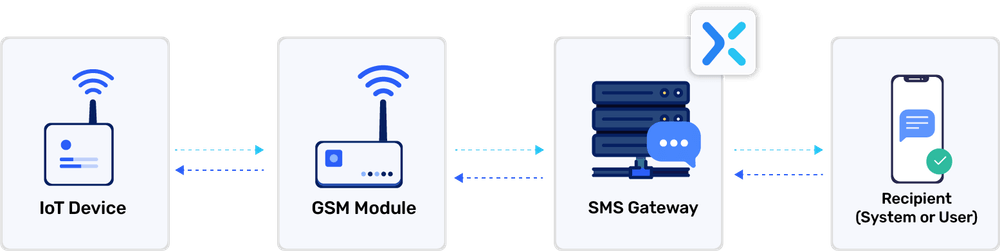
IoT devices equipped with GSM modules send SMS via cellular networks. These texts are routed through SMS gateways, which act as intermediaries to deliver them to the backend system or end users.
APIs play a crucial role by enabling applications and dashboards to programatically send, process, and receive SMS, making the entire workflow scalable and automated.
2. SMS as an alert layer
SMS acts as a crucial alerting mechanism within IoT architecture.
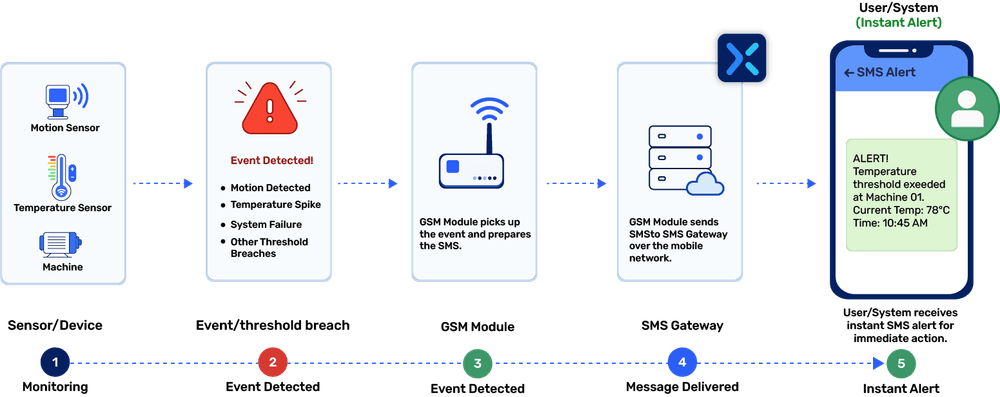
When an IoT machine, such as a sensor, detects an event, such as motion detection, temperature spikes, or system failure, it triggers an SMS notification to the relevant system or user.
These alerts are typically threshold-based, ensuring that only urgent or meaningful events prompt communication, making SMS highly effective for time-sensitive situations that require immediate awareness.
3. Two-way communication via SMS
SMS in IoT is not limited to one-way alerts. It supports full two-way interaction between systems and devices.
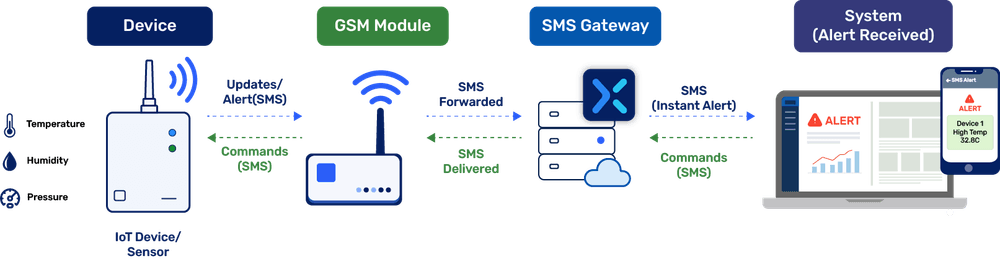
Devices can send real-time updates, such as fault alerts, status changes, or sensor readings. At the same time, systems or users can send commands back to devices via SMS, such as changing configurations, resetting systems, or turning equipment ON/OFF. This bidirectional capability makes SMS an excellent tool for remote device control, especially in environments with limited internet access.
4. SMS as a fallback layer
As legacy technologies like 2G/3G are phased out and networks evolve, SMS remains relevant and efficient.
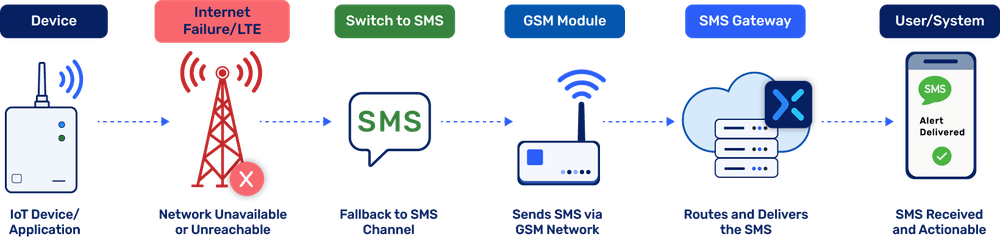
It’s supported by modern cellular frameworks, such as LTE via IMS and SGd interfaces, ensuring service continuity. In IoT deployments, SMS often acts as a fallback channel when primary communication methods fail, ensuring that critical device communication is never interrupted.
5. SMS as a control layer
Beyond alerts, SMS also serves as a control layer in IoT systems, enabling devices to wake up or trigger specific actions.
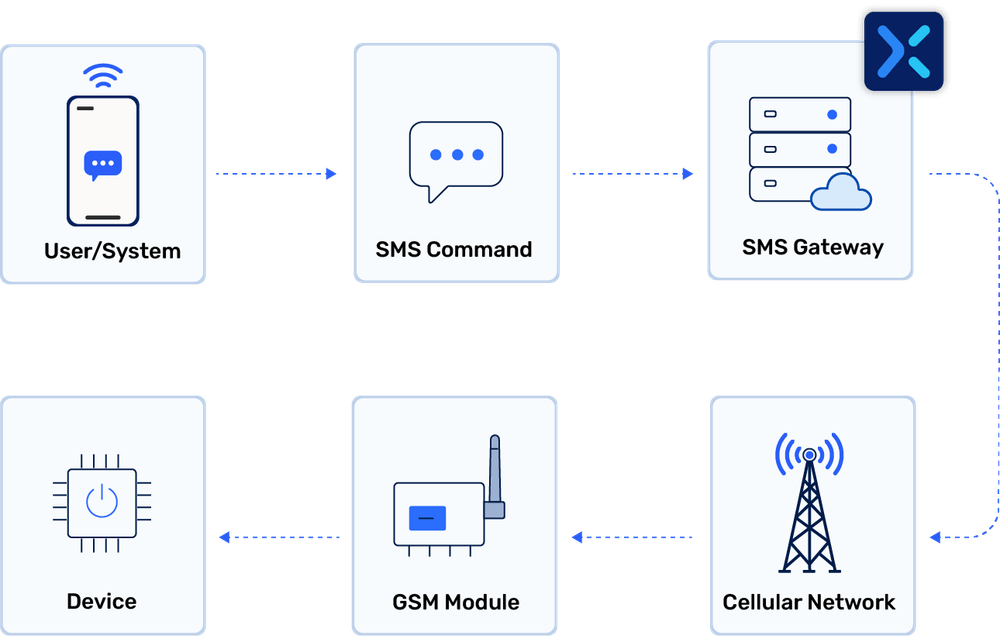
For instance, a simple SMS command can activate a device, initiate a process, or request it to send updated data. This is especially useful for low-power devices that remain idle to conserve energy and respond only when prompted.
How IoT Devices Send and Receive SMS: Technical Architecture
IoT devices rely on software and hardware layers to enable reliable SMS communication over cellular networks. This architecture ensures seamless sending and receiving of alerts and commands without requiring internet connectivity.
Hardware Layer
- GSM/LTE Module: Connects the device to cellular networks and handles SMS transmission and reception.
- Antenna: Ensures stable signal transmission and reception for reliable communication.
- SIM Card: Authenticates the device and provides a unique number for sending/receiving SMS.
Software Layer
- APIs/AT Commands: Enable the devices to send, manage, and receive SMS via the communication module.
- Firmware: Controls device behavior, including when and how SMS messages are triggered.
- SMS Logic Engine: Defines rules for alerts and notifications and processes incoming commands for preconfigured automated actions.
How Businesses Can Use TXTImpact SMS Gateway in IoT Systems for M2M Communication, System Alerts, and Notifications.
TXTImpact acts as a reliable SMS gateway for communication and as a notification layer that bridges IoT systems with end users and devices. Here are the different ways you can use TXTImpact’s solutions across various IoT systems.
1. SMS API integration in IoT Systems
Businesses can use the TXTImpact SMS API to integrate SMS capabilities into their IoT systems for two-way M2M communication and to trigger real-time notifications directly from IoT sensors, backend systems, or applications. Whether it’s a system anomaly, threshold breach, or device failure, automated workflows can instantly send SMS notifications to relevant users. This significantly reduces dependency on manual monitoring and enables faster response times.
2. Bulk SMS for large IoT deployments
In large-scale IoT environments and deployments, such as smart cities, enterprise systems, or utilities, TXTImpact enables bulk SMS delivery to notify multiple users simultaneously.
This is ideal for mass notifications/alerts, such as system-wide failures, power outages, or public safety notifications, ensuring timely communication at scale.
3. Email-to-SMS for IoT systems
For less complex or legacy systems that rely on email notifications, TXTImpact provides a seamless email-to-SMS bridge and can even route through TXTImpact’s SMTP server if you don’t have your own.
IoT systems that generate alerts or notifications via email can be automatically converted into SMS and delivered to users, ensuring crucial messages are not missed and preventing low email engagement or inbox delays.
💡 Also Read: 40 Legacy systems that use Email to SMS for real-time alerts and notifications. |
4. Real-time monitoring integration
TXTImpact easily integrates with IoT platforms, monitoring systems, and dashboards. Once an event is detected, the system triggers TXTImpact to send an SMS, ensuring a smooth flow:
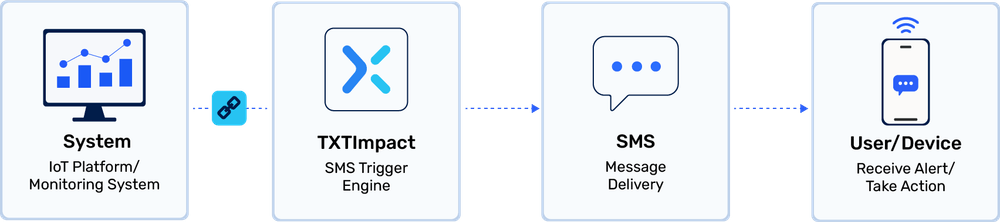
This real-time pipeline ensures that critical insights from IoT systems translate into immediate, actionable communications.
💡Also Read: How to send SMS/MMS notifications from HMI Systems for Industrial Monitoring? |
TXTImpact as an IoT Messaging Layer
TXTImpact is designed to meet the demanding requirements of IoT M2M communication by serving as a reliable messaging backbone.
- Reliable SMS delivery: Ensures high deliverability, throughput, and instant message routing for mission-critical alerts.
- Flexible integrations: TXTImpact easily connects with CRMs, IoT platforms, monitoring systems, and legacy systems via email or developer-friendly APIs.
- Scalable API infrastructure: Supports high-volume messaging for growing IoT deployments without performance issues.
- Enterprise-ready communication layer: Built for compliance, security, and global reach, making it suitable for industries like logistics, utilities, healthcare, and manufacturing.
Common Use Cases of SMS in IoT and M2M Communications
SMS provides essential features and capabilities across industries, providing valuable use cases for mission-critical and remote IoT deployments.
1. Industrial monitoring
In industrial environments, sensors and machines continuously monitor parameters, such as temperature, pressure, and vibration. When abnormal rise and fall of these parameters are detected, or early signs of failures are identified, the system immediately sends SMS alerts to the technicians or supervisors.
This helps significantly reduce downtime, enable faster response times, and support predictive maintenance strategies, preventing expensive breakdowns before they occur.
2. Healthcare and remote patient monitoring
Wearable sensors and medical devices can use SMS to send critical health alerts, such as missed medication schedules or abnormal heart rates.
SMS ensures healthcare providers or caregivers are instantly notified during emergencies, even if internet-based systems fail, making SMS a reliable communication channel for patient safety.
3. Fleet tracking and logistics
In logistics and transportation, IoT devices are installed in vehicles to track movement, location, and performance. In such cases, SMS is used to send instant alerts for delays, route deviations, maintenance needs, or unauthorized usage.
It ensures fleet managers stay informed even in areas with poor data connectivity, improving operational control and safety.
4. Security and surveillance systems
IoT-enabled security systems rely on SMS for instant alerts about fires, intrusions, or system tampering.
When a sensor detects unusual activity, an SMS is sent to security personnel or the property owner, ensuring a rapid response, even if internet access is compromised or unavailable.
5. Smart energy and utilities
Utility providers use SMS-enabled IoT systems for real-time monitoring of water, electricity, or gas usage.
Smart meters can send outage alerts, usage updates, or tampering notifications directly via SMS. This significantly enhances customer communication, improves operational efficiency, and ensures quick actions during service disruptions.
SMS in IoT After 2G/3G Shutdown
As 2G and 3G networks are being phased out, SMS remains highly relevant for IoT communication. Modern cellular technologies, such as LTE-M, LTE, and NB-IoT, still support SMS via IMS and other frameworks, ensuring continuity without relying on legacy networks.
For IoT deployments, SMS is increasingly used as a reliable fallback channel, especially when primary data connections fail, ensuring critical alerts and messages are always delivered on time.
With updated network support and hardware, SMS continues to provide low-power, dependable, and widely accessible communication, proving its value in IoT lies in reliability rather than bandwidth. Source: GSMA
Conclusion
SMS provides value in IoT and M2M communication by offering what modern systems need most: reach, reliability, and real-time responsiveness. While data-driven protocols dominate high-bandwidth communications, SMS stands out as an excellent channel for critical alerts or notifications, fallback communication, and remote control.
From healthcare to monitoring and smart utilities, SMS works even without internet connectivity, making it well-suited for real-world deployments.
TXTImpact offers a highly reliable, scalable, secure, and SMS messaging service, offering high control, visibility, and deliverability in a single messaging platform. If you’re looking for an SMS service for legacy IoT deployments, contact us to get started or start a free trial to try the platform yourself.
FAQs
♦ Is SMS still used in IoT after the 2G shutdown?
Yes, SMS is widely used in IoT even after 2G shutdowns. Modern networks, such as LTE-M, LTE, and NB-IoT, support SMS via technologies like IMS, ensuring continued functionality. SMS also serves as a reliable fallback channel when primary data networks fail.
♦ What is SMS over LTE in IoT?
SMS over LTE refers to sending and receiving SMS via LTE networks rather than traditional 2G/3G circuits. It works via IP-based frameworks, such as IMS, allowing IoT devices to continue using SMS even on newer cellular networks.
♦ How does SMS help IoT systems?
SMS enables IoT devices to send real-time alerts, receive commands, and maintain communication without an internet connection. It also ensures that critical updates are instantly delivered, improving responsiveness, reliability, and operational efficiency.
♦ Can businesses track SMS delivery in IoT systems?
Yes, several reliable SMS platforms offer detailed delivery reports and tracking features, allowing businesses to monitor whether messages are sent, delivered, or failed. This also helps ensure critical alerts reach the intended recipients.
♦ Is SMS cost-effective for global IoT deployments?
Yes, SMS is cost-effective for sending critical, low-volume alerts across regions. It eliminates the need for complex infrastructure and works globally, making it an ideal solution for IoT communication.
About the Author:
 | Sandeep Gulyani (Co-founder Wire2air TXTImpact) Sandeep Gulyani is the Founder of Wire2air TXTImpact, a leading Mass texting and business text service for sending SMS alerts, reminders, notifications, and marketing campaigns to customers and employees worldwide. With over 25 years of experience in technology and innovation, Sandeep has built TXTImpact as a platform that simplifies communication. |