Complete SMS Compliance Checklist for Business Texting 2026
Disclaimer: This guide is for informational purposes only and does not constitute legal advice. Consult qualified legal counsel regarding your specific SMS compliance obligations. |
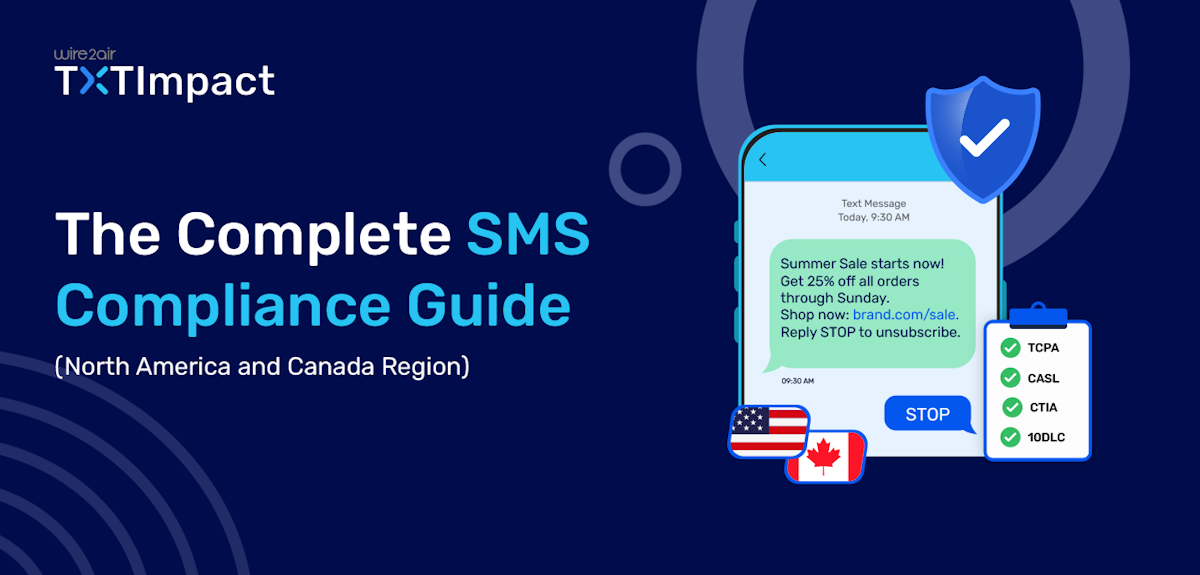
SMS remains one of the most effective communication channels for businesses. However, running SMS campaigns requires compliance with federal, carrier, state, and industry regulations.
Non-compliance can result in penalties up to $1,500 per message, legal action, blocked campaigns, and damaged brand reputation.
This comprehensive guide covers everything you need to build a compliant, high-deliverability SMS program in the USA and Canada Region.
Key Takeaways:
|
Jump to: |
What is SMS Compliance and Why Does it Matter?
SMS compliance refers to the legal, regulatory, carrier, and industry requirements that businesses must abide by and follow when sending and receiving text messages to customers.
These regulations are designed to protect customers from spam fraud, unwanted communications, and privacy violations.
SMS compliance is governed by regulations such as the Telephone Consumer Protection Act (TCPA) in the United States and Canada's Anti-Spam Legislation (CASL), as well as industry standards like CTIA guidelines and carrier requirements such as 10DLC registration.
Here’s why compliance matters in today’s age:
- Avoids lawsuits and legal penalties that can cost businesses thousands and millions of dollars.
- Prevents carrier filtering and blocking, as mobile carriers actively block messages that violate compliance requirements.
- Protects brand reputation, as non-compliance can lead to customer complaints, negative reviews, and long-term damage to credibility.
- Improves customer trust and credibility, as when messages reach customers, it demonstrates respect for customer preferences.
- Supports long-term SMS campaigns, helping businesses maintain consistent communication channels and avoiding regulatory disruptions.

Who Governs SMS Compliance?
Several distinct organisations shape what is and is not permitted when sending commercial SMS in the United States.
Regulator / Authority | Role |
Administers the TCPA; primary federal authority for SMS rules | |
FTC (Federal Trade Commission) | Maintains the Do Not Call (DNC) Registry; enforces telemarketing rules |
CTIA (Cellular Telecommunications Industry Association) | Develops carrier industry standards for A2P messaging (practically mandatory) |
Wireless Carriers | AT&T, T-Mobile, Verizon filter traffic; can block non-compliant messages. |
The Campaign Registry (TCR) | Central system for 10DLC registration; mandatory since Feb 2025. |
State Legislatures | Many states have "mini-TCPA" laws stricter than federal rules |
SMS Compliance Framework in North America
A combination of federal laws, carrier requirements, industry standards, and state-specific regulations governs SMS compliance in the United States. Understanding each component of the U.S. compliance is important for building and maintaining a compliant SMS campaign.
TCPA (Telephone Consumer Protection Act)
The Telephone Consumer Protection Act (TCPA) of 1991 is a primary U.S. federal law regulating SMS marketing and automated communications.
Governed and overseen by the Federal Communications Commission (FCC), the TCPA requires businesses to obtain the appropriate consent before sending text messages. In addition to SMS and MMS, the TCPA also applies to voice calls, fax transmissions, and robotic or other pre-recorded voice messages.
The act applies to:
SMS and MMS marketing messages
Automated or templated text messages sent to mobile numbers
Robocalls and pre-recorded voice messages
Fax transmissions
AI-generated voice or text communications (per the FCC's February 2024 ruling)
While the TCPA was enacted in 1991, it has been updated several times since. The key recent major updates include:
- Prior Express Written Consent (PEWC): Required for all marketing messages
- Consent Revocation (April 2025): Businesses must honor opt-out requests by reasonable means (text keywords, email, voicemail)
- 10-Day Processing Rule (April 2025): Process opt-outs within 10 business days (real-time processing is best practice)
- One-to-One Consent (January 2026): Each sender must obtain its own consent—no sharing or selling consent across brands
TCPA Penalties:
The TCPA allows both FCC enforcement and private rights of action, including class-action litigation. Statutory damages are assessed per individual message:
Violation Type | Statutory Damages per Message |
Standard TCPA violation (negligent) | $500 |
Willful or knowing violation | $1,500 |
DNC Registry violation (FTC) | Up to $43,792 per call or text |
No aggregate cap — a 100,000-message campaign without consent could exceed $150 million in liability.
Recent Example: Designer Shoe Warehouse (DSW) settled for $4.42 million (March 2025) for sending unwanted promotional SMS.
CTIA Messaging Principles
- Clear, documented opt-in processes
- Sender identification
- HELP and STOP instructions
- Transparent frequency disclosure
Following CTIA standards is essential for maintaining deliverability.
10DLC Registration (Mandatory)
10DLC (10-Digit Long Code) is the carrier-approved standard for business SMS. Since February 2025, carriers block unregistered 10DLC traffic.
Two-Step Process:
Brand Registration (~1-3 business days)
Legal business name, EIN, business type, website, contact info
Campaign Registration (~2-7 business days)
Campaign purpose, sample messages, opt-in documentation, opt-out procedures
Separate registrations needed for different use cases (marketing, support, 2FA, etc.)
Restricted Industries:
Cannabis, payday lending, debt relief, MLM, certain firearms promotions
💡 Also Read: A2P 10DLC Campaign Registration Guide: Step by Step Registration Process |
Consent: The Foundation of SMS Compliance
Consent is the foundation of SMS compliance in the United States. Whether a business is sending promotional offers or transactional updates, obtaining the appropriate level of consent is essential to meeting TCPA requirements and reducing compliance risk.
Types of Consent
The TCPA distinguishes between two levels of consent based on message type:
Consent Type | Required For | Requirements |
|---|---|---|
Prior Express Written Consent (PEWC) | Marketing / Promotional SMS | Documented affirmative opt-in, clear disclosure, separate SMS action |
Prior Express Consent | Transactional SMS | Generally obtained when customer provides phone number (e.g., during checkout) |
Required Disclosure Elements
Display this information at the point of opt-in:
- Business/program name
- Message types and estimated frequency (e.g., "up to 6 messages/month")
- Notice that message and data rates apply
- Opt-out instructions (Reply STOP)
- HELP instructions (Reply HELP)
- Statement: "Consent is not a condition of purchase"
- Links to terms and privacy policy
Example Disclosure: "By signing up for ABC Retail SMS Alerts, you agree to receive recurring promotional offers. Up to 6 messages per month. Msg & data rates may apply. Reply STOP to unsubscribe or HELP for assistance. Terms: [URL] | Privacy: [URL]" |
Valid Opt-In Methods
✓ Valid:
- Web forms with unchecked SMS consent checkbox
- Keyword opt-ins (text JOIN)
- Paper forms with signature
- In-store/point-of-sale opt-ins
- Double opt-in (confirmation reply required)
✗ Invalid:
- Pre-checked consent boxes
- Consent bundled into general T&Cs
- Collecting phone number alone
- Third-party/purchased consent
- Verbal consent
Best Practices
- Maintain consent records: Date, time, method, opt-in source
- Use double opt-in: Especially for cart abandonment and high-risk campaigns
- Monitor reassigned numbers: Phone numbers reassigned to new users create compliance risk
- Keep records for: Duration of customer relationship + applicable retention periods
💡 Also Read: 13 Proven Methods to build a Compliant SMS Subscriber list |
Opt-Out Management
Proper opt-out management is a critical component of SMS compliance. Failing to honor unsubscribe requests can lead to customer complaints, carrier penalties, and potential legal action. Businesses must recognize and process:
Standard Keywords (any capitalization/punctuation):
- STOP, END, CANCEL, UNSUBSCRIBE, QUIT
Expanded Opt-Out Requests (post-April 2025):
Recent TCPA updates require businesses to recognize opt-out requests communicated through reasonable alternative methods, not just standard keywords.
- "Please stop texting me"
- "Remove me from this list"
- "Don't contact me anymore"
- Misspellings or abbreviations
- Requests via email, voicemail, or other channels
Opt-Out Processing & Record-Keeping
- Process within 10 business days (real-time is best practice)
- Send one confirmation message (no promotional content)
- Maintain opt-out records with timestamp, phone number, method, and confirmation
- Apply opt-outs centrally across all campaigns and numbers.
State-specific Regulations
In addition to federal regulations, several states have introduced their own telemarketing and SMS-related regulations that impose additional compliance obligations. These laws often apply based on the recipient’s location rather than the business location.
States such as Texas, Florida, and Oklahoma have implemented regulations that require businesses to monitor closely. Some of the major state-level SMS regulations examples include:
State | Law/Regulation | Effective date | Key SMS Requirements |
|---|---|---|---|
Texas | Texas Business and Commerce Code (SB 140) | September 2025 | Expands telemarketing rules to SMS/MMS marketing messages; introduces registration and additional compliance requirements for certain senders. |
Florida | Florida Telephone Solicitation Act (FTSA) | July, 2021 (Amended 2024) | Requires prior express written consent for several automated marketing texts and provides a private right of action. |
Maryland | Maryland Telephone Consumer Protection Act | October, 2023 | Restricts certain telemarketing practices and complements federal TCPA requirements. |
Oklahoma | Oklahoma Telephone Solicitation Act (OTSA) | November, 2022 | "Mini-TCPA" law regulating automated marketing texts and requiring proper written consent. |
New Jersey | New Jersey Telemarketing and Consumer Fraud Laws | 2024 | Businesses must comply with telemarketing registration and consumer protection requirements where applicable. |
California | California Consumer Privacy Act (CCPA) / CPRA | January, 2020 (CCPA) January, 2023 (CPRA)
| Governs the collection, storage, and use of consumer phone numbers and SMS marketing data. |
Washington | Washington Commercial Electronic Mail Act & Telemarketing Laws | 2024 | Prohibits deceptive commercial messaging practices and requires compliance with consumer protection laws. |
Virginia | Virginia Consumer Data Protection Act (VCDPA) | January, 2023 | Governs how businesses collect, process, and protect consumer data used in SMS programs. |
Connecticut | Connecticut Data Privacy Act (CTDPA) | July, 2023 | Establishes privacy and data management obligations for businesses using consumer phone numbers and marketing data. |
Colorado | Colorado Privacy Act (CPA) | July, 2023 | Requires transparency and consumer rights regarding the use of personal data for marketing communications. |
The National Do Not Call Registry
The National Do Not Call (DNC) Registry, maintained by the FTC and FCC, allows consumers to opt out of receiving unsolicited marketing calls and text messages. Businesses are responsible for ensuring their marketing lists do not include numbers registered on the DNC list.
Key compliance requirements include:
- Scrubbing contact lists against the DNC Registry regularly, typically every 31 days for active campaigns
- Avoiding contact with DNC-registered numbers unless the consumer has provided direct consent to your business after joining the registry
- Maintaining processes to identify and suppress DNC-listed numbers from marketing campaigns
- Using internal or third-party compliance tools to manage DNC screening and recordkeeping
Failure to comply with DNC requirements can result in significant penalties, with violations carrying fines of up to $43,792 per call or text. Regular DNC list management is therefore a critical part of any SMS compliance program.
Disclosure Language and CTA Requirements
Whenever consumers are asked to opt in to receive marketing text messages, businesses must clearly disclose the terms of the SMS program at the point of consent. Proper disclosure helps ensure transparency, supports compliance, and sets clear expectations for subscribers.
A compliant disclosure should include:
- The business or program name
- The types of messages subscribers will receive
- Estimated message frequency
- A notice that message and data rates may apply
- Instructions to opt out (e.g., Reply STOP)
- Instructions to get assistance (e.g., Reply HELP)
- A statement that consent is not a condition of purchase
- Links to the business's terms and conditions and privacy policy
Example Disclosure Statement: "By signing up for ABC Retail SMS Alerts, you agree to receive recurring promotional offers, product updates, and special announcements. Up to 6 messages per month. Msg & data rates may apply. Reply STOP to unsubscribe or HELP for assistance. Consent is not a condition of purchase. Terms: [URL] | Privacy Policy: [URL]." |
Disclosure Placement Requirements
Disclosure language should be displayed prominently and immediately adjacent to the opt-in mechanism, such as a sign-up button or consent checkbox. It should be easy to read and not hidden within fine print or separate pages.
Canada SMS Compliance Framework
Businesses sending SMS messages to recipients in Canada must comply with a combination of telecommunications regulations, federal anti-spam legislation, and privacy laws. Canada's SMS compliance framework is among the strictest in the world, placing a strong emphasis on consent, transparency, and consumer protection.
CASL (Canada's Anti-Spam Legislation)
CASL is Canada's primary law for commercial electronic messages, including SMS marketing.
Two Types of Consent:
- Express Consent: Explicit agreement to receive SMS
- Implied Consent: Inferred from existing business relationship (limited period)
Every Commercial SMS Must:
- Include valid contact information
- Clearly identify the sender
- Honor unsubscribe requests promptly
- Provide functional unsubscribe mechanism
CRTC Enforcement & Privacy Laws
The Canadian Radio-Television and Telecommunications Commission (CRTC) enforces CASL and focuses on:
- Proper consent collection
- Consumer protection from spam
- Functional unsubscribe mechanisms
- Record-keeping and documentation
Additional privacy laws govern collection, storage, and use of personal information, including mobile numbers.
Sender Identification Requirements
Every commercial SMS must clearly identify who is sending the message.
Best Methods:
- Brand name prefix (most common): "[BrandName]: Your order shipped..."
- Branded Sender ID: Alphanumeric ID displaying business name instead of phone number
- Business contact details: Website, email, phone when appropriate
Best Practices:
- Include identification in EVERY message, not just opt-in confirmations
- Use consistent branding across all campaigns
- Keep contact information current and accessible
SMS Content Compliance Best Practices
Creating compliant SMS content is equally important as obtaining proper consent. Here are the best SMS compliance practices businesses must follow.
Required in Every Marketing Message:
- Clear sender/brand identification
- Clear purpose or offer
- Accurate promotional details
- Opt-out instructions ("Reply STOP to unsubscribe")
- Content matching the opt-in promise
Prohibited content categories in SMS
Category | Status | Notes |
|---|---|---|
Sex/Adult Content | Prohibited | Explicit sexual content is not allowed. |
Hate Speech/Violence | Prohibited | Content promoting violence, hatred, or discrimination is prohibited. |
Firearms/Weapons | Restricted | Allowed only in limited cases and may require age verification where permitted. |
Alcohol | Restricted | Subject to carrier review and approval requirements. |
Tobacco/Vaping/CBD | Restricted | Age verification is generally required. |
Cannabis | Prohibited | Restricted due to federal regulatory limitations. |
Gambling | Restricted | Permitted only for licensed operators and typically requires carrier approval. |
Payday Loans/Debt Relief | Prohibited | Not permitted on 10DLC messaging programs. |
Phishing/Fraud/Malware | Prohibited | Strictly blocked across all messaging channels. |
MLM Programs | Restricted | Frequently restricted or prohibited by carriers. |
URL/Link Best Practices:
- Use branded short domains (avoid Bitly, TinyURL)
- Use dedicated link-tracking domains
- Ensure linked websites comply with carrier policies
- Remember: Carriers assess both message AND destination
Age-gated Messaging Requirements
- Verify the recipient's age where required, as certain products can only be promoted to adults.
- Maintain proof of age verification by documenting how age eligibility was confirmed.
- Include responsible marketing practices by ensuring age-restricted content is not sent to underage recipients.
- Comply with local regulations, as age restrictions may vary by state, country, or province.
Quiet Hours (by Recipient Time Zone)
Federal Standard: 8:00 AM – 9:00 PM (recipient's local time)
Stricter State Rules (examples):
Florida, Oklahoma, Maryland, New Jersey, Washington: 8:00 AM – 8:00 PM
Connecticut: 9:00 AM – 8:00 PM
⚠️ Apply the most restrictive rule for each recipient's location
Message Frequency Limits
Some states restrict how often you can message the same recipient:
- Florida, Oklahoma, Maryland: Max 3 messages per 24-hour period (same topic/campaign)
- Cart abandonment: One SMS per abandonment event, within 24 hours
Messaging Types and Compliance Examples
Different categories of SMS messages carry different compliance obligations. Understanding these distinctions is critical to applying the correct consent standard and avoiding inadvertent violations.
Marketing/Promotional SMS
Requires: Prior Express Written Consent (PEWC)
Includes:
- Promotional offers and discount codes
- Product announcements
- Abandoned cart reminders (requires double opt-in)
- Re-engagement campaigns
- Any message with a commercial call-to-action
Compliant Example: "TXTImpact: Get 20% off your next purchase this weekend! Shop now at TXTImpact.com. Reply STOP to opt-out."
Common Violations:
- Sending without written consent
- Texting after user opted out
- Contacting DNC-listed numbers
- Missing sender ID or opt-out instructions
- Sending outside quiet hours
Transactional SMS
Requires: Prior Express Consent (not the higher PEWC standard)
Includes:
- Order confirmations
- Shipping notifications
- Appointment reminders
- Account alerts (low balance, fraud alerts)
- Two-factor authentication codes
Critical Rule: Adding even one promotional element (discount, upsell) reclassifies the entire message as marketing and requires PEWC.
AI-Generated and AI-Assisted Messages
FCC Ruling (February 2024): AI-generated voices and AI-assisted text constitute "artificial voices" under the TCPA.
Requirements:
- Apply same consent standards as human-composed messages
- Disclose to consumers that messages may be AI-generated or personalized
- Subject AI content to prohibited content filters and quiet hours
- Include within existing consent and registration framework
Quiet Hours and Messaging Frequency
Businesses must comply with SMS sending time restrictions, commonly known as quiet hours. These restrictions are based on the recipient's local time zone, not the sender's, and help protect consumers from unwanted communications during early-morning and late-evening hours.
Federal Quiet Hours (TCPA)
Under the TCPA, commercial text messages may only be sent between 8:00 AM and 9:00 PM in the recipient's local time zone.
Key requirements include:
- Apply sending schedules based on the recipient's local time
- Monitor campaigns across multiple time zones
- Avoid sending messages outside permitted hours
- Maintain automated controls to prevent accidental violations
Sending messages outside permitted hours may result in TCPA violations and potential penalties.
State-Level Quiet Hour Requirements
Several states impose stricter restrictions than the federal standard. Businesses must comply with the most restrictive rule applicable to each recipient.
Examples include:
- Florida: No marketing texts before 8:00 AM or after 8:00 PM
- Oklahoma: No marketing texts before 8:00 AM or after 8:00 PM
- Maryland: No marketing texts before 8:00 AM or after 8:00 PM
- New Jersey: No marketing texts before 8:00 AM or after 8:00 PM
- Washington: No marketing texts before 8:00 AM or after 8:00 PM
- Connecticut: No marketing texts before 9:00 AM or after 8:00 PM
Regularly reviewing state-specific requirements is essential, as regulations may change over time.
Message Frequency Limits
In addition to quiet hours, certain states restrict how frequently businesses can send marketing messages to the same recipient.
Examples include:
- Florida: Maximum of 3 messages within a 24-hour period for the same campaign or subject matter
- Oklahoma: Maximum of 3 messages within a rolling 24-hour period
- Maryland: Maximum of 3 messages within a rolling 24-hour period
- Cart abandonment campaigns: Limited to one SMS per abandonment event and must be sent within 24 hours
Following frequency limits helps reduce consumer complaints, maintain carrier trust, and minimize compliance risk.
Sender Identification Requirements
Every commercial SMS should clearly identify the business sending the message. Proper sender identification helps build trust, reduces spam complaints, and aligns with carrier and industry compliance standards.
Common methods of sender identification include:
- Brand name prefix: Begin messages with the company or program name (e.g., "[BrandName]: Your order has shipped."). This is the most widely used approach.
- Branded Sender ID: Where supported, use an alphanumeric sender ID that displays the business name instead of a phone number.
- Business contact details: Include a website, email address, phone number, or other contact information when appropriate.
Best Practices:
- Include sender identification in every message, not just the initial opt-in confirmation.
- Use consistent branding across all SMS campaigns and programs.
- Ensure recipients can easily recognize who is contacting them.
- Keep business contact information current and accessible.
Clear sender identification improves customer trust, supports compliance efforts, and helps maintain strong message deliverability by reducing spam reports and consumer confusion.
TCPA & CTIA Compliance Checklists
Following a structured compliance checklist helps businesses reduce legal risk, improve deliverability, and maintain alignment with TCPA, CTIA, carrier, and state-level requirements.
Before Launch ✓
- Obtained valid prior express written consent for all marketing recipients
- Maintained timestamped, auditable consent records
- Completed 10DLC brand and campaign registration
- Clear sender identification in every message
- Opt-out instructions in all marketing messages
- Messages scheduled within federal + state quiet hours
- Contact lists scrubbed against DNC Registry
- Previously opted-out contacts removed
- Messages and landing pages reviewed for prohibited content
- Consent collected directly by your organization (not purchased/third-party)
Ongoing Operations ✓
- Process opt-out requests within 10 business days
- Recognize standard AND non-standard opt-out requests
- Maintain detailed opt-out records with timestamps
- Apply state-specific quiet hours and frequency limits
- Regularly audit consent and subscriber records
- Review for reassigned numbers
- Update 10DLC registrations when practices change
- Train team on current TCPA/CTIA/state requirements
Consent Compliance Checklist
Consent remains the foundation of SMS compliance and should be reviewed regularly.
Key requirements include:
- Use unchecked opt-in checkboxes by default
- Keep SMS consent separate from other marketing consents
- Display disclosure language clearly near the opt-in mechanism
- Identify the sender, message types, frequency, data rates, and opt-out instructions
- Include links to terms of service and privacy policies
- State that consent is not a condition of purchase
- Use double opt-in for cart abandonment and other higher-risk programs
- Regularly remind subscribers how to opt out of communications
Consistently following these practices helps businesses maintain compliance, improve customer trust, and reduce the risk of carrier filtering, regulatory penalties, and consumer complaints.
Common SMS Compliance Mistakes
Mistake | Why It Matters | Solution |
|---|---|---|
Only recognizing STOP/CANCEL | April 2025 rules require recognizing natural opt-out language | Implement flexible opt-out recognition ("stop texting me," etc.) |
Mixing promotional + transactional | Changes consent requirements | Keep message types separate |
Relying on purchased lists | January 2026 one-to-one consent rule requires direct collection | Collect consent directly from each user |
Ignoring state laws | Many states stricter than federal | Apply most restrictive rule per recipient location |
Sending outside quiet hours | Violates TCPA | Implement timezone-aware scheduling |
Missing opt-out confirmation | Reduces compliance proof | Send one non-promotional confirmation |
Centralized suppression failure | Users get re-added accidentally | Sync opt-outs across all campaigns/numbers |
Using public URL shorteners | Triggers carrier filtering | Use branded short domains only |
Adding promo to transactional messages | Reclassifies message, changes consent requirements | Keep messaging types separate |
Not maintaining consent records | Creates legal vulnerability | Document date, time, method for every opt-in |
Penalties and Litigation Risk
SMS compliance violations can result in substantial financial penalties, regulatory action, and class-action litigation. Because penalties are often assessed on a per-message basis, even small compliance failures can become costly at scale.
Non-compliance can be expensive.
Violation | Potential Penalty |
|---|---|
Standard TCPA violation | $500 per message |
Willful TCPA violation | $1,500 per message |
DNC Registry violation | Up to $43,792 per text |
Texas SB 140 violation | Up to $5,000 per violation |
Connecticut violation | Up to $20,000 per violation |
Example Exposure: A campaign of 100,000 non-compliant messages = potential liability exceeding $150 million
Beyond Fines:
- Damaged brand reputation
- Increased spam complaints
- Carrier filtering/blocking of future messages
- Class-action litigation (filings increased 95% through mid-2025)
Best Practices for Sustainable SMS Compliance
- Choose the right SMS platform: Look for opt-out automation, consent management, 10DLC support, and compliance monitoring
- Work with legal counsel: Review your consent processes and compliance procedures
- Audit regularly: Check consent records quarterly or when regulations change
- Apply the strictest rule: Always use the most restrictive federal or state requirement
- Keep messaging separate: Maintain distinct marketing and transactional programs
- Monitor updates: Follow FCC, CTIA, and carrier policy changes
- Test opt-out workflows: Periodically verify opt-out processes, including non-standard requests
- Honor opt-outs permanently: Don't re-add contacts unless new consent is obtained directly
Quick Reference: Compliance Checklist at a Glance
Requirement | Marketing SMS | Transactional SMS |
|---|---|---|
Prior Express Written Consent | ✓ Required | ✗ Not required |
Separate SMS Consent Action | ✓ Required | ✓ Recommended |
Sender ID in Every Message | ✓ Required | ✓ Required |
Opt-Out Instructions | ✓ Required | ✓ Required |
Double Opt-In | ✓ For cart abandonment | ✗ Not required |
Quiet Hours Compliance | ✓ Required | ✓ Required |
10DLC Registration | ✓ Required | ✓ Required |
DNC Registry Screening | ✓ Required | ✓ Required |
Consent Record Retention | ✓ Required | ✓ Recommended |
Disclaimer: This guide is for informational purposes and does not constitute legal advice. Compliance requirements vary by industry and jurisdiction. Consult qualified legal counsel regarding your specific obligations. | ||
Conclusion
SMS remains one of the easiest and most effective communication channels for customer communications and marketing. However, successful SMS campaigns require ensuring compliance at every stage of the messaging process, right from collecting data and building a subscriber list to drafting messages and sending texts to the right people.
Fortunately, SMS compliance doesn’t have to be overwhelming. With the right business SMS provider, you don’t have to worry about compliance. TXTImpact, a leading and reliable SMS provider, helps your business comply with regulations such as 10DLC, GDPR, TCPA, and HIPAA across all industries and business types.
It significantly streamlines the crucial 10DLC registration process with its all-new 10DLC AI Campaign Wizard, making it a breeze in just a few steps, without any complicated forms.
Ensuring compliant messaging not only helps meet legal requirements and protect your brand reputation but also enhances customer satisfaction and experience. Contact us to get started with TXTImpact or start a free trial to learn more.
FAQs
♦ What role does an SMS provider play in compliance?
SMS providers like TXTImpact support compliance through opt-out automation, consent management, audit trails, and 10DLC registration. However, the business sending messages remains ultimately responsible for compliance.
♦ How long should we keep consent records?
Retain records for the duration of the customer relationship plus applicable retention periods. Many businesses keep records for 3-5 years to support audits and legal disputes.
♦ What's the #1 SMS compliance mistake?
Assuming a customer's phone number automatically grants permission to send marketing texts. Always obtain proper documented consent before sending promotional SMS.
♦ How often should we review compliance practices?
At least annually and whenever major regulatory, carrier, or operational changes occur. Recent updates (April 2025, January 2026) require immediate review.
♦ Can we send SMS messages outside business hours?
Only during quiet hours permitted by the recipient's location (typically 8 AM – 9 PM, but stricter in some states). Timing is based on recipient's time zone, not sender's.
About the Author:
 | Sandeep Gulyani (Co-founder Wire2air TXTImpact) Sandeep Gulyani is the Founder of Wire2air TXTImpact, a leading Mass texting and business text service for sending SMS alerts, reminders, notifications, and marketing campaigns to customers and employees worldwide. With over 25 years of experience in technology and innovation, Sandeep has built TXTImpact as a platform that simplifies communication. It offers features like email to text/mms, Outlook to text, Landline to text, etc, and seamless integration with business tools to meet diverse messaging needs. |