The State of SMS Marketing in 2025: Recap, Trends, Stats & 2026 Predictions
2025 turned out to be a major turning point in the SMS marketing landscape across the globe. What was once a lightweight, quick option for sending text messages has now evolved into a popular platform with high open and conversion rates.
In fact, in 2025, SMS marketing saw a high open rate of 98% with a response rate of 45% compared to just 6% for email marketing.
The growing popularity of SMS marketing is due to the major shift in market growth, compliance, and richer messaging. From market performance, changing consumer behavior, and tighter compliance requirements to technology upgrades and a few service shutdowns, 2025 saw major trends and shifts in SMS marketing.
This recap blog breaks down everything that redefined SMS marketing in 2025 and how your business can prepare for 2025:
Jump to: |
SMS Marketing Market Overview: 2025 at a Glance
In 2025, 66% of businesses use SMS marketing to text their customers, and 66% are increasing their SMS marketing budgets.
The U.S. SMS Marketing Market Report – Grand View Research in the U.S. is projected to grow at a CAGR of 20.8% from 2024 to 2030.
82% of businesses agree that SMS marketing is an effective way to drive revenue.
Over 60% of marketers increased their SMS marketing budgets in 2025, realizing its higher engagement and RoI.
As per the TXTImpact’s 15-Year Industry Study Report — Original Study, overall, SMS adoption increased by over 300% between 2013 and 2024, with an acceleration seen in the past 24 months.
Key Trends in the SMS Marketing Industry
Here are some of the top trends in the SMS marketing industry:
Personalization, automation, and two-way messaging have become standard and integral customer expectations from SMS campaigns.
Omnichannel integration, rich media, and interactive content, like polls and gamified rewards, are becoming increasingly popular and common, enabling businesses to create seamless customer experiences.
Businesses are using predictive analytics and location-based targeting to optimize the relevance and timing of messages.
Customer service is the primary reason businesses are using SMS marketing in 2026.
Performance Benchmarks
Here are the SMS performance metrics that continued to outperform every other digital channel in 2025:
98% higher open rate
45% higher response rate compared to email
An average of 21-35% click-through rate (CTR)
73% of users opt out or unsubscribe if messages are too frequent
Consumer Behavior
While grabbing consumer attention isn’t easy these days, SMS is a highly reliable and convenient solution that reaches customers in their native messaging apps and has high open rates.
93% of consumers text every day, and nearly 80% check their texts within minutes, with 45% checking their messages more than 10 times a day.
In 2025, 84% of customers opted in to receive text messages from businesses.
Women are more likely to opt in to business texts than men, at 88% vs. 78%.
SMS is highly effective in retail and e-commerce, with customers demanding immediate, direct communication from businesses.
With rising opt-in rates, controlling message frequency is paramount, as 73% of customers unsubscribe after receiving too many messages.
In 2025, 71% of customers prefer the ability to text the business, approximately 18% more than last year, underscoring the importance of two-way messaging.
Core SMS Marketing Trends That Defined 2025
Here are the major trends that defined and reshaped the SMS marketing infrastructure:
The shift from one-way texts to two-way conversations
The shift from one-way broadcasts to two-way interactive communication is surging in 2025. Businesses are increasingly adopting two-way conversational messaging, making it easier for customers to ask questions, reply to messages, and receive instant responses.
Brands using two-way messaging report 85% faster response times and 60% improved customer satisfaction scores compared to other messaging channels.
Applications of two-way messaging include customer support, appointment confirmations, interactive surveys, product discovery, order management, and feedback collection.
The rising demand for conversational commerce
Conversational commerce blends messaging, including in-chat experiences, bots, and voice assistants, with shopping and browsing experiences, enabling customers to enjoy personalized, seamless journeys.
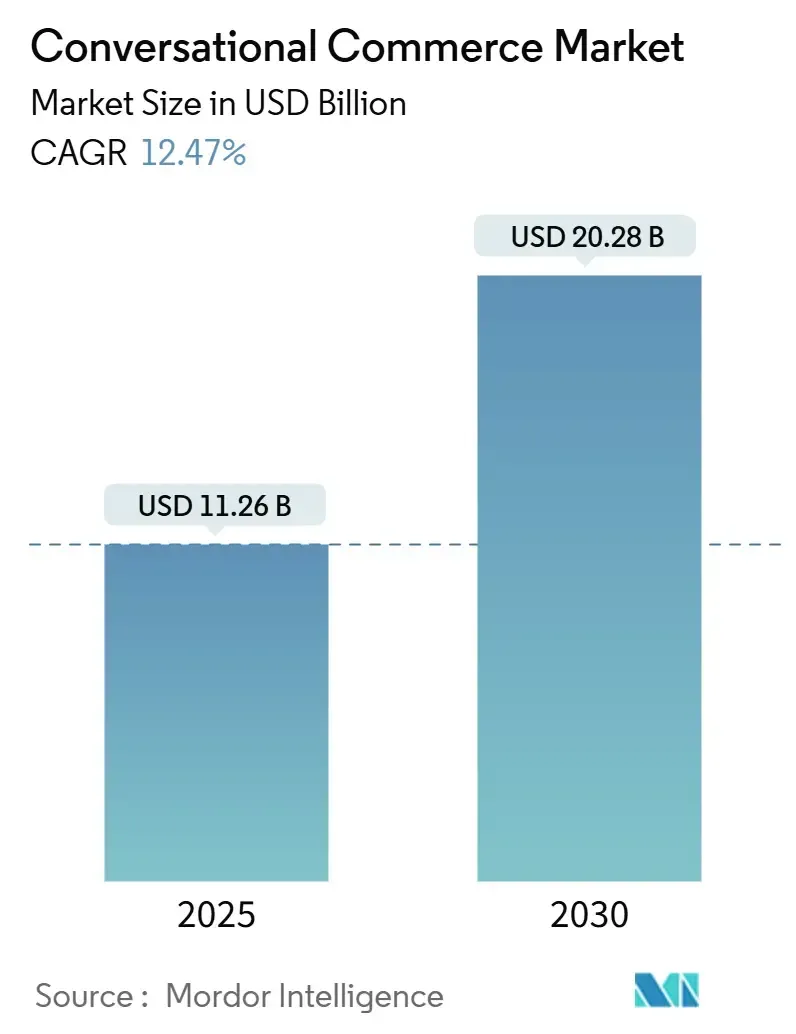
The Conversational Commerce Market Report – Mordor Intelligence estimated at $11.26 billion in 2026, is projected to grow to $20.28 billion by 2030, driven by advanced AI and generative models and rising consumer expectations.
Key conversational commerce trends from the report include:
In 2024, chatbots command 64% of the conversational commerce market share.
Intelligent virtual assistants are rapidly advancing at 15.8% CAGR by 2030.
Large enterprises account for 66% of market share in 2024, with medium enterprises accounting for 34%, but adoption is expected to grow rapidly, with a 17.2% CAGR, by 2030.
Omnichannel integration is becoming the standard
SMS could no longer exist in isolation in 2025, with omnichannel integration becoming the standard and integral to campaign success.
Leading brands and businesses are integrating SMS with other critical channels, such as email, WhatsApp, and social media, to create and offer unified customer journeys and experiences.
This helps enhance channel optimization, effectively coordinate campaigns, and use SMS as a fallback and escalation channel.
Advanced automation and AI-driven personalization
AI in SMS campaigns has seen a drastic increase this year, evolving beyond simple drip campaigns to multi-trigger, sophisticated workflows. AI in SMS marketing significantly streamlines personalization and automation, driving significant engagement.
Over 60% of businesses increased their investment in AI-driven SMS tools in 2025. The capabilities of AI in SMS marketing include dynamic message personalization, automated audience segmentation, predictive send-time optimization, and intelligent routing of message replies to chatbots or live agents.
Rich media and interactive content
Customers expect experiences beyond plain text. Messaging solutions, like MMS and RCS, are gaining traction, allowing businesses to include rich media and interactive elements, such as visually appealing images, videos, carousels, interactive CTAs, buttons, and suggested replies and actions.
This significantly boosts customer engagement and experiences, boosting conversions and business revenue.
Predictive analytics and location-based targeting
Location-aware business messaging became quickly popular and gained momentum in 2025. Brands and businesses leveraged predictive analytics and geolocation data to deliver messages at relevant times and places, such as events, local store promotions, and regional service updates.
The Rise of RCS in 2025
Rich Communication Services, or RCS, emerged as one of the most popular and talked-about business messaging solutions in 2025.
A billion RCS messages are sent every day in the U.S.
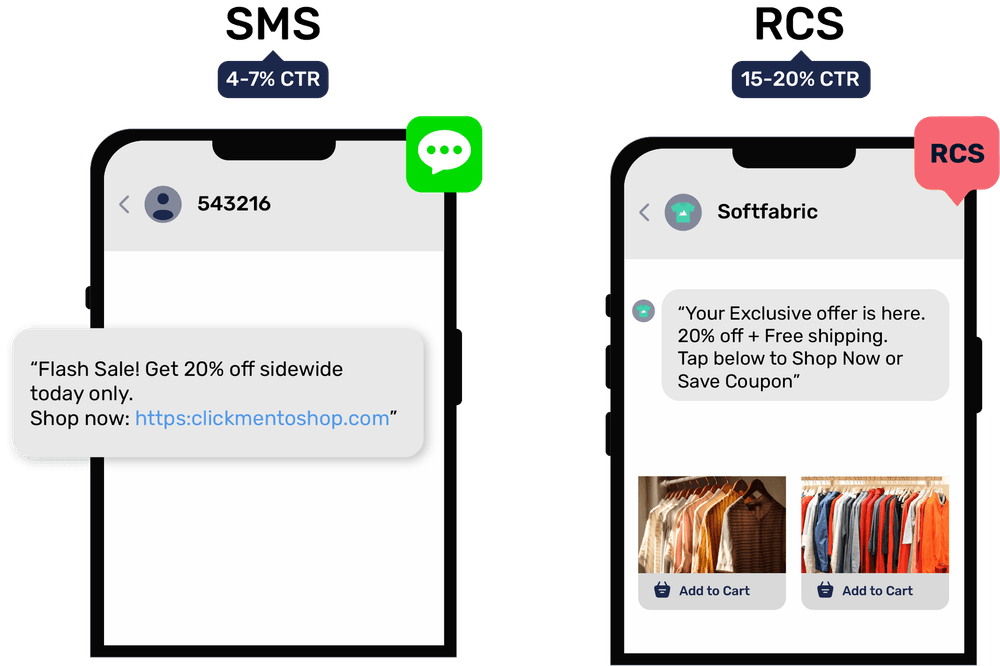
Compared with SMS, which has a 4-7% CTR, RCS has a 15-20% click-through rate.
The global rcs market size is estimated to be approximately 3 billion in 2025.
59% of customers prefer RCS over SMS for critical communication, such as verification messages.
Also known as SMS 2.0, RCS enables businesses to include richer media, such as images, videos, and carousels, as well as interactive elements, such as polls, buttons, links, and quick replies.
Beyond visuals and interactivity, RCS also boosts brand identity with a verified sender ID and strengthens overall security.
Compared to SMS, RCS offers higher engagement, improved brand trust, and provides enhanced analytics and insights, helping businesses fight spam and security threats and leverage insights to improve and optimize messaging campaigns.
💡 Also Read: https://www.txtimpact.com/blog/rcs-vs-sms-guide |
Regulatory Landscape: SMS Compliance Tightens in 2025
The increasing regulatory scrutiny requires businesses to prioritize business compliance. Here are regulatory and compliance changes in 2025:
TCPA Updates and Expanded Opt-out Rules
The Telephone Consumer Protection Act (TCPA) underwent key updates in 2026, requiring businesses to obtain explicit, documented opt-in consent and also honor opt-out requests via reasonable means, instead of just keywords, like ‘STOP.’
State-Level ‘Mini-TCPAs’
Several states introduced stricter local regulations, referred to as mini-TCPAs, which expanded exposure around auto-dialing, increased disclosure requirements, and increased fines and penalties for non-compliance.
Transparency at the opt-in process
Business transparency and consent language become highly critical in 2025. Businesses are now required to disclose their business name, message frequency, and message types. Features such as pre-checked consent checkboxes and vague disclosures are completely prohibited by law.
FCC One-to-One Consent Rule Delay
While the FCC delayed the implementation of the one-to-one consent rule by a year, the need for explicit, clear consent remains critical. Brands and businesses need to maintain documentation at the point of opt-in and ensure compliance.
Texas Senate Bill 140
Texas introduced some of the most effective and efficient state-level compliance laws in 2025, which regulate or classify SMS as telemarketing, require state registration and a $10,000 security deposit, and impose penalties of up to $5,000 per unsolicited text message.
Carrier and Platform-Level Changes and Service Shutdowns
Several mobile carriers have implemented stricter security measures, including blocking or suspending services and platforms for noncompliance with new regulations.
Carrier services that lack transparent consent collection or multi-channel opt-out support have been phased out or required to upgrade their compliance regulatory features.
One of the major and most prominent carrier service shutdowns has been of the email-to-text service.
Verizon officially announced the discontinuation of its email-to-text messaging service in late 2024.
AT&T discontinued its email-to-text and text-to-email services on June 17, 2025.
T-Mobile’s email-to-text service stopped working in December 2024, with no official announcement from the company.
The discontinuation was due to reasons such as unreliability, delivery issues, spam, and security concerns. These shutdowns significantly affected businesses that rely on carriers’ email-to-text services, disrupting IT alerts, automated notifications, and customer communication systems, forcing brands to opt for email-to-text alternatives.
Technology and Infrastructure Changes Impacting SMS
Besides compliance and consumer-facing trends, some major consequential changes also occurred at the infrastructure level for SMS marketing.
The registration and consent enforcement, carrier mandates, and platform-level shutdowns forced marketers and IT leaders to treat SMS as a regulated communication platform requiring planning, ongoing maintenance, and documentation.
10DLC Registration Enforcement
The full enforcement of 10-digit long code (10DLC) registration in the United States was implemented in 2025, with carriers beginning to actively block unregistered traffic in February 2025 to ensure high security.
According to the 10DLC framework, businesses must register their brand identity, messaging samples, opt-in flows, opt-out language, campaigns, and use cases. 10DLC registration typically requires 1-3 weeks.
Certain industries, like firearms, cannabis, and payday loans, are disqualified from the 10DLC registration, affecting their messaging options.
Enhanced Security and Privacy Measures
Security concerns and expectations sharply rose in 2025. While SMS itself isn’t end-to-end encrypted, messaging providers are now required to implement stronger security measures around data handling.
Key security enhancements include role-based access controls, encrypted data at rest, audit logs for message activities, and stricter vendor compliance requirements.
Messaging App and OS-Level Updates
Other most influential changes in the SMS marketing industry came from messaging apps and operating systems. Google and Apple made meaningful updates that reshaped customer experiences and how messages are categorized, filtered, and displayed on customers’ devices, impacting visibility, deliverability, and user trust.
Google Messages: RCS-Driven UX Enhancements
Google started to evolve Google Messages, especially around RCS. It launched Material 3 Resign alongside a suite of functional upgrades that enhance both business communication and user experience.
Here are the key Google Messages updates in 2025:
@mentions in RCS group chats help get users’ attention in group conversations.
Messaging Layer Security (MLS) protocol facilitates cross-platform (Android-iOS) RCS communication.
Redesign and background color change of read receipts.
‘Leave unknown group chats’ allows users to leave a group with options to block and report when invited by known numbers.
Spam link detection warns users when they click on links that may be harmful if visited.
Other notable enhancements include enhanced media quality control, standalone media galleries, custom group chat icons, enhanced group search features, selfie GIFs, and expressive reaction effects.
Apple iOS 26: SMS Screening and Filtering Update
Apple iOS 26 introduced ‘Screen Unknown Senders,’ one of the most impactful changes to SMS visibility and message delivery. The update significantly enhances how messages from unknown numbers are displayed and categorized on users’ mobile devices.
iOS 26 automatically sorts incoming messages into:
Known senders: Messages from known senders/contacts.
Unknown senders: Messages from unsavved numbers and numbers not present in the contacts list.
Recently deleted: Messages that have been removed or filtered.
Suspected spam: Messages flagged as spam by Apple’s on-device intelligence.
While the updates still show and surface critical notifications and time-sensitive alerts, it most likely deprioritizes marketing and promotional messages from unknown numbers. While the filter is ‘off’ by default, Apple consistently and increasingly nudges users towards enabling it, especially when they receive large volumes of marketing and unsolicited messages.
TXTImpact’s Role in the 2025 SMS and RCS Ecosystem
At TXTImpact, we offer highly reliable, secure, and intuitive messaging services, including Mass texting/Bulk SMS Marketing, Email to text, Landline textingSMS Polling, SMS Surveys, RCS Messaging and WhatsApp Business Messaging.
Serving over 30,000 businesses across North America for over 20 years, we help businesses reach existing and potential customers to drive engagement, sales, and revenue through our SMS services and new and evolving services.
We continuously strive to enhance customer experience and engagement by adding the latest services in line with technological trends and customer expectations. To understand our consumer expectations and behavior, we also studied and released a 15-year SMS tools usage report to understand SMS adoption, tools usage, and key trends in SMS adoption in 2025.
In 2025, our approach was towards compliance-first, future-oriented, and omnichannel-ready messaging services.
Launch of Rich Communications Services (RCS)
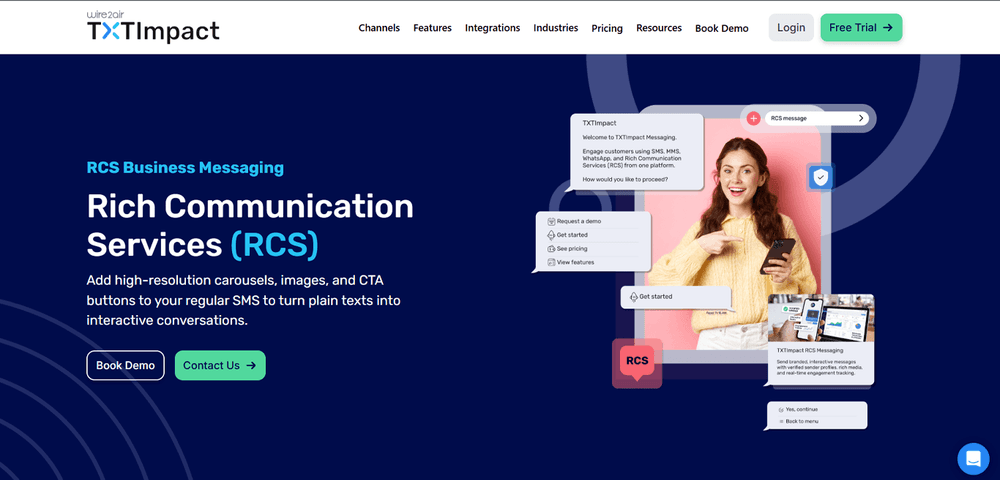
One of the most foundational services we launched at TXTImpact this year is RCS Business Messaging, which helps businesses meet growing consumer expectations with ease.
We offer branded, interactive, and rich media messaging that helps brands offer app-like experiences in their native messaging applications. Key features include interactive chat buttons, CTAs, OT delivery, and read receipts, besides rich media.
To ensure seamless onboarding and implementation, we offer 24/7 developer assistance, comprehensive technical resources, ready-to-use templates, unified multi-platform experience, and seamless integration with apps like Shopify, Zendesk, and Salesforce.
In addition to support and smooth onboarding, we offer transparent pricing for RCS, suitable for businesses of all sizes across industries.
SMS Marketing Best Practices For 2025
Here are the best practices for compliant, sustainable, and high-RoI SMS marketing for the upcoming year, 2025:
Ensure explicit, documented opt-in consent for all SMS campaigns and programs
Treat message frequency as a core user experience metric
Use contextual, behavioral, and predictive personalization to drive engagement
Design SMS as a two-way conversation
Build compliance into campaign architecture
Optimize SMS campaigns for visibility and inbox placement, not just delivery
Integrate SMS into a reliable omnichannel strategy
Prepare for and implement RCS without abandoning SMS
Leverage advanced analytics and AI tools for optimization
Choose an SMS infrastructure that supports long-term scale
SMS: The New & Growing Relationship Engine in 2025
With data regulations growing stricter, brands need to invest in direct and consent-driven communications, and SMS sits right at the center of this requirement, helping brands establish a strong relationship with their customers.
In 2025, the future of SMS doesn’t lie in how many texts a business sends, but in how smart, relevant, engaging, and interactive messages brands send to their customers, along with omnichannel channels, such as RCS, WhatsApp, and social media.
Looking ahead, brands must prohibit sending impersonal and generic texts that feel like spam, and instead prioritize consent, ensure message relevance, optimize timing, and invest in scalable infrastructure to be best positioned to stand out in the evolving business messaging and SMS marketing landscape.
If you’re looking for a reliable SMS service provider, TXTImpact is the way to go. The intuitive dashboard, seamless onboarding, and 24/7 support ensure quick service implementation and help you reach your target audience.
Contact us to try and opt for our business messaging services.