How to Send Mass Text from the Web Using the Broadcasting Tool? (Step by Step Guide)
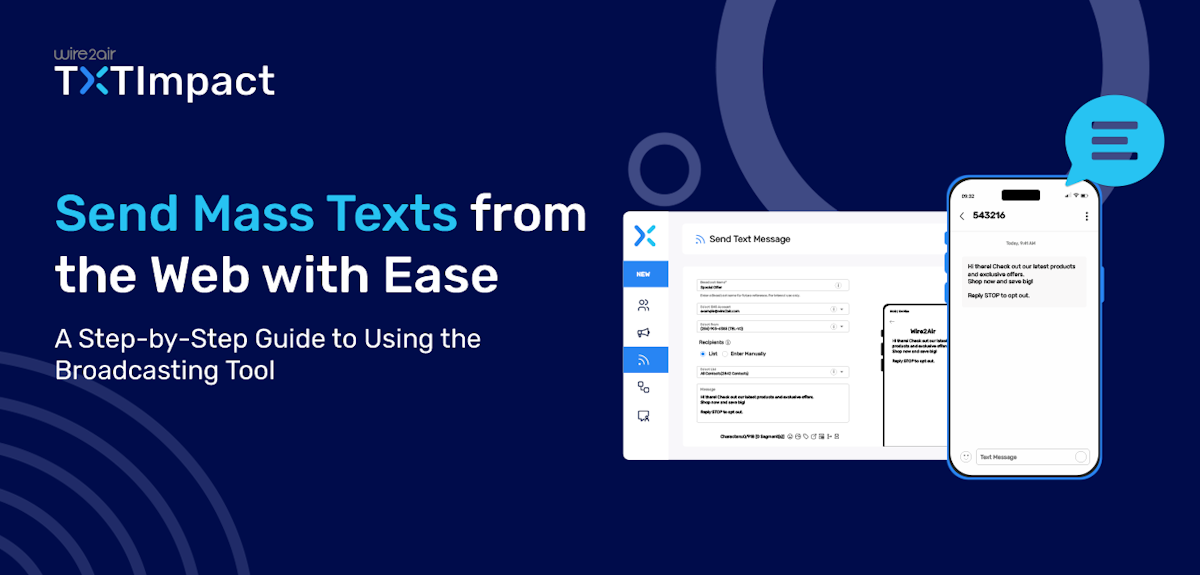
Text messaging, though old, remains one of the most powerful and impactful marketing platforms, reaching customers within seconds.
While customers find emails lengthy and cumbersome to read, and social media feeds feel cluttered, SMS broadcasting helps businesses cut through the noise, providing instant reach and deliverability.
As soon as their phones buzz with an SMS, customers are bound to check it, thanks to the SMS broadcast tool. SMS broadcasting enables businesses to send a single message to thousands of customers, providing a secure, reliable way to reach them.
In this article, we’ll dive deep into understanding web or SMS broadcasting, its significance, use cases, and how businesses can send mass texts to their customers.
Key Takeaways:
|
What is SMS Broadcasting?
SMS broadcasting, also known as mass texting, is a process that allows businesses to send a single SMS message to a large group of recipients at the same time. Instead of marketers manually texting each individual one by one, sms broadcasting makes it easier to create a single campaign and deliver messages instantly to hundreds or even thousands of customers at once.
Thus, unlike one-on-one messaging, web broadcasting is specifically designed for business communication, allowing businesses to send messages to a group of people at once and respond to customers’ replies privately (two-way communication), not to the entire group.
This makes broadcasting an excellent tool for businesses for large-scale communication and running campaigns such as flash sale alerts, reminders and notifications, internal staff alerts, event updates, and more.
How Does SMS Broadcasting Work?
Here’s how SMS broadcasting works for businesses:
- First, you need to select or upload the contact list consisting of the user numbers that have opted in to receive texts from them.
- You can segment these contacts into specific groups based on user behavior, location, purchase history, or other factors.
- Next, you need to compose a relevant broadcast message based on the use case in the business messaging dashboard you choose. Several reliable tools offer personalization using custom fields, such as name, offering a personalized experience.
- You can either send the message instantly or schedule it for later. Once you click send, the platform routes your message through an SMS gateway and delivers it via approved sender types, such as toll-free numbers, 10DLC, or short codes.
This ensures that each recipient receives the SMS individually on their device, and any replies come directly back to the sender or business accounts. Reliable and secure platforms, like TXTImpact, also help track clicks, delivery rates, response rates, and opt-outs, enabling you to measure the campaign's effectiveness in real time.

Prerequisites for Sending a Mass Text Message with the TXTImpact Broadcasting Tool
Before launching a broadcast messaging campaign, it’s important to set the foundation right to avoid risks of downtimes, poor engagement, carrier blocking, or compliance issues.
Here are the crucial prerequisites you need to ensure before sending broadcast SMS texts to your customers.
1. Build a Consent-based contact list (Opt-in List)
It’s crucial to send mass SMS only to contacts who have explicitly opted in to receive messages from your business. You can easily collect consent through checkout pages, website forms, and keyword opt-ins or written agreements.
A typical opt-in process should clearly explain:
- How often can they expect messages?
- What type of messages will subscribers receive?
- How to opt-out (e.g., reply STOP)
- Those data rates and messages may apply
A clean, permission-based contact list protects your sender reputation, avoids compliance issues, and improves delivery rates.
💡 Also Read: 13 best strategies to increase opt-in list |
2. Choose the right sender type
An approved sender type is one of the most crucial aspects of sending SMS broadcast and mass texts legally and reliably. Most SMS providers provide these common options:
- Toll-free numbers: Suitable for promotional messaging and customer support.
- 10 DLC numbers: Ideal for businesses sending high-volume A2P (application-to-person) messages in the U.S., requires brand and campaign registration.
- Short codes: Perfect for fast, large-scale, high-volume marketing and messaging campaigns.
- RCS Agent: In case you are wondering about RCS broadcasting to send interactive branded messages rather than sms.
- WhatsApp Number: If you are planning to broadcast WhatsApp messages, add your WhatsApp number to the Broadcasting tool.
Choosing the right sender depending on your business needs and use cases ensures high deliverability, better throughput, and carrier compliance.
3. Define your campaign objective
Before jumping straight to sending mass texts and launching campaigns, it’s crucial to be clear about the goal and objective of the campaign. Analyze whether you’re trying to:
- Send appointment reminders
- Promote a limited-time offer
- Collect feedback through a survey
- Share an urgent alert
- Notify employees about an update
A clear goal and objective facilitate the process of drafting focused messages with strong CTAs.
4. Prepare your messaging strategy effectively
Lastly, it’s also crucial to analyze certain aspects that will shape your marketing strategy effectively. Consider factors such as
- Your target audience
- The problem you’re solving for them
- Personalization requirements, if needed
- Best time to send the message
These aspects help keep your messages clear, concise, and actionable, enabling you to serve your purpose.
Step-by-Step Process: Broadcast SMS From a Web SMS Platform (TXTImpact)
Once you have the prerequisites sorted, it’s time to send the SMS broadcast messages to your customers.
1. Log in to your SMS broadcasting platform
Log in to your text broadcasting dashboard, and click on the option to create a new broadcast campaign or a mass texting campaign.
At the same time, it’s also important to:
- Select your approved sender number (short code, toll-free, and 10 DLC)
- Name your campaign for internal tracking
Choose the messaging channel (SMS or MMS)
2. Select or upload your contact list
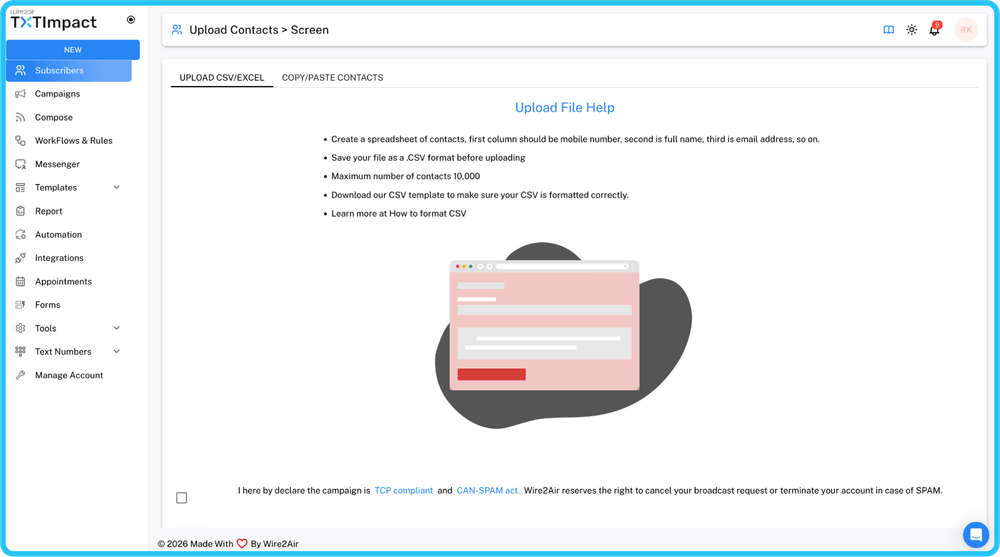 The next step is to choose who will receive the message. To do so, you can
- Select an existing contact group
- Upload a new CSV file with opt-in numbers
- Filter contacts using segmentation (behavior, location, tags, etc.)
It’s important to ensure the numbers in the contact list are formatted correctly, remove duplicates, and confirm all contacts have given consent.
3. Compose your message
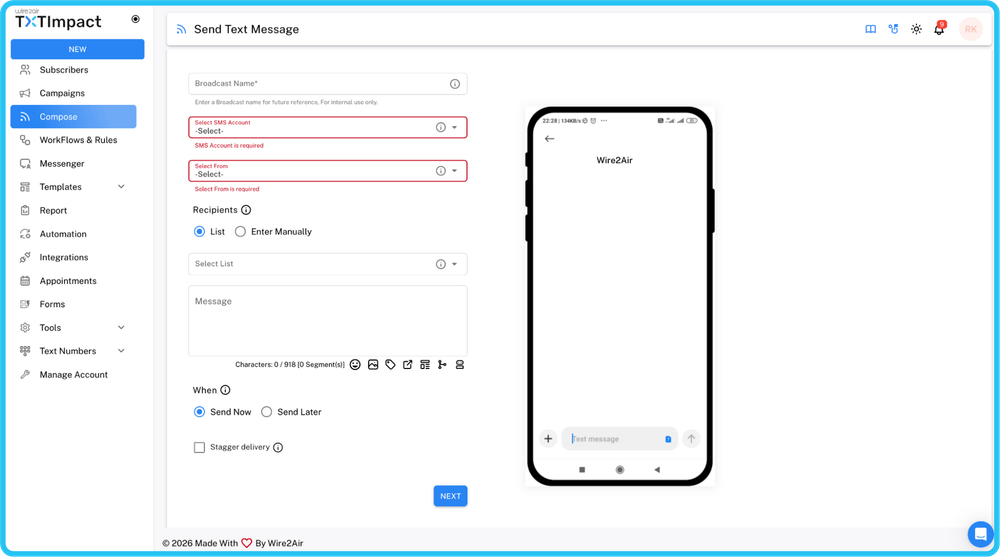 Now, it’s time to write the text message depending on the use case. It’s important to be clear and concise, add a strong CTA, avoid spammy language, and include your business name for recognition.
Most broadcasting tools, such as TXTImpact, offer personalization fields, such as first name, appointment date, and order ID, to make each message feel tailored and personalized.
TXTImpact also provides AI Assist, an AI-powered text generator that helps you compose and generate messages instantly with minimal effort.
4. Add links or media
If your SMS campaigns require richer content, you can include rich media and elements, such as images, shortened trackable links, coupon codes, or even PDFs.
Trackable links can help you measure click-through rates and campaign RoI.
5. Preview and text your message
Before sending the message to your customers, test and preview how it appears on a phone screen, check the character count and message segments, and send a test SMS to your own number to confirm how it looks.
Additionally, it’s crucial to review for typos, incorrect personalization tags, broken links, or compliance language (opt-out instructions) to avoid any costly or compliance mistakes.
6. Send messages immediately or schedule for later
Once the messages are ready, you have two options: either send them immediately or schedule them for later, for time-zone-based campaigns or for sending texts during peak engagement hours.
Some tools also allow recurring broadcasts, such as weekly reminders.
7. Launch and monitor the campaign
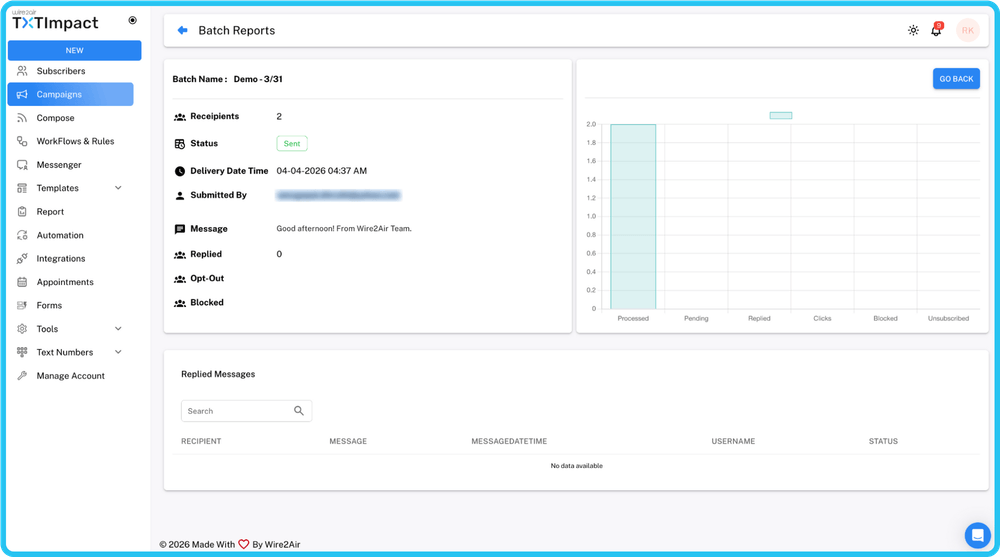 After reviewing all the necessary details, confirm the sender ID, recheck the selected contact list, double-check compliance, and verify scheduling time. If everything is right, click send or launch the campaign to initiate SMS delivery.
Once the SMS broadcast is live, it’s crucial to monitor key metrics, such as delivery rate, click-through rate, failed messages, replies, opt-outs, and conversion rate, to measure the performance through your dashboard. These insights help you understand what worked and what needs improvement.
8. Manage responses and follow up
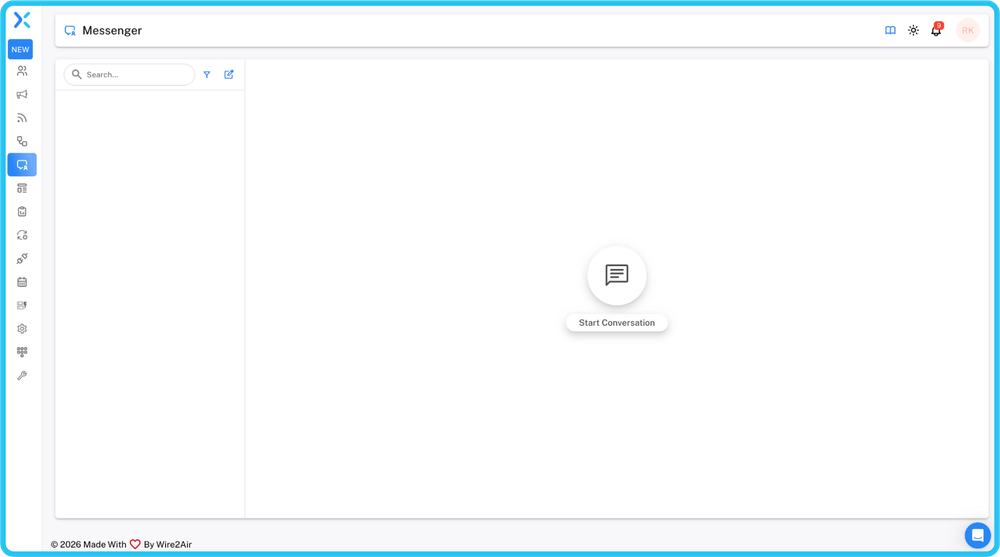 Unlike group texting, user replies come back privately to your business, making it easier to respond to the texts individually, trigger automated replies, move leads into sales workflows, or tag contacts based on response behavior.
Quick follow-up questions and replies can significantly improve engagement and conversions.
Benefits of SMS Broadcasting For Businesses
Here are the key benefits of a business text message broadcasting tool that turns basic SMS into a scalable, structured, and measurable messaging experience for businesses:
- High open and engagement rates: SMS consistently outperforms email and other marketing channels, especially when it comes to open and response rates. SMS delivers directly to the user’s mobile device, offering a personalized experience and quick engagement, making it highly reliable for time-sensitive communications.
- Instant delivery and reliability: Text messages are delivered within seconds to hundreds of thousands of users, regardless of their mobile device model or internet connectivity. Whether you’re sending an emergency alert, announcing a flash sale, or sending appointment reminders, SMS provides guaranteed and instant reach and delivery.
- Personalization at scale: Modern SMS broadcasting platforms allow businesses to insert dynamic fields, such as appointment dates, names, or order details, making messages feel more personal even when sent to a larger group of people.
- Scalability and automation: As your business grows, SMS broadcast tools ensure high scalability, automatically sending texts to hundreds and thousands of users as required. Additionally, automation capabilities enhance scalability by making it easier to set up triggered messages based on scheduled campaigns or customer behaviour.
- Cost-efficiency: A broadcasting tool eliminates the time and costs associated with sending texts manually to individual users. Instead, businesses can send bulk texts in just a few clicks, while keeping costs scalable and predictable.
- Real-time analytics and reporting: Reliable SMS and web broadcast tools allow you to track delivery rates, responses, opt-outs, and click-through rates from a centralized dashboard. These insights provide a path to refine future campaigns and improve campaign performance and RoI.
- Scheduling and automation: Several reliable broadcast tools also let you plan campaigns, schedule, and send messages at the right times. Some tools also support recurring campaigns and automated workflows triggered by customer actions.
Use Cases of Bulk Broadcasting SMS For Businesses
Businesses can use SMS broadcasting for a variety of use cases. Across industries, organizations rely on mass texting for fast, direct, and reliable communication beyond just promotions and marketing.
Here are the most common and effective use cases of mass texting for businesses:
- Flash sales and promotional campaigns: Retailers and e-commerce companies use SMS to announce holiday offers, limited-time discounts, exclusive subscriber lists, and product launches, making them ideal for time-sensitive promotions that could drive immediate traffic and conversions.
- Appointment reminders: Service businesses, healthcare providers, salons, and fitness centres use SMS to reduce no-shows and send appointment reminders and notifications. Automated reminders significantly help improve attendance rates and save revenue lost to missed appointments.
- Emergency alerts and critical notifications: Corporate offices, schools, property managers, and factories rely on SMS for urgent communications, such as safety alerts, weather-related closures, facility shutdowns, and system outages, enabling critical notifications.
- Event updates: Event organizers and companies use text broadcasting tools to send registration confirmations, provide last-minute updates, share event details, and notify attendees of schedule changes, ensuring attendees receive updates instantly.
- Order updates and transactional notifications: e-commerce and service businesses use SMS to send order confirmations, delivery notifications, shipping updates, and payment reminders, improving customer experience by keeping buyers informed at every step.
- Internal employee communication: Shift-based companies, logistic companies, and manufacturing units use mass texting to announce shift changes, notify teams about urgent issues, share production updates, or communicate policy changes, since many workers don’t have constant access to emails, ensuring messages reach them instantly.
- Payment reminders: Clinics, financial institutions, and subscription services use SMS to send invoice reminders, renewal notifications, and due date alerts, reducing late payments and improving cash flow.
- Customer reengagement campaigns: SMS can bring customers back, especially when customers haven’t interacted with your brand for a while. Businesses can run loyalty rewards, special reactivation buttons, and personalized offers for reconnecting with inactive customers.
TXTImpact: The Best SMS Broadcasting Tool For Bulk Messaging
TXTImpact stands out as a top-tier SMS broadcasting tool and a highly reliable, fast, and compliant mass texting platform for reaching hundreds of thousands of customers and employees in seconds.
With an intuitive and secure TXTImpact OmnihubDashboard, various opt-in tools for Compliant texting, TXTImpact makes SMS business communication a breeze, backed by 20+ years of service and 30,000+ businesses served.
TXTImpact Omnihub offers all the core text broadcasting features, including text scheduling, easy contact imports, seamless integrations, real-time reporting, reply forwarding, number filtering, automatic opt-outs, multi-user access, personalization tags, mobile coupon codes, unlimited group creation, and advanced subscriber segmentation.
What makes TXTImpact unique is that, in addition to these traditional features, the platform continues to evolve by introducing new capabilities designed to meet modern business messaging needs and support custom solutions.
Some of the new features include:
- Multilingual messaging with Unicode: TXTImpact allows you to send messages in multiple languages, supporting diverse cultures and global coverage beneficial for businesses operating in multiple countries.
- AI Assist: AI Assist makes content creation and message composition a breeze, generating relevant messages based on the preferred tone, use case, and language. It helps save time and effort in drafting a text, boosting productivity and campaign creation.
- Built-in 10DLC registration: built-in 10DLC brand and campaign registration enables brands and businesses to meet carrier-specific needs and requirements, ensuring compliance and improving message deliverability.
- Multichannel Broadcasting: TXTImpact not only offers sms broadcasting tools, but users can also choose other messaging channels, such as MMS, RCS, WhatsApp, and Even API to broadcast messages to thousands of recipients.
TXTImpact provides mass broadcast texting for businesses of all sizes with transparent pricing that supports business growth and scalability with no hidden costs.
Conclusion
SMS broadcasting is an excellent way to reach a large number of customers or employees from a single centralized dashboard. Whether you want to send time-sensitive alerts, promotional messages, or system outage updates, broadcast text messages help deliver texts in seconds, ensuring high reach and deliverability.
However, choosing the right SMS provider makes a huge difference. TXTImpact, for instance, provides an intuitive, streamlined process for sending mass texts through its easy-to-use dashboard, seamless integrations, and automation capabilities.
Irrespective of your business sector, TXTImpact’s mass texting lets you send emergency notifications, event information, follow-ups, and other relevant messages while ensuring compliance, security, and high deliverability.
If you want to send broadcast texts in your next marketing or communication campaign, contact us to get started or start a free trial to explore the platform yourself.
FAQs
♦ Can I send mass texts internationally?
Yes, several SMS broadcasting platforms, including TXTImpact, support international messaging with Unicode or multilingual capabilities. However, it’s crucial to note that sender registration requirements, delivery rules, and pricing may vary depending on the destination country or region.
♦ How many contacts can I send mass texts to at once?
The number truly depends on your sender type and SMS provider. Most professional broadcasting platforms, like TXTImpact, let you send texts to hundreds or even thousands of users in a single messaging campaign, with no downtime or deliverability issues.
♦ Can I integrate SMS broadcasting with my CRM or website?
Yes, you can easily integrate the text broadcasting tool with native integrations with CRM, websites, or e-commerce platforms, as offered by SMS providers. This makes it easier to automate triggers, opt-ins, and customer workflows.
♦ Is SMS broadcasting legal?
Yes, SMS broadcasting is legal as long as it complies with carrier guidelines and TCPA regulations. Businesses must obtain opt-in consent from users before sending messages and also provide clear opt-out instructions in every campaign to ensure compliance and avoid legal issues. TXTImpact facilitates this process by providing built-in 10DLC registration so you don’t have to worry about it.
♦ How quickly are mass texts delivered to the recipients?
Mass broadcast texts are usually delivered within seconds. However, delivery speed may vary slightly depending on sender type, carrier throughput, and campaign size.
About the Author:
 | Tejal Sushir (Content Writer) Tejal Sushir is a content writer with 4+ years of experience writing fresh and insightful content for B2B SaaS companies. She has delivered top-performing and top-ranking blogs in the SMS marketing, Digital Marketing, web hosting, AI & ML, cybersecurity, WordPress, HR Tech, and technical SEO domains. Her meticulous research when writing content ensures industry expertise and keeps up with emerging trends. |