Why Businesses Should Offer SMS Customer Support in 2026
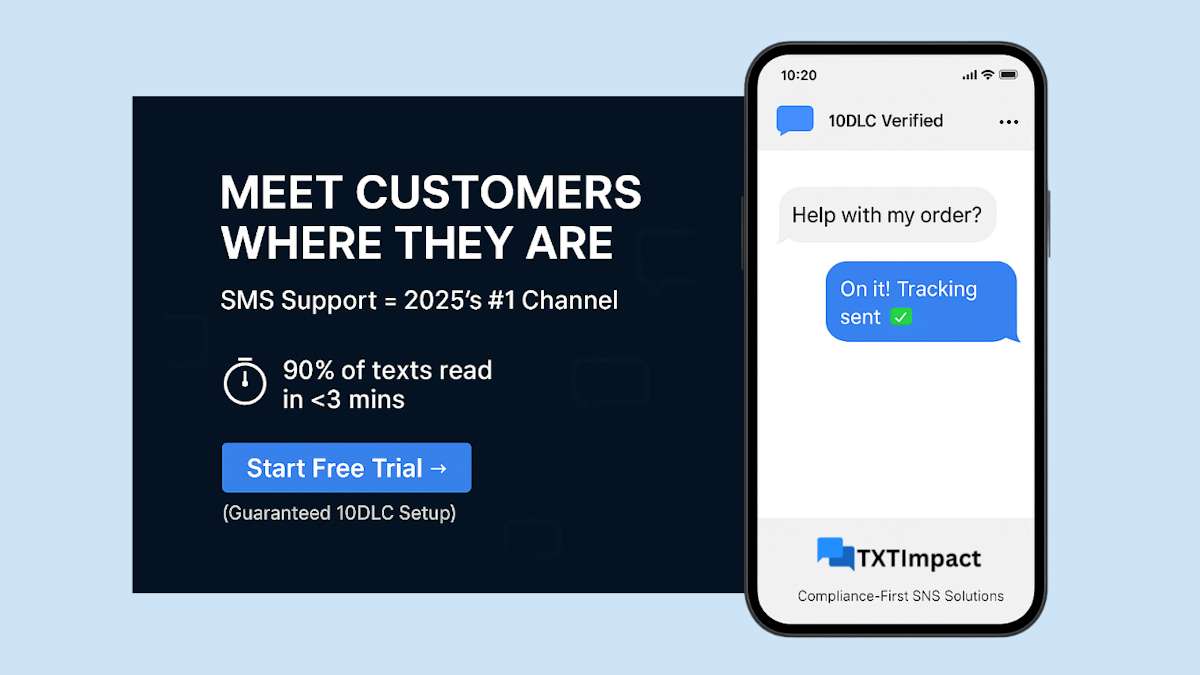
In today’s fast-paced digital world, customers expect fast, convenient, and efficient ways to communicate with businesses. Traditional methods like phone calls and emails are losing traction as people prefer quick responses. This is where SMS customer support comes in. Offering SMS as a customer service channel in 2025 is not just an option—it’s a necessity.
With the widespread adoption of mobile phones and the increasing demand for instant support, businesses that integrate SMS into their customer service strategy stand to gain a competitive advantage. Let’s explore why SMS customer support is a must-have for businesses in 2025 and beyond.
1. Customers Prefer SMS Over Calls and Emails
Consumers today value convenience above all else. With the rise of on-demand services, people expect businesses to communicate in a way that fits their lifestyle. Studies show that:
90% of texts are read within three minutes of being received.
The average response time for SMS is just 90 seconds, compared to 90 minutes for email.
75% of consumers prefer texting over talking when it comes to customer support.
Unlike phone calls that require immediate attention or emails that often get lost in inbox clutter, SMS provides a non-intrusive yet immediate way for customers to get assistance.
2. Faster Resolution Times Lead to Higher Customer Satisfaction
One of the biggest frustrations for customers is waiting on hold or dealing with slow responses. SMS eliminates these issues by:
Allowing businesses to provide instant replies with automated responses for common queries.
Offering asynchronous communication, meaning customers can send a message and get a response without waiting on hold.
Enabling support teams to handle multiple conversations at once, reducing resolution times.
With the ability to integrate AI chatbots and automated workflows, SMS can help businesses provide faster and more efficient customer service.
3. SMS Support is More Cost-Effective Than Call Centers
Maintaining a traditional call center with live agents is expensive. Businesses have to factor in costs related to:
Salaries for customer service agents.
Infrastructure costs for phone lines and software.
The time agents spend handling calls instead of resolving multiple inquiries at once.
SMS reduces these costs by:
Minimizing the need for live agents to handle every interaction.
Allowing a single agent to manage multiple conversations simultaneously.
Using chatbots and automation to answer FAQs and reduce workload.
By shifting a portion of customer support interactions to SMS, businesses can significantly cut costs while improving efficiency.
4. SMS Integrates Easily With Other Customer Support Channels
Omnichannel support is becoming the norm, and SMS can seamlessly integrate with:
Live chat on websites.
Email and ticketing systems like Zendesk or Freshdesk.
CRM platforms like Salesforce for personalized responses.
Social media messaging platforms like WhatsApp and Facebook Messenger.
With an integrated support system, businesses can track conversations across channels, ensuring a smooth customer experience without making customers repeat their issues.
5. Personalization in SMS Improves Customer Engagement
Personalized customer experiences drive loyalty, and SMS is an excellent tool for customization. Businesses can use:
Customer data to tailor responses based on past interactions.
AI-driven automation to provide context-aware suggestions.
Triggered messages based on customer behavior (e.g., follow-ups after a support request).
By making support interactions more relevant and personal, businesses can enhance customer satisfaction and build stronger relationships.
6. Compliance & Security Make SMS a Trusted Support Channel
With increasing concerns about data privacy, businesses must prioritize secure and compliant communication. SMS provides:
Two-factor authentication (2FA) to secure customer accounts.
Encrypthttps://www.txtimpact.com/blog/two-factor-authentication-using-text-messageed https://www.txtimpact.com/blog/two-factor-authentication-using-text-messagemehttps://www.txtimpact.com/blog/two-factor-authentication-using-text-messagessaging for sensitive support queries.
Opt-in and opt-out compliance to prevent spam.
Adhering to SMS best practices ensures that customers trust the platform, making them more likely to engage with a business via text.
CTA>> “Get 15 Day Trial with TXTImpact SignUp Now
Future of SMS Customer Support in 2025 and Beyond
The Impact of 10DLC Compliance on SMS Support
One of the most significant changes in SMS communication is the introduction of 10DLC (10-Digit Long Code) compliance by wireless carriers. This regulation is designed to:
Reduce spam and fraud by ensuring only verified businesses can send SMS.
Improve deliverability for legitimate business messages.
Create transparency by requiring companies to register their texting campaigns.
With 10DLC enforcement, businesses using SMS for customer support can benefit from higher trust and engagement since consumers will feel more confident interacting via text.
AI and Automation in SMS Support
Looking ahead, AI-powered chatbots and natural language processing (NLP) will revolutionize SMS customer support by:
Automating common queries without human intervention.
Providing instant replies based on real-time data.
Offering predictive support, addressing issues before customers even reach out.
Rich Communication Services (RCS) Will Enhance SMS Support
RCS (Rich Communication Services) is the next evolution of SMS, offering features like:
Interactive buttons for faster issue resolution.
Image and video support to share troubleshooting steps.
Read receipts and typing indicators for a more conversational experience.
As RCS adoption grows, businesses that integrate these capabilities into their SMS support will have a competitive edge.
Read: RCS vs SMS: Why You Should Make the Switch Today?
Final Thoughts
In 2025, SMS customer support is no longer just an option—it’s a critical part of a business’s customer service strategy. With higher engagement rates, lower costs, and faster resolution times, SMS helps businesses meet modern consumer expectations.
As compliance regulations like 10DLC make SMS more secure and spam-free, trust in SMS as a support channel will continue to grow. Coupled with AI automation and future innovations like RCS, businesses that invest in SMS support today will be well-positioned for success in the years ahead.
If your business isn’t offering SMS customer support yet, now is the time to start. The future of customer service is mobile, and SMS is at the forefront of this transformation.
Frequently Asked Questions
What is SMS customer service?
Like any customer service, SMS customer service is similar, but the channel or medium for service is SMS. SMS customer service is support delivered via text messaging. It enables quick, convenient, and real-time assistance, helping customers resolve issues, get updates, or ask questions—all without phone calls or long wait times."
What is SMS commonly known as in customer support?
In customer support, SMS is commonly known as Text Support or Text Messaging Support—a quick, direct way to assist customers via mobile text messages.
What is a good message for customer service?
Hi [Customer Name], thank you for reaching out! We're here to help and will resolve your issue as quickly as possible. Let us know how we can assist you further.
What are the customer service expectations for 2025?
In 2025, It is expected that Customers will have instant, personalized, and 24/7 support via chat, SMS, and AI bots. Seamless omnichannel service and quick issue resolution are key.
Can a business text a customer?
Yes, a business can text a customer, but it should be done only after obtaining their consent through an opt-in method. Businesses also need to adhere to compliance regulations. This means the business must get permission from customers before sending them text messages for communication.
What is the future of customer service?
In the future, customer service will evolve with a greater focus on fast resolution, personalization, and AI-driven support. It will rely on automation, chatbots, SMS, and omnichannel solutions to deliver instant, seamless experiences across platforms—meeting customers where they are, anytime they need help.
What are the consumer trends for 2025?
The consumer trends for 2025 are personalized experiences, AI-powered support, mobile-first interactions, ethical shopping, instant service, and seamless omnichannel engagement. Shoppers expect speed, convenience, trust, and brand values that align with their own.
What are the 6 most common customer service expectations?
The six most common customer service expectations are: Instant response, personalized support, 24/7 availability, omnichannel communication, knowledgeable agents, and easy, quick issue resolution.
What are the new trends in customer service?
The new trends in customer service you might see are:
1. AI and Chatbots for instant support
2. Personalized Experiences using data and automation
3. Omnichannel Communication
5. Self-Service Portals
6. Voice Assistants
7. Proactive Support through predictive analytics